Hormuz on the Brink: UK and France Rally 30+ Nations as Oil Lifeline Becomes Global Flashpoint
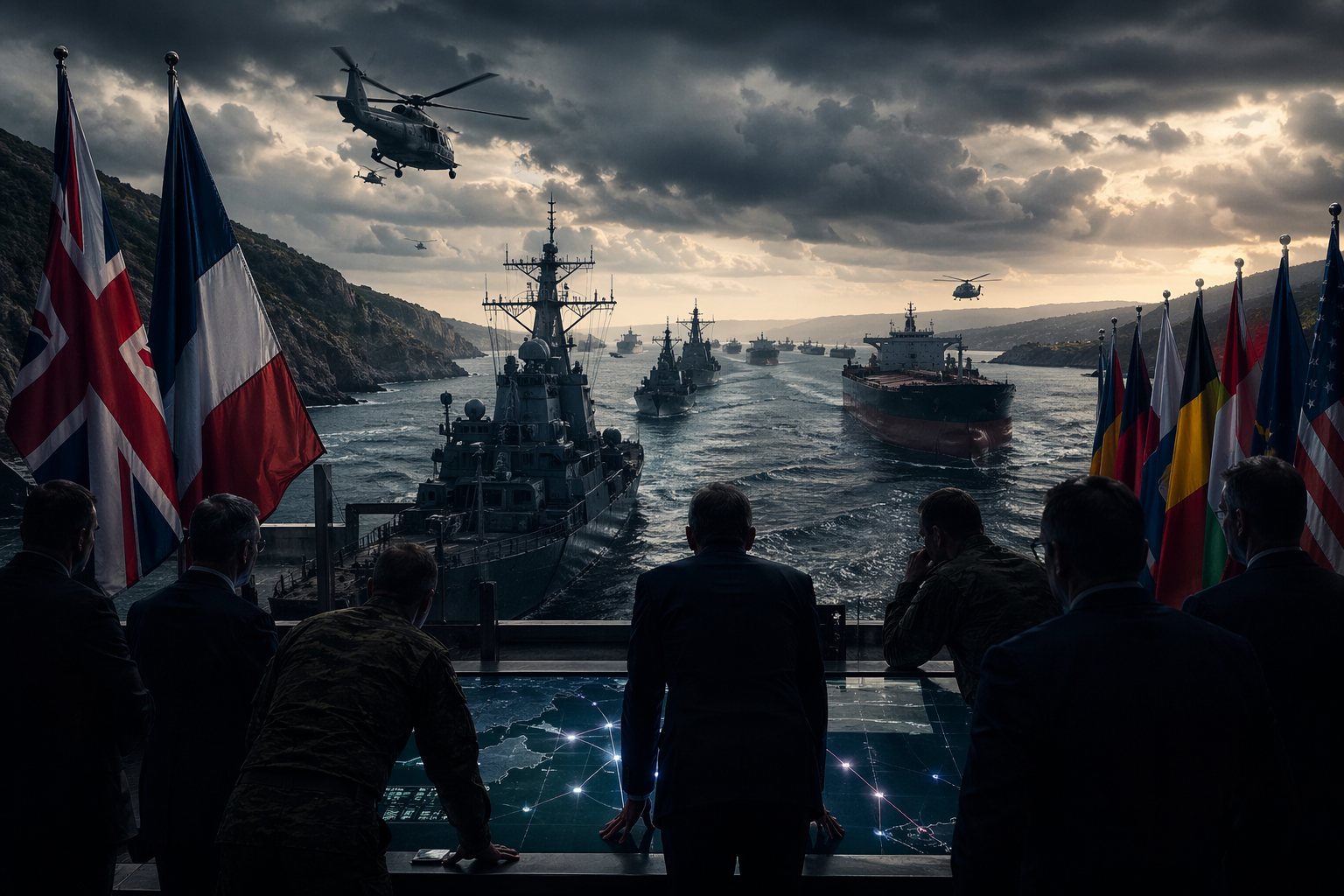
The World’s Most Critical Oil Route Is Now a War Table
Global Powers Scramble to Secure Strait as Iran Tensions Surge
More than 30 nations are now moving from diplomacy to military planning as the world’s most critical energy corridor teeters between reopening and escalation
The Strait of Hormuz is no longer just a geopolitical pressure point. It is becoming a coordinated military problem.
Military planners from more than 30 countries are now meeting under UK and French leadership to design a mission aimed at reopening and securing the narrow waterway that carries a significant share of the world’s oil.
This is the moment where rhetoric hardens into structure. Diplomacy is still in motion, but planning has begun for what happens if it fails.
Because if Hormuz stays closed, the consequences will not remain regional.
They will be global.
Why Hormuz matters more than almost anywhere else
The Strait of Hormuz is one of the most strategically important chokepoints on Earth. Roughly a fifth of global oil supply passes through it under normal conditions.
When traffic slows or stops, the impact spreads instantly:
Energy prices spike
Shipping routes distort
Insurance costs surge
Supply chains tighten across continents
Recent disruptions have already shown how fragile that system is. Tanker movements have collapsed at points during the crisis, and alternative routes cannot fully compensate.
This is why the current talks are not optional diplomacy. They are an attempt to stabilise a system the global economy quietly depends on.
From ceasefire to contingency planning
The current situation sits on an unstable contradiction.
On one side, there is an extended ceasefire between major actors in the conflict. On the other, military pressure has not disappeared. Naval blockades, seizures of vessels, and continued threats mean the risk of escalation remains active.
That contradiction is forcing governments into a dual-track approach:
Support diplomacy publicly
Prepare operational plans privately
The London talks are designed to bridge that gap—translating political agreement into deployable capability.
This includes:
Maritime security operations
Mine-clearing scenarios
Command and control coordination
Contributions from allied navies and technologies
The mission itself is framed as defensive, aimed at ensuring freedom of navigation rather than initiating conflict.
But the scale of participation tells a different story: this is no longer theoretical.
The deeper shift: Europe stepping into the vacuum
One of the most significant undercurrents is who is leading.
The United Kingdom and France are driving the coalition effort—bringing together European, Middle Eastern, and allied nations into a coordinated framework.
This matters because it reflects a subtle but important shift:
The United States remains heavily involved militarily
But allies are increasingly organising independently
And not always aligned on escalation strategy
Earlier in the crisis, several countries resisted direct military involvement, preferring de-escalation.
Now, the posture has evolved.
Not toward aggression—but toward preparedness.
What this coalition is really trying to avoid
At the surface, the mission is about reopening a shipping route.
Underneath, it is about preventing three scenarios:
1. A prolonged economic shock
If Hormuz remains disrupted, energy markets tighten globally. That feeds inflation, slows growth, and creates secondary crises in food, manufacturing, and transport.
2. Fragmented security responses
Without coordination, countries could act independently—escorting ships, deploying assets, or escalating locally. That increases the risk of miscalculation.
3. A direct naval confrontation
The most dangerous outcome is a collision between military forces operating in close proximity under unclear rules.
The coalition effort is designed to impose structure before any of those scenarios spiral.
What happens next
Three pathways now sit in front of the crisis:
Most likely
A phased reopening under heavy security presence, tied to a fragile but maintained ceasefire. Naval escorts and monitoring operations become routine.
Most dangerous
A breakdown in talks combined with continued maritime disruption—triggering direct confrontation or targeted strikes in and around the strait.
Most underestimated
A slow, partial reopening that keeps markets unstable. Not a dramatic shock, but a persistent drag on global growth and supply chains.
The talks in London are meant to prevent the second scenario.
But they are happening because the first is no longer guaranteed.
The real story most people miss
This is not just about oil.
It is about control.
Control of a narrow strip of water that connects production to consumption. Control of global energy flows. Control of escalation itself.
The countries involved are not just trying to reopen a route. They are trying to define who gets to shape the rules of access to it.
And once that question is answered in Hormuz, it does not stay in Hormuz.
The hard landing
The Strait of Hormuz has always been a pressure point.
Now it is something more dangerous: a test case.
A test of whether global trade routes can still be stabilised through coordination—or whether they are becoming contested spaces where power, not rules, decides who passes.
The meetings underway are not just about reopening a channel.
They are about preventing a future where every critical route looks like this one.
