

How Did England Draw With Ghana? The Tactical Failure That Exposed Their Oldest World Cup Problem
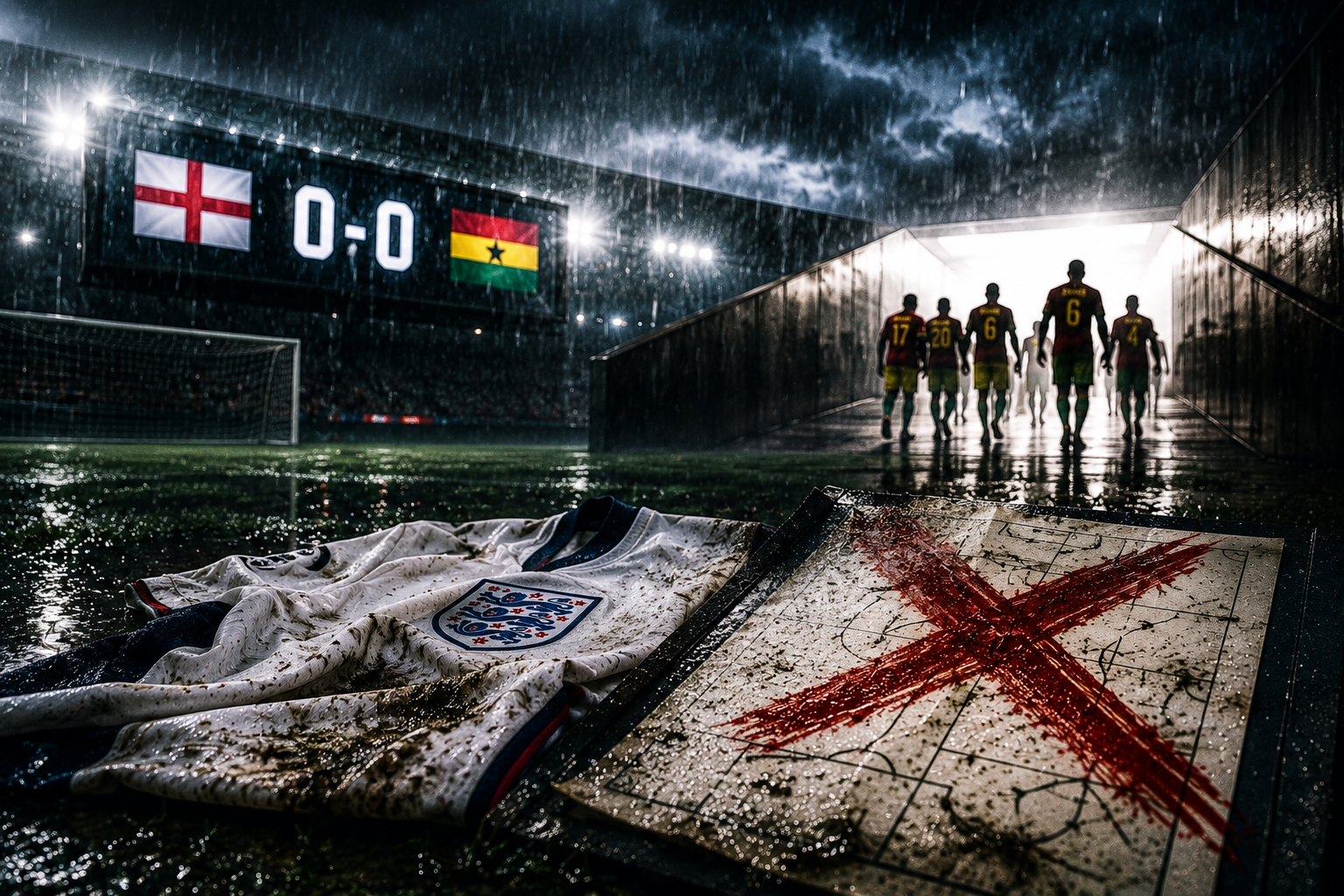
How England Turned 78.8% Possession Into A World Cup Warning
England Had The Ball, The Stars, The Rain And The Stage — Ghana Still Exposed The Same Old Weakness
The Draw That Felt Like An InterrogationEngland did not draw 0-0 with Ghana because Ghana dominated them. That is what makes the result more uncomfortable. England drew because they had almost everything a favourite is supposed to have — possession, territory, elite attacking names, a late surge, even the weather — and still failed to turn control into authority.
The numbers are brutal in precisely the wrong way. England finished with 78.8% possession, their highest figure in a World Cup match on record since 1966, and the highest possession figure by any side that failed to score in a World Cup match over that same period. They also had 19 shots and 1.28 expected goals, yet Ghana escaped with a clean sheet after allowing only two shots themselves.
That is the dark comedy of the match. England did not lack the ball. They drowned in it. Ghana understood that England’s possession was not the same thing as danger, and once that became clear, the match became less about talent and more about whether England could solve a problem without being invited to run into space.
They could not.
Ghana Did Not Outplay England — They Out-Thought The Game
Ghana’s plan was not complicated, but it was disciplined. Carlos Queiroz’s side defended deep, narrowed central spaces, protected the penalty area, and dared England to produce high-quality combinations under pressure. It was a classic underdog structure: concede harmless possession, deny clean central entries, wait for England to become frustrated, then look for counter-attacking moments.
That plan worked because England’s attacking rhythm became too flat. The ball moved, but Ghana moved with it. England circulated possession around Ghana rather than cutting through Ghana. Too many sequences looked clean but sterile: centre-back to full-back, full-back inside, recycle, switch, repeat, with the final action either delayed or forced.
The most damning statistic may not be the final possession share. It is that England completed 104 successful passes ending in the final third in the first half, the most by a team that failed to have a shot on target in the first half of a World Cup match since records began in 1966. That is not dominance. That is decorative control.
Ghana’s real success was psychological. They made England feel as if patience was control, when in reality patience without disruption becomes a sedative. The longer the game stayed 0-0, the more England looked like a team trying to win by reputation rather than by tactical violence.
What Went Wrong Tactically For England
England’s biggest tactical failure was their inability to create chaos in Ghana’s defensive block. Against deep teams, the favourites need at least one of four things: aggressive occupation between the lines, fast switches that isolate defenders, third-man combinations around the box, or relentless runs behind to stretch the back line. England had moments of all four, but not enough repetition, speed, or conviction.
The full-backs and wide players did not consistently force Ghana into emergency defending. Noni Madueke produced one of the few early signs of genuine one-v-one threat, creating the opening for Declan Rice’s headed chance, but England did not lean into that pattern with enough aggression. Anthony Gordon’s first shot on target only arrived just before the hour, and it was tame.
Harry Kane also became part of the problem as well as the solution. Kane’s instinct to drop into midfield can be devastating when runners attack the space beyond him. Against Ghana, that movement often removed England’s most important penalty-box reference point from the area Ghana were most desperate to protect.
Jude Bellingham was another key frustration. He has the profile to break these games with carries, wall passes, late box entries and sheer force of personality. But Ghana crowded the central corridor, and England did not consistently create the angles around him to turn his presence into repeated high-value chances.
Which Players Underperformed
Kane underperformed because he is judged by the brutal economy of elite finishing. His late chance, after Nico O’Reilly’s header hit the woodwork and the rebound fell kindly, was the moment England needed their captain to turn pressure into escape. He fired over from close range, and in a tournament game that tight, that becomes the image everyone remembers.
Bellingham underperformed relative to his status, not because he was lazy or invisible, but because he did not impose enough damage on the game. England needed him to become the rupture point. Instead, Ghana kept him surrounded, delayed, and often forced into areas where his influence looked more symbolic than decisive.
Gordon and Madueke both had moments, but neither consistently bent the match. Gordon’s first meaningful shot on target was too comfortable for Benjamin Asare, while Madueke’s best moments did not become a sustained attacking route. Against a low block, wide forwards cannot just threaten. They have to repeatedly force defenders into panic decisions.
There were positives. Marc Guéhi justified his selection, completed 126 passes — the most by an England player in a World Cup match on record since 1966 — and was strong defensively. But that statistic also says something uncomfortable: when a centre-back becomes England’s record passer in a 0-0 draw, the opponent has probably succeeded in controlling where the game happens.
Did Thomas Tuchel’s System Fail?
The system did not collapse, but it failed the specific test Ghana set. England were secure, territorially dominant, and rarely exposed, but the structure did not produce enough clean disruption in the final third. That matters because World Cups are not won by abstract control. They are won by solving different game states quickly.
Tuchel’s changes added energy, but not a fundamentally different question for Ghana. Bukayo Saka forced a good save, Morgan Rogers and Eberechi Eze were introduced, and England did create late pressure. But the adaptation felt like adding more talent into the same puzzle rather than changing the shape of the puzzle itself.
The manager’s problem was not that he refused to act. It was that England’s adjustments did not arrive with enough clarity. When a side has nearly 80% possession and cannot score, the issue is not simply personnel. It is spacing, tempo, occupation, risk appetite, and whether the players know exactly how to break the block rather than merely surround it.
So yes, the system failed in the attacking phase. Not catastrophically. Not irreparably. But clearly enough to matter.
Should The Rain Have Helped England?
On paper, rain should have helped England. A slick surface can speed up passing, make switches sharper, punish defensive slips, and increase the chance of rebounds or goalkeeper errors. For a technically superior side, bad weather can become an accelerant.
But weather only helps the team that uses it aggressively. England often played as if the conditions were something to manage rather than exploit. The passing was controlled, but not always cutting. The ball moved through safe areas more than dangerous ones. Ghana, meanwhile, benefited from the same conditions in a different way: wet weather can also make games scrappier, reduce technical cleanliness, and reward teams defending their box with concentration and physical commitment.
Rain does not automatically favour the better team. It favours the team whose tactical plan benefits most from imperfection. England needed speed and incision. Ghana needed disruption, delay, and survival. In this match, the rain arguably made Ghana’s job more emotionally intense but not tactically impossible.
That is the real sting. England had an environmental advantage available, and still did not turn it into attacking violence.
The Statistics That Make This Result So Striking
The headline statistic is 78.8% possession without a goal. That is not just frustrating; it is historically strange. England had more of the ball than they have ever had in a World Cup match since 1966, yet produced no breakthrough.
The second statistic is Ghana’s two shots. That is the fewest England have faced in a World Cup match on record since 1966, and still England did not win. That reverses the normal logic of tournament football. If a favourite restricts an underdog to two shots, the post-match discussion should usually be about professionalism and control, not failure.
The third is England’s 19 shots without scoring, their highest such total in a World Cup match since the 2002 draw with Nigeria, when they had 25. That tells the deeper story: England eventually shot enough, but too much of it arrived too late, too rushed, or from situations that Ghana could survive.
The fourth is the group consequence. England moved to four points, Ghana also reached four, Croatia’s later win over Panama kept the group alive, and England still need to complete the job against Panama. The draw did not wreck England’s tournament, but it denied them control of the narrative.
Why England’s Best Players Keep Underperforming
England usually underperform because international football punishes exactly what England like to believe should be enough: individual talent, Premier League pedigree, and emotional expectation. Having some of the best players in the world is not the same as having the best attacking mechanism in the world.
Club football gives elite English players automated structures. They play under coaches who rehearse patterns daily for months and years. International football compresses that into short camps, tournament pressure, and opponents who know England carry a psychological burden. The result is a familiar contradiction: England often have world-class parts, but the machine can still look improvised when the game becomes tactically awkward.
There is also a cultural issue. England are often caught between two identities. They want to be brave and front-foot, but fear tournament humiliation. They want control, but control can become caution. They want their stars to express themselves, but the shirt often seems to make expression feel like responsibility rather than freedom.
That is why matches like Ghana matter. They are not just group-stage irritations. They reveal whether England have actually evolved beyond the old pattern: enough talent to scare everyone, enough caution to frustrate themselves, enough chances to regret the one they missed.
Can England Still Win The World Cup?
Yes, England can still win it. A 0-0 draw in the second group game is not fatal, and there is a long history of eventual contenders surviving ugly tournament nights. England remain in a strong qualification position, and the final match against already-eliminated Panama gives them a clear route to the knockout stage.
But their outlook has changed. Before Ghana, the Croatia win suggested England might have found the balance between attacking force and tournament control. After Ghana, the question returns: can they break down a disciplined opponent when the game slows down, the spaces disappear, and the emotional pressure rises?
The best version of England can still beat anyone. The worrying version can dominate the ball, produce record possession, restrict the opponent to almost nothing, and still end the night staring at a scoreboard that refuses to move.
That is why this draw should not be dismissed as a blip. Ghana did not expose England’s lack of quality. They exposed something more dangerous: the gap between England’s talent and England’s certainty. In a World Cup, that gap is where favourites go to die.
