

If China Invades Taiwan: A Plausible Hour-by-Hour Look at the First 24 Hours
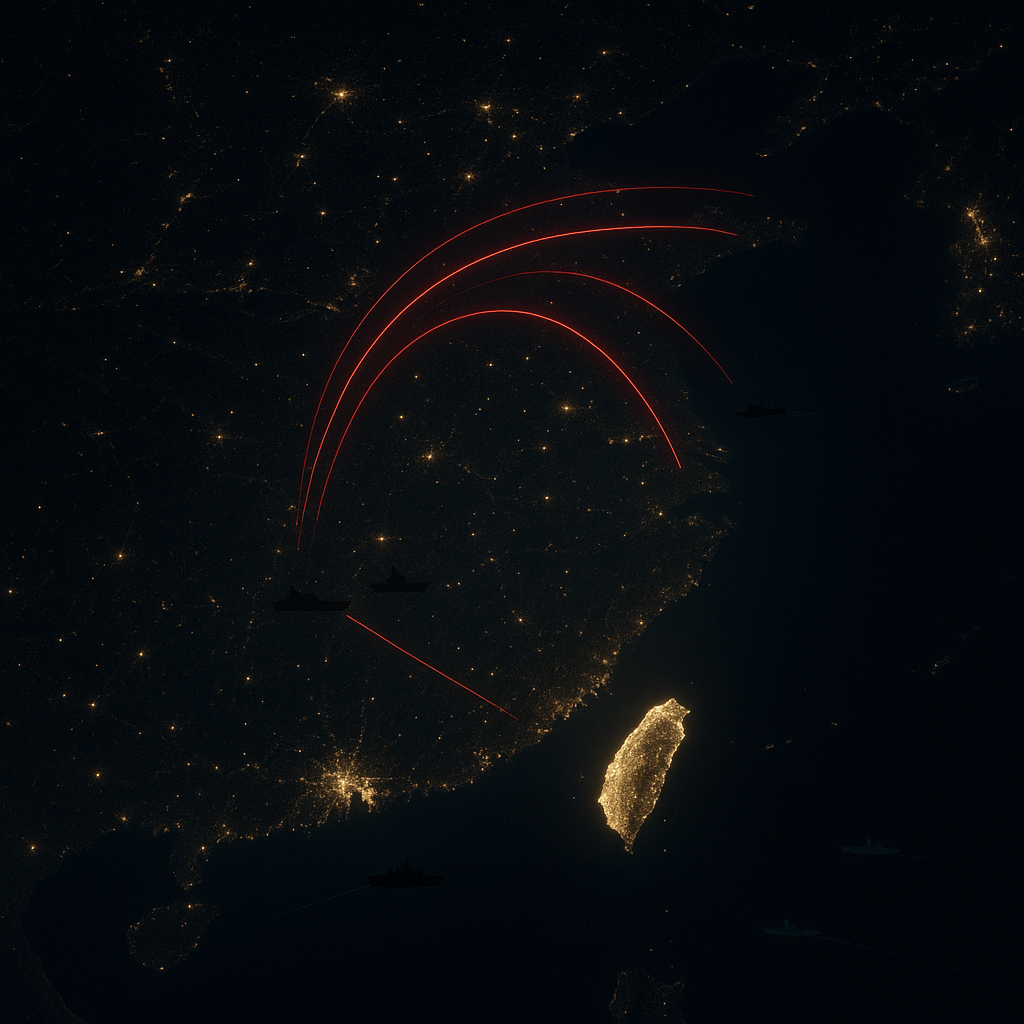
If China ever decides to resolve the Taiwan question by force, the first 24 hours would be fast, violent, and confusing. A Chinese invasion of Taiwan would not begin with beach landings. It would start with screens going dark, runways cratered, and satellites under attack.
The timing matters because the entire war would be shaped by how much China can destroy or disable in that opening window—and how much Taiwan, the United States, and regional allies can keep alive. If China can paralyze Taiwan’s air defenses, command networks, and leadership before outside help can mobilize, it might try to present the world with a quick fait accompli. If it fails, the conflict could turn into a long, grinding regional war with global consequences.
This piece sketches one plausible, high-level timeline of those first 24 hours if China invades Taiwan. It combines what is known about current military capabilities, recent exercises, and typical doctrine with a strict focus on uncertainty: this is a scenario, not a prediction, and there are many other ways events could unfold.
By the end, you’ll have a clearer sense of how the first day could unfold hour by hour, what political and economic shocks would follow, and why the choices made in those opening moves would echo far beyond the Taiwan Strait.
The story turns on whether China can overwhelm Taiwan fast enough to prevent outside intervention from changing the outcome.
Key Points
A Chinese invasion would likely open with a wave of cyberattacks, jamming, and missile strikes designed to blind Taiwan’s radar, disrupt command, and ground its air force.
The first 6–12 hours would focus on isolating the island: severing communications, blocking ports and airspace, and potentially attacking satellites to limit outside awareness.
Amphibious landings and airborne assaults would probably come later in the first day or spill into the second, once China judged Taiwan’s coastal defenses and air power sufficiently degraded.
The United States and close partners would face immediate pressure to decide whether to intervene militarily, respond with sanctions and cyber measures only, or delay in the hope of avoiding a wider war.
Global markets would react within minutes: shipping routes, energy prices, and tech stocks—especially those tied to semiconductors—would be shaken.
Even if China achieves tactical surprise, heavy losses and logistical limits mean the first 24 hours would almost certainly not decide the entire war.
Background
China regards Taiwan as part of its territory and has steadily built up military, economic, and political pressure to push the island toward unification on Beijing’s terms. Taiwan, with its vibrant democracy and critical semiconductor industry, has moved in the opposite direction, strengthening its separate identity and seeking deeper security ties with the United States and other partners.
Over the past decade, China has expanded its arsenal of ballistic and cruise missiles, modernized its navy and air force, and rehearsed blockades and amphibious operations along its coast. Recent reporting shows the use of civilian roll-on/roll-off ferries in beach-landing drills—suggesting Beijing wants extra lift capacity if it ever attempts a large-scale crossing.
Taiwan has responded with higher defense spending, a shift toward more “asymmetric” weapons such as mobile missiles and drones, and renewed focus on civil defense. The United States, which no longer has a formal defense treaty with Taiwan, is legally committed to helping the island maintain its self-defense and to sustaining the capacity to resist coercion, but it remains deliberately ambiguous about whether it would fight directly if China invades.
Against that backdrop, an invasion remains only one—extreme—option. But if it happens, here is how the first day could plausibly unfold.
First 24 Hours if China Invades Taiwan
Hours 0–2: The Silent Shock
The “first hour” might not begin with explosions but with silence. In the minutes leading up to the attack, Taiwan’s networks could see a surge of sophisticated cyber intrusions and denial-of-service attempts against power grids, telecoms, financial systems, and government servers. Many of these attacks are likely pre-positioned long in advance.
Almost simultaneously, GPS spoofing and electronic jamming would intensify in and around the Taiwan Strait. Civilian aircraft and ships could start reporting navigation glitches. Then, within minutes, the first waves of Chinese missiles would launch: ballistic missiles aimed at air bases, long-range radars, key ports, and possibly government compounds; cruise missiles and loitering munitions targeting air defense batteries, command centers, and runways.
Taiwan’s early-warning systems might detect the launches, but decision-makers would have only minutes to react. Fighters would scramble from dispersed bases and civilian airports where possible. Shelters would open. Air raid sirens would sound across major cities. For ordinary people, the transition from peace to war would feel almost instantaneous.
Hours 2–6: Isolation and Air Control
In the next several hours, China would aim to turn Taiwan into a military black box. Additional missile waves would try to finish off any surviving fixed radars and runways. Cyberattacks and physical strikes on undersea cables, satellite links, and data centers would attempt to cut or at least disrupt Taiwan’s connection with the outside world.
Chinese aircraft, including fighters and bombers, would push into the battlespace under cover of dense surface-to-air missile umbrellas and land-based air defense. Their goals: suppress remaining air defenses, intercept Taiwanese aircraft, and demonstrate local air superiority over key parts of the strait. At the same time, Chinese warships and submarines would move to choke off commercial approaches, firing on Taiwanese naval vessels that venture out and warning civilian ships to divert.
In Taipei and other cities, people might experience rolling blackouts, patchy mobile service, and flooded emergency hotlines. Conflicting reports would circulate on social media. The government would fight to maintain a unified public message and to show that leadership remains intact and in control.
Hours 6–12: First Landings and Special Operations
If China judges that Taiwan’s coastal defenses and air power are sufficiently degraded, the next window might see more visible moves to establish a foothold on or around the island. Fast-moving special operations units could be inserted by helicopter or small boats near key infrastructure: airfields, ports, broadcast centers, and possibly government buildings.
Limited airborne or heliborne assaults might target islands off Taiwan’s main coast or lightly defended stretches of shoreline, testing Taiwan’s response and seeking propaganda victories. Civilian ferries and cargo ships, already requisitioned and loaded with vehicles, could begin to move toward pre-selected points, shielded as far as possible by warships and air cover.
Inside Taiwan, military units would rush to block likely landing zones, while territorial defense forces secure bridges, tunnels, and key junctions to slow any breakthrough. Emergency laws could formalize curfews, requisition private property for defense, and mandate labor for critical tasks.
Abroad, the United States, Japan, and others would be in continuous crisis talks. Reconnaissance satellites, patrol aircraft, and submarines would be tracking Chinese movements, feeding data into rushed options for intervention: strikes on Chinese ships, cyber retaliation, or a narrower focus on evacuating citizens and reinforcing allied bases.
Hours 12–24: Wider War or Contained Crisis
By the halfway point of the first day, the basic shape of the conflict becomes clearer, but the outcome remains wide open.
In one path, China has succeeded in severely degrading Taiwan’s air power and command structure, but landings are still limited and contested. The main battle becomes whether a first wave of Chinese forces can secure and expand a beachhead under fire before Taiwan’s ground units and any outside help can push them back.
In another path, Taiwan has kept enough anti-ship and anti-air systems alive to make crossings extremely costly. Chinese ships and aircraft begin to take heavy losses, and Beijing faces a choice: escalate further or settle for a blockade-and-bombardment strategy instead of a full-scale landing.
Meanwhile, global markets do not wait for clarity. Shipping insurers raise rates or refuse cover for routes near the strait. Energy prices spike on fears of disruption. Semiconductor stocks swing violently as investors try to guess how much Taiwan’s chip production will be affected and for how long.
Diplomatically, emergency sessions at international institutions and regional forums race to catch up with events already in motion. Some governments condemn the attack outright; others call for restraint on all sides. The longer this first day goes on, the harder it becomes for any actor to unwind the conflict without major loss of face.
Analysis
Political and Geopolitical Dimensions
Politically, a Chinese invasion of Taiwan would be about much more than territory. For Beijing, it would be a test of regime credibility and national identity. For Washington and its allies, it would be a test of their willingness to defend a partner whose security has been central to the regional order but is not covered by a mutual defense treaty.
In the first 24 hours, leaders would face brutal time pressure. China would want to move so quickly that foreign governments are still drafting statements while its forces are trying to lock in military gains. Other capitals must decide almost immediately whether to send forces into harm’s way, impose sweeping sanctions, or hold back in the hope that diplomacy can still work.
Those choices would reshape alliances in the Indo-Pacific for decades.
Economic and Market Impact
The Taiwan Strait is one of the world’s busiest shipping lanes and home to the most advanced semiconductor manufacturing facilities on the planet. A war there would instantly become an economic shock.
Within the first day, shipping companies could reroute vessels, pushing up costs and delaying deliveries far beyond Asia. Energy markets would likely price in the risk that a prolonged conflict disrupts flows through nearby chokepoints. Technology firms, especially those reliant on Taiwan’s chips, would see their valuations and supply plans thrown into doubt.
Even if fighting remains concentrated around Taiwan in the opening 24 hours, investors would already be adjusting to the possibility of sanctions packages, export controls, and boycotts that could fracture global trade into more rigid blocs.
Social and Cultural Fallout
For people on the ground in Taiwan, the first day of an invasion would be defined by fear, confusion, and sudden disruption of daily life. Families would crowd into shelters or basements, listen to scratchy radio updates, and try to contact loved ones over overloaded networks.
In China, tightly controlled media would present the operation as a historic mission. Public reaction—supportive or uneasy—would be difficult to read, but the narrative would stress national unity. Abroad, social media would fill with real footage, misinformation, and emotionally charged commentary.
Technological and Security Implications
A Chinese invasion of Taiwan would be one of the first major wars fought in a world saturated with commercial satellites, cheap drones, and global social media. The first day would likely see attacks on space assets, swarms of unmanned systems at sea and in the air, and fierce competition to control the information picture.
Cyber operations would blur the line between front-line combatants and civilians as hospitals, banks, and logistics networks become targets for disruption. At the same time, open-source intelligence communities would be mapping movements and strikes in near real time, influencing public debate and possibly government choices.
What Most Coverage Misses
Much commentary focuses on whether China could “win” an invasion of Taiwan. What often gets less attention is how quickly both sides—and their partners—could run into hard constraints: ammunition stockpiles, spare parts, trained crews, and political tolerance for casualties.
The first 24 hours would consume missiles, aircraft, and ships at a pace rarely seen in modern warfare. Replacing them is not fast or easy. If the war does not end quickly, the balance of industrial capacity and alliance cohesion could matter as much as initial surprise.
Another overlooked factor is civil resilience: how well Taiwan’s society can absorb shocks, keep essential services running, and maintain trust in institutions under extreme stress.
Why This Matters
The immediate victims of any Chinese invasion of Taiwan would be the people living on and around the island. But the effects would spread quickly to East Asian neighbors, major trading economies in Europe and North America, and developing countries whose growth depends on stable, affordable access to manufactured goods and energy.
In the short term, the world would feel the shock through higher prices, delayed shipments, and financial volatility. In the longer term, a war over Taiwan could accelerate the fragmentation of the global economy, harden security blocs, and push more countries to rethink their defense spending and industrial policies.
Key events to watch in any real-world buildup would include sudden changes in Chinese exercises near Taiwan, mobilization of civilian shipping, unusual movements of missile units, escalations in cyber probing, and emergency diplomatic travel by senior officials.
Real-World Impact
A production manager at a semiconductor plant in northern Taiwan could see their factory go from humming to dark in minutes, as power cuts, air raid alarms, and leadership orders collide.
A logistics executive in Rotterdam might spend the first day of the invasion rerouting container ships, calling insurers, and recalculating delivery times for clients on multiple continents.
A nurse in Tokyo, Seoul, or Manila could arrive at work to find new emergency protocols, drills for mass-casualty events, and family questions about whether their city might be pulled into the conflict.
An investor in Nairobi or São Paulo might watch local markets swing wildly as global funds dump riskier assets and pile into perceived safe havens.
Conclusion
The first 24 hours of a Chinese invasion of Taiwan would be a race between destruction and resilience, speed and caution, military plans and political realities. China would try to move so fast that the world can only react after key facts on the ground are already set. Taiwan and its partners would try to keep enough capabilities alive to prevent that from happening.
The core fork in the road is simple but stark: either the opening blows leave Taiwan isolated and overmatched, or they fail to deliver a quick decision and drag the region into a longer, more dangerous war.
In the real world, the clearest early warning signs will not be dramatic speeches but quieter shifts: unusual deployments, mobilization of ships and reserves, intensified cyber probing, and sudden, urgent diplomacy. How governments respond to those signals—well before the first missiles fly—will do as much as any battlefield move to decide whether this scenario stays hypothetical.
