

Russian general killed by car bomb in Moscow as investigators probe who planted it
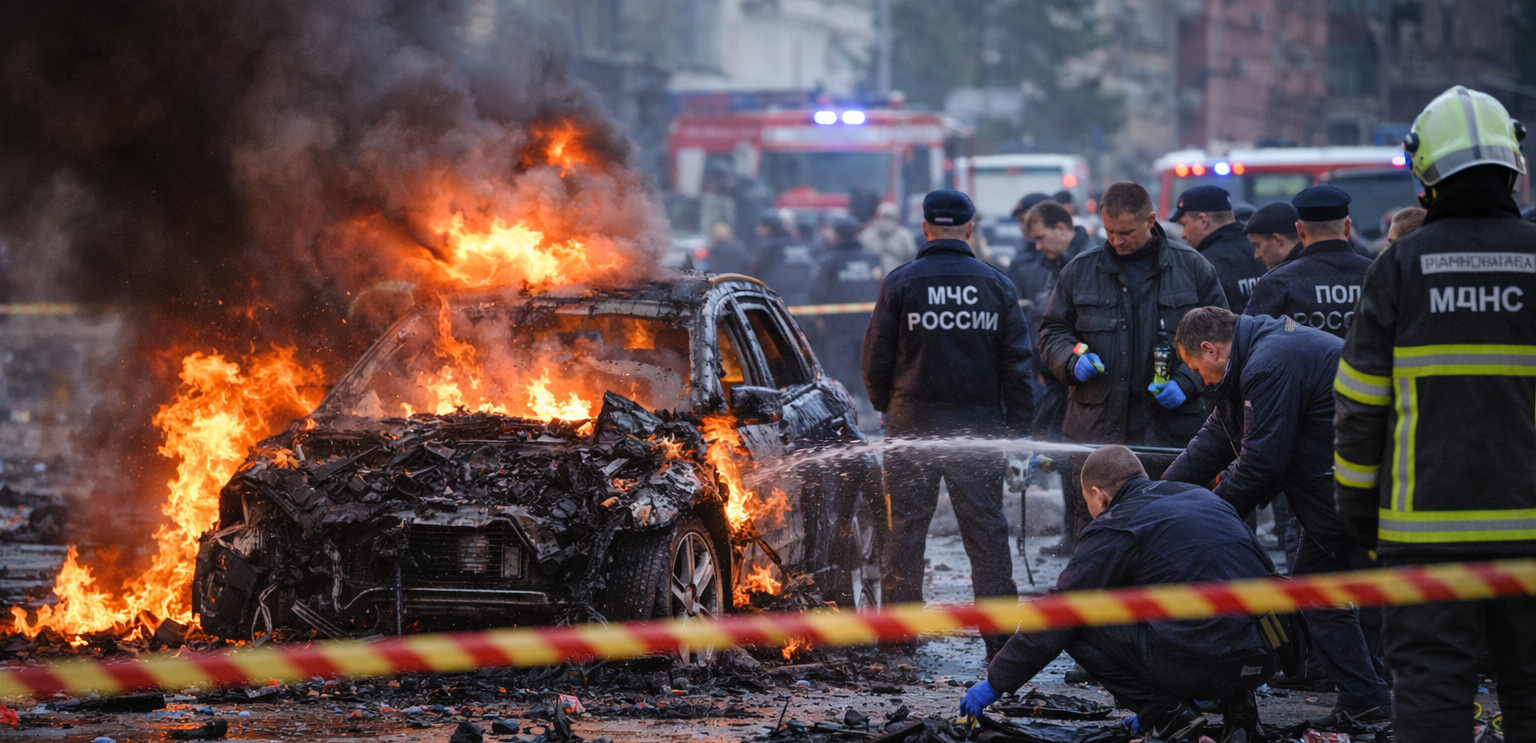
As of December 22, 2025, a senior Russian military officer has been killed in Moscow by a bomb placed under his vehicle. Russian investigators say Lieutenant General Fanil Sarvarov died after an early-morning explosion in the south of the capital, a rare strike on a high-ranking figure in the heart of the country’s security state.
The immediate facts are stark: a device detonated beneath the car as Sarvarov was leaving a parking space, and authorities opened a murder investigation. The bigger question is what this attack changes—inside Russia’s security apparatus, in the Russia–Ukraine war, and in the shadow conflict that has steadily expanded beyond the front lines.
This piece explains what is known so far, what remains unconfirmed, and why the choice of target matters. It also lays out the most plausible scenarios for who ordered the killing, what they were trying to achieve, and what signs will indicate which path this story is taking next.
The story turns on whether Russia can prevent a widening campaign of targeted killings inside its own capital.
Key Points
Lieutenant General Fanil Sarvarov was killed on December 22, 2025, when an explosive device detonated under his car in southern Moscow, Russian investigators said.
Authorities identified Sarvarov as the head of the General Staff directorate responsible for operational training, placing him among the senior ranks tied to force readiness and wartime planning cycles.
Russia’s Investigative Committee said it opened a criminal case and is examining multiple lines of inquiry, including possible involvement by Ukrainian special services.
Ukraine had not immediately commented publicly on the incident at the time Russian authorities announced the investigation.
The attack follows earlier high-profile killings of senior Russian figures linked to the war, including a December 2024 bombing in Moscow that killed Lieutenant General Igor Kirillov, which Ukrainian security sources claimed.
Beyond the individual loss, the killing pressures Russia to tighten elite security, reshuffle roles, and demonstrate control—moves that can ripple through military planning and domestic politics.
Background: Russian general killed by car bomb in Moscow
Russian investigators said the blast occurred around 7 a.m. local time on Yaseneva Street in southern Moscow. Reuters reported the explosion happened at 06:55 Moscow time as Sarvarov’s Kia Sorento pulled out from a parking space. The Investigative Committee said Sarvarov later died from injuries sustained in the blast.
Authorities released footage and images from the scene, including the wrecked vehicle. The Investigative Committee described the incident as a murder and said investigators were working through several possible explanations, including a version involving Ukrainian special services.
Sarvarov’s position—head of the operational training directorate within the General Staff—matters because the General Staff sits at the centre of Russia’s military planning. Even without assuming details of his day-to-day responsibilities, the title signals a senior role tied to readiness, training cycles, and the machinery that sustains a large force in wartime.
The killing also fits a broader pattern: as the war has dragged on, violence linked to it has repeatedly surfaced far from the battlefield. Some attacks have been explicitly claimed; others have not. In December 2024, Lieutenant General Igor Kirillov was killed in Moscow by a bomb concealed in an electric scooter, and Ukrainian security sources claimed responsibility. Earlier in 2025, another senior officer, Yaroslav Moskalik, was reported killed by a car explosion near Moscow, though early reporting at the time included unverified elements about the circumstances.
Analysis
Political and Geopolitical Dimensions
If this was an externally directed assassination, it signals an intent to demonstrate reach: striking a senior officer in the capital is not only about removing one person. It is a message to the broader system that seniority does not guarantee safety.
For Moscow, the political problem is twofold. First, there is the practical security failure—how a device could be planted under a vehicle in a major city. Second, there is the narrative challenge: the Kremlin must reassure elites and the public that the state remains in control, while also sustaining the wartime claim that Russia is the one applying pressure, not absorbing it.
For Kyiv, if Ukrainian services were involved, the likely logic would be asymmetric leverage: targeting figures linked to military planning can be framed as a way to degrade the war effort without matching Russia weapon-for-weapon. It also aims at psychological effects—forcing Russia to divert resources into internal security, and encouraging a sense of vulnerability among key personnel.
But attribution is the hinge. Ukraine has not publicly acknowledged involvement in this killing. Russia’s investigators have said Ukrainian special services are among the theories being explored, not a settled conclusion.
Economic and Market Impact
This is not an “oil price headline” in the way a pipeline strike might be. The more realistic economic effects are second-order.
If Moscow responds with a heavier security posture—more checkpoints, more surveillance sweeps, broader detentions—there can be localised disruption and higher compliance costs for businesses operating around sensitive districts and government nodes. Risk pricing can also shift subtly: firms and foreign investors weigh not only sanctions and battlefield risk, but also internal stability and the state’s capacity to control violence in major cities.
There is also a defence-industrial angle. A leadership shock in training and readiness functions can trigger reshuffles, audits, and changes to exercise schedules—bureaucratic moves that affect procurement priorities and internal budgets, even if they never show up in public.
Social and Cultural Fallout
In Russia, attacks like this often harden public sentiment in two directions at once. Some people rally around the state and demand harsher measures. Others internalise a quieter conclusion: if senior generals can be killed in Moscow, the war is closer than officials admit.
The information environment matters, too. Images of the wrecked car and official statements circulate rapidly, while details about who did it remain contested. That gap—high visibility of the act, low certainty about the perpetrator—creates space for rumor, opportunistic misinformation, and factional narratives.
In Ukraine, such incidents can be interpreted through the moral frame of wartime reciprocity: Russia attacks Ukrainian cities, so Russia’s war machine should not feel untouchable. That does not require public confirmation from Ukrainian authorities to shape public reaction.
Technological and Security Implications
Planting an explosive beneath a car in a major city sounds low-tech, but the enabling conditions are often high-skill: surveillance to establish routines, access to the vehicle or parking area, and tradecraft to avoid detection.
This will likely intensify Russian countermeasures around senior personnel: changes in routes and schedules, tighter access control to parking areas, more vehicle inspections, and broader monitoring of communications and movements near military and government facilities. The effect is a tax on time and predictability—exactly what complex bureaucracies rely on.
It may also trigger a deeper internal review of how protective services coordinate. When a state projects near-total domestic control, successful attacks can expose seams between agencies—seams that become political as well as operational.
What Most Coverage Misses
The target selection is not only about rank. “Operational training” is a clue: the most valuable battlefield effects often come months later, through weakened readiness, slower adaptation, and disrupted institutional learning. If the goal was to hinder Russia’s ability to regenerate and train forces, targeting a senior figure associated with that function makes grim strategic sense.
There is also a feedback loop that is easy to underestimate. The more Russia tightens security after a strike, the more it risks creating friction within its own system—slower decision-making, more suspicion, more energy spent policing insiders and routines. Even if the state absorbs the immediate shock, that friction can accumulate.
Finally, there is the possibility of mixed motives. Wartime environments create opportunities for personal vendettas, corruption-linked coercion, and internal score-settling. A single attack can serve multiple agendas, and early official attribution can reflect political incentives as much as evidence.
Why This Matters
In the short term, the killing forces Russian authorities to respond visibly—through investigative updates, security measures, and likely personnel adjustments. The key immediate signals to watch are any announced arrests, any public evidence about the device or method, and any official escalation in claims about who directed the attack.
In the longer term, it contributes to a pattern: the war’s boundaries are porous. When targeted violence reaches senior figures in the capital, it expands the conflict’s psychological footprint and raises the risk of retaliatory logic—each side seeing attacks beyond the front as legitimate pressure.
It also matters for diplomacy and conflict management. Any effort to de-escalate becomes harder when high-profile assassinations and counter-accusations dominate headlines, because they narrow leaders’ room to compromise without looking weak at home.
Real-World Impact
A mid-level logistics manager in Moscow who supports defence-related contracts finds new security checks and restricted access around offices and transit routes. Deliveries slow, meetings move online, and deadlines slip without anyone saying why out loud.
A Ukrainian tech contractor working on battlefield systems sees heightened concern about retaliation and cyber intrusion. Even without public claims, the expectation of reprisal shapes how teams communicate and travel.
A European compliance officer at a bank reviews exposure to Russian counterparties and contractors, not because the bombing changes sanctions overnight, but because internal stability risk and enforcement unpredictability can shift suddenly after security shocks.
A Russian conscript’s family outside Moscow watches the footage and hears official claims about “special services.” They do not need to know who did it to feel the war’s gravity moving closer to daily life.
What’s Next?
The next phase is less about spectacle and more about signals. Russia will try to show it can investigate, deter, and control. That usually means public updates, heightened security procedures, and potentially a narrative of external sabotage to justify tougher internal measures.
Several paths remain plausible:
If Russia produces credible forensic details and arrests tied to an organised network, the story tilts toward a coordinated operation with external direction or support.
If the investigation stalls, or if public claims outrun evidence, the story shifts toward political messaging and internal pressure management.
If similar attacks follow, the meaning changes again—from a single strike to a campaign, with compounding consequences for elite confidence and security posture.
The clearest indicators will be concrete: who is detained, what evidence is shown, whether Ukraine responds publicly, and whether Russia reshapes protection for senior military figures in ways that leak into everyday life in the capital.
