Iran’s Counterstrike Map Signals a Wider War Risk Across the Middle East—Where Are They Targeting?
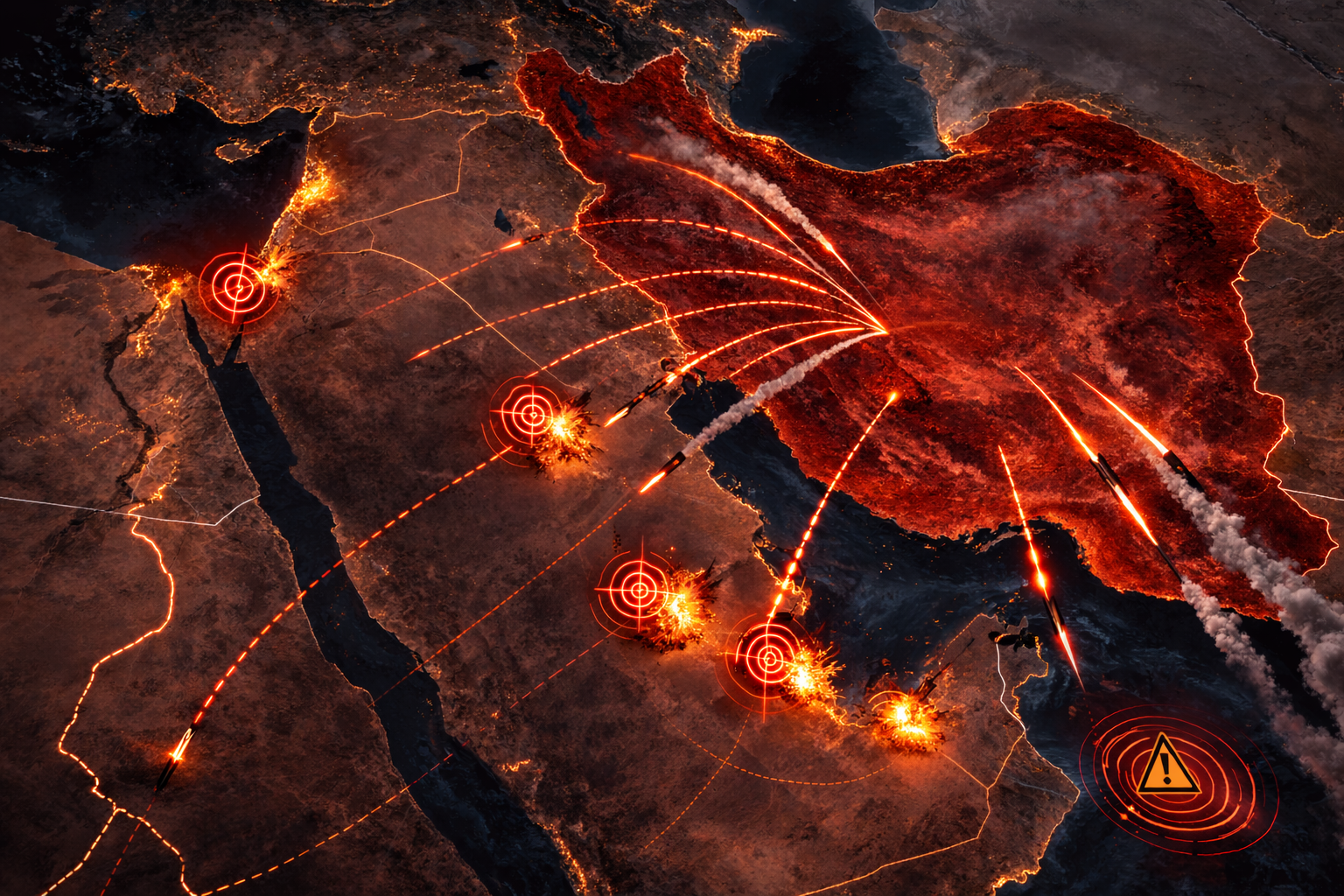
Iran Hits U.S. Footprint in the Gulf as Israel Braces for Follow-On Barrages
Iran’s Retaliation Is Aimed at One Pressure Point: America’s Regional Basing Network
Iran’s retaliation is not confined to a single location. It is spreading across a map that links Israel’s air defenses to the U.S. military footprint in the Gulf.
After U.S.-Israeli strikes on Iran, Tehran answered with missiles and drones toward Israel and toward U.S. bases in the region.
What stands out is the target logic. The clearest pattern is Iran aiming at the infrastructure that lets the U.S. operate nearby—air bases, command nodes, and naval facilities—especially in Qatar, Kuwait, the UAE, and Bahrain.
The story turns on whether Iran keeps its retaliation focused on regional bases and symbolic pressure—or expands toward energy chokepoints and broader state targets.
Key Points
Iran’s retaliatory strikes are aimed at Israel and at U.S. military sites across the Gulf, with repeated mentions of targets in Qatar, Kuwait, the UAE, and Bahrain.
Named installations tied to reporting include Al Udeid (Qatar), Ali Al Salem (Kuwait), Al Dhafra (UAE), and U.S. Fifth Fleet-linked facilities (Bahrain).
Wider coverage reports some additional locations, such as Saudi Arabia, Iraq, Syria, and Jordan, but the details vary from outlet to outlet and may not receive consistent confirmation.
The immediate strategic effect is to pull Gulf host states into the conflict’s risk envelope, even if they did not choose escalation.
Maritime and aviation risk is rising because the same region contains key routes and chokepoints, including the Strait of Hormuz, with official warnings already flagging shipping hazards.
Interception rates, follow-on salvos, and the potential shift of targets from bases to energy and transport infrastructure will determine the next course of events.
Iran’s retaliation follows U.S.-Israeli strikes on Iranian territory that triggered a rapid regional escalation cycle.
In practical terms, “retaliation” here means Iran using missiles and drones to impose costs on two linked systems: Israel’s security posture and the U.S. military network that supports operations across the region.
Those U.S. sites sit inside sovereign Gulf countries. That geography makes basing both powerful and politically fragile, because the host state becomes a battlefield address even if it wants neutrality.
The boundary risk: hit U.S. power without collapsing the region
Iran’s target set suggests it wants to punish capability and presence while trying to avoid an irreversible spiral. Hitting bases pressures Washington directly while still leaving Tehran room to claim it is striking military targets rather than civilian centers.
The danger is that “military targets” are embedded in dense national infrastructures—airspace, ports, and logistics corridors—so even “limited” strikes can trigger wider disruption.
Competing models: deterrence display vs escalation pathway
One model is deterrence theater: Iran demonstrates reach across the Gulf, shows it can hit the U.S. footprint, and signals endurance.
The other model is an escalation pathway: a first wave aimed at bases, followed by indirect or proxy-linked pressure, cyber activity, or attacks that expand the economic cost—especially if Tehran thinks the initial message is ignored.
The core constraint: geography turns Gulf hosts into unwilling participants
The clearest confirmed risk signal is how quickly governments issued shelter guidance and security warnings in Gulf states that host U.S. assets.
That constraint matters because the U.S. relies on access and permissions—overflight, basing, and resupply. If Gulf publics and leaders see themselves dragged into war, they may tighten operational latitude even while remaining allied.
The hinge: basing permissions become the real lever of power and control
Iran’s retaliation is not only about physical damage. It is also about changing the political cost of hosting U.S. forces.
If Iran can keep Gulf capitals under recurring threat, the long-run pressure is not just on American hardware. It is on the host states’ willingness to keep offering frictionless access—because every strike turns “hosting” into a domestic sovereignty and safety crisis.
The measurable signal: what to watch in the next hours and days
Watch for three high-signal indicators.
First, whether strikes remain focused on the best-known U.S. hubs—Qatar, Kuwait, the UAE, and Bahrain—or expand consistently to other arenas.
Second, interception and damage reporting: heavy interception suggests signaling; repeated penetrations suggest capability and intent are rising.
Third, maritime warnings and disruptions, because that is where economic shock can become global quickly.
What Most Coverage Misses
The hinge is that Iran’s real target may be the political permission structure that keeps U.S. forces forward-based, not just the bases themselves.
Mechanism: a strike that forces Gulf governments to issue shelter orders, close airspace, or harden internal security turns “hosting” into a visible domestic cost. Over time, that cost can translate into tighter basing conditions, quieter cooperation, or demands for restraint—shaping U.S. options even if the bases remain intact.
Signposts to confirm it: watch for host-state statements that shift from generic condemnation toward concrete limits—airspace rules, basing restrictions, or new conditions on operations. Also watch for sustained advisories affecting travel and shipping, because those are the policy fingerprints of a government preparing for repeat risk.
What Happens Next
In the short term (24–72 hours), the main question is whether the retaliation stays inside a “military-to-military” lane or whether the target set widens toward energy, ports, and regional infrastructure, because that would raise the cost for everyone fast.
In the longer term (months to years), the consequence is a potential rewiring of Gulf security politics, because repeated strikes force governments to balance alliance commitments against domestic stability and economic continuity.
Decisions to watch include emergency diplomatic sessions and any announced operational posture changes by the U.S., Israel, and key Gulf states, because those moves determine whether this becomes a contained exchange or a sustained regional campaign.
Real-World Impact
Aviation routes detour or pause, driving sudden delays, missed connections, and higher costs for passengers and freight moving through the region.
Shipping firms reroute or raise security posture, which can add time and insurance costs to cargo that touches Gulf corridors.
Businesses with Gulf supply exposure face immediate uncertainty around delivery windows, staffing, and contingency planning, especially where operations rely on predictable transit lanes.
The fork in the road for regional stability
Iran’s retaliation map is telling you what it thinks the leverage is: the places that enable U.S. power projection and the defensive system Israel depends on to absorb incoming fire.
The decision is straightforward, yet it carries a harsh consequence. If strikes stay focused and intermittent, diplomacy and deterrence may reassert themselves. If the target set expands into economic chokepoints or becomes a sustained campaign, the region’s daily life and global trade flows will feel it quickly.
The signposts worth watching are repeated salvos, shifts in host-state permissions, and any sustained disruption to air and sea corridors, because those signals reveal whether the attack is a message—or a new phase of war.
