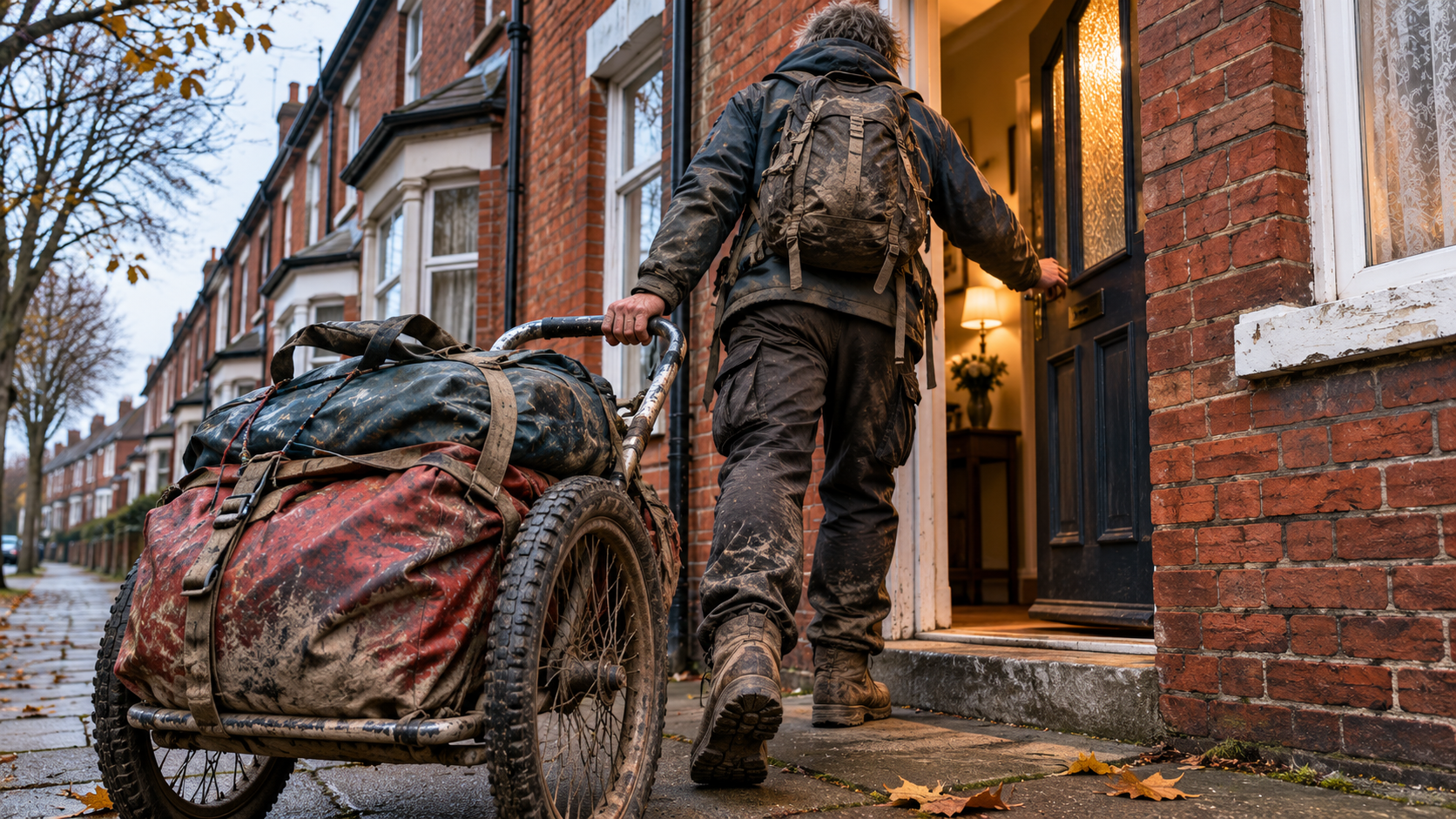
He Set Off in 1998. Karl Bushby Has Finally Walked Home
From Chile to Hull
Karl Bushby’s return to Hull ends a journey from Chile shaped as much by borders and waiting as by physical endurance.
Karl Bushby has arrived at his mother’s home in Hull, completing the journey he began in southern Chile in November 1998.
The 57-year-old former paratrooper reached the family house on 2 November 2026 after an expedition widely reported at approximately 31,000 miles. His arrival followed a public welcome in the city centre and brought the Goliath Expedition to its destination after 28 years.
The extraordinary distance is only part of the explanation. Bushby had made getting home conditional on how he travelled: no transport to advance the expedition, and no returning home before completing the route under his own power.
The Welcome Was Not Quite The Finish
Hull had prepared for an arrival with two different endings: the public celebration and the private destination.
The council invited people to gather in Queen Victoria Square, where the Lord Mayor would welcome Bushby before a reception at City Hall. He would then continue towards the family home.
That arrangement preserved the expedition’s essential logic. Reaching a civic reception was a milestone; reaching home was the purpose.
For the crowd, the occasion offered a finish line they could share. For Bushby, it marked the point at which a condition imposed decades earlier finally stopped governing his movements.
What Did “Walking Around The World” Actually Mean?
Bushby’s achievement is often described as a walk around the world. His own explanation is more precise.
In a first-person account written in 2020, he described a point-to-point undertaking rather than a technical circumnavigation. The objective was to connect the southern Americas with home in England.
The distinction prevents an extraordinary journey from acquiring the wrong claim. He did not need to complete a conventional circuit returning to the same geographical starting point.
Nor does “continuous” mean that he walked every day without stopping. The expedition’s rules concerned maintaining the connection along the route and avoiding transport that would carry him forward.
Rest, delays and logistical interruptions therefore need to be distinguished from skipping a section. Calling it 28 years of uninterrupted walking would misrepresent the very obstacles that made it last so long.
Why The Journey Took Almost Three Decades
Bushby originally divided the route into two broad sections: the Americas and the onward journey through Asia and Europe. In his account, he allowed roughly six years for each, while recognising that the Bering Strait introduced substantial uncertainty.
That was planning, rather than a promise of a fixed completion date. Once a journey crosses so many jurisdictions and environments, multiplying distance by daily mileage becomes an increasingly weak forecast.
His expedition website describes the Russian section as dependent on both suitable winter conditions and limited visa windows. Frozen ground could make a route possible that rivers and swamp obstructed in another season.
The financial crisis then damaged sponsorship. A viable path on a map was insufficient without money for permits and logistics.
These constraints interacted. Permission granted at the wrong time could miss a useful weather window; funding arriving too late could mean losing another opportunity to advance.
The important achievement was therefore repeated resumption. He had to preserve the possibility of continuing through periods when greater effort on the road could not solve the immediate problem.
The Walker Who Had To Become A Swimmer
Water crossings exposed the practical consequences of Bushby’s rules.
At the Caspian Sea, the expedition eventually adopted a solution that required a different skill altogether. In 2024, Bushby crossed between Kazakhstan and Azerbaijan with fellow adventurer Angela Maxwell, Azerbaijani swimmers and a support team.
Maxwell’s own account says that neither she nor Bushby had been swimmers and that they spent months preparing.
That detail changes the meaning of perseverance. Maintaining the objective did not require repeating the same activity indefinitely. It required learning how to tackle a barrier that walking could not overcome.
Support also matters to the description. This was a team undertaking, not a lone man disappearing into open water without assistance. A human-powered route and an unsupported expedition are different claims.
His final major water crossing brought him to England. The expedition website records his arrival at Shakespeare Beach near Dover on 5 October 2026 after swimming the Channel.
He had reached his home country. He still had to reach home.
Why The Rules Made The Journey Matter
For most travellers, finding a faster route is a success. For Bushby, a vehicle carrying him past an obstacle would have changed the nature of the project.
His rules created the challenge, but they also magnified its costs. A closed crossing could no longer be solved simply by buying a ticket.
There is a temptation to turn that into a universal instruction never to abandon a goal. His story supports a narrower and more useful observation: an ambitious commitment requires decisions about which principles must remain fixed and which methods can change.
The destination remained fixed. The timetable did not. Walking could give way to swimming, and a self-imposed challenge could still depend on other people.
That combination explains the expedition better than a picture of solitary stubbornness.
What Happens When Getting Home Is No Longer The Goal?
Bushby’s return creates a question that distance alone cannot answer: what replaces the structure of the journey?
His official website already offers speaking engagements and tour information. There is a practical route towards sharing the experience, though a programme of appearances cannot tell us how he will feel after the homecoming.
The achievement deserves celebration without requiring an invented account of his inner life. Completing a long commitment can be a real success even when what follows remains undecided.
For 28 years, home was both a place and a condition he had yet to fulfil. Now it can become somewhere he leaves for an ordinary reason—and somewhere he is free to return.
Sources
Associated Press — Karl Bushby completes 28-year, 31,000-mile walk around world and returns to mother’s house — Confirmation of the completed homecoming, his age and the reported distance. AP News
Karl Bushby — The Goliath Expedition — Expedition rules, Russian logistical difficulties, sponsorship setbacks, water crossings and speaking information. The Goliath Expedition
Armchair Adventure Festival — An update on Karl Bushby: the man who is walking home to Hull — Bushby’s first-person explanation of the point-to-point objective, route planning and original timescale. armchairadventurefestival.com
Hull City Council — Let’s give Karl a Hull welcome home — Arrangements distinguishing the civic welcome from the final journey to his family home. Hull CC News
Angela Marie Maxwell — She Walks the Earth — Her participation in the Caspian crossing and the swimming preparation undertaken with Bushby.
