

Aleppo on the Brink: Syrian Army Issues Strike Warnings in Kurdish District
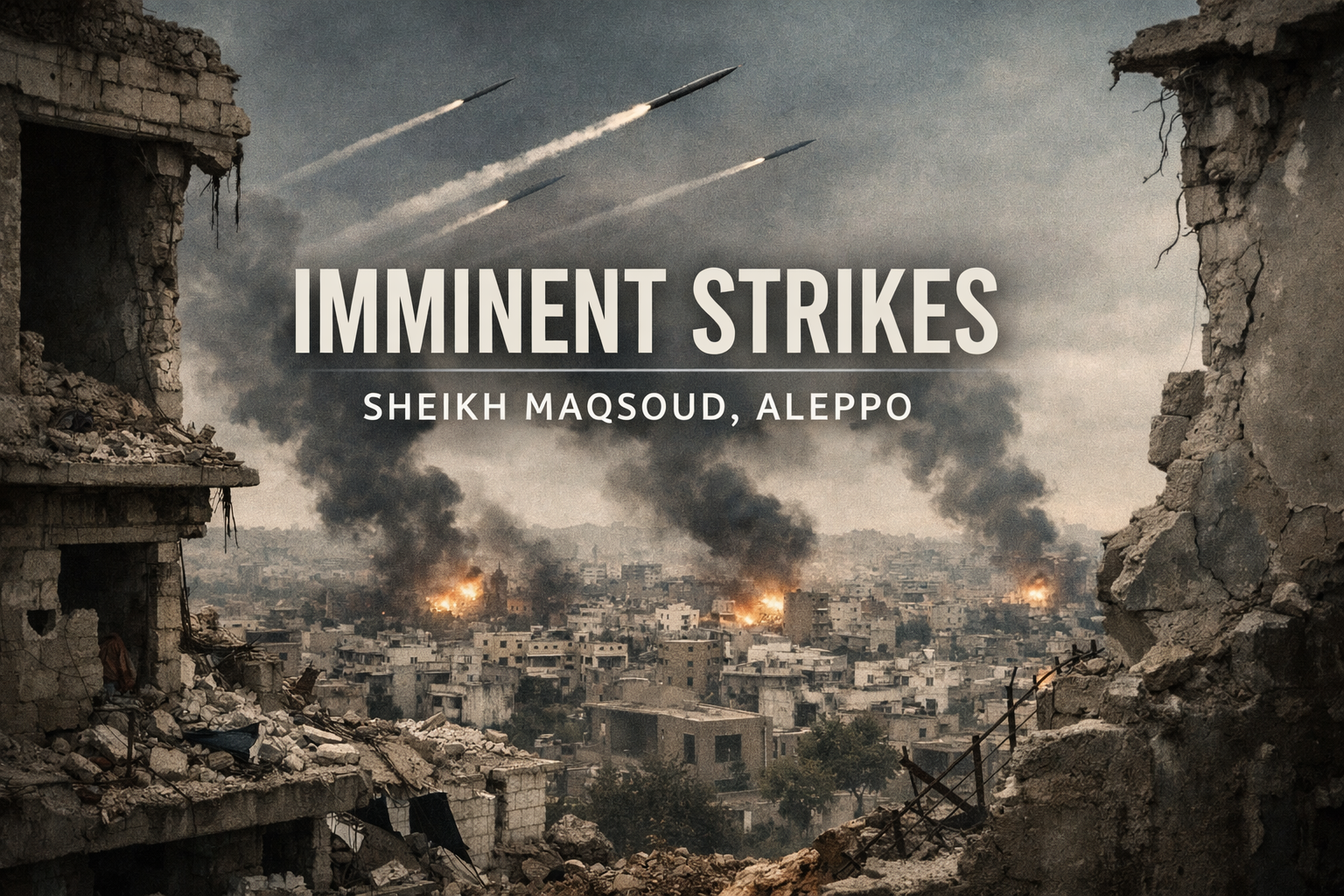
Countdown to Impact: Aleppo Residents Warned of Imminent Strikes in Sheikh Maqsoud
Warning of Imminent Strikes in Sheikh Maqsoud Raises Fears of a Wider Kurdish-Government Break
As of January 9, 2026, a fresh escalation in Aleppo has turned one Kurdish-majority district into the center of a looming decision: leave, endure, or resist. Syrian forces have issued warnings that strikes are imminent in Sheikh Maqsoud, alongside a broader push to reassert control over contested neighborhoods.
The most alarming detail is the specificity. Residents have been told to avoid a set of marked locations that the army says it intends to hit. Different reports describe different counts, but the intent is the same: a public signal that bombardment may be treated as pre-announced and “targeted,” even though the neighborhoods are densely civilian.
This is not just an Aleppo story. It is a stress test for Syria’s post-war political settlement, for Kurdish autonomy, and for the fragile arrangements that have kept old front lines from reopening inside major cities.
The story turns on whether Damascus can force a Kurdish withdrawal from Aleppo without triggering mass displacement, civilian casualties, and regional escalation.
Key Points
Syrian forces have warned residents in Sheikh Maqsoud to avoid multiple mapped locations that the army says it will target, sharpening fears of imminent strikes in a populated district.
The escalation is tied to a wider confrontation with Kurdish-led forces, including competing claims about ceasefires, evacuation corridors, and whether withdrawal demands amount to surrender.
The messaging around “designated targets” is doing double duty: shaping civilian behavior and attempting to frame legal and political responsibility for harm.
Turkey and the United States sit close to the fault line, with Turkey opposing Kurdish armed presence and Washington seeking to prevent a broader rupture with Kurdish partners.
Displacement has surged, and the risk is that “temporary evacuation” becomes lasting demographic change, a fear voiced by Kurdish officials and echoed by regional Kurdish leaders.
The next signals to watch are whether evacuation routes function safely, whether a ceasefire holds, and whether negotiations move from deadlines to verifiable steps.
Background
Sheikh Maqsoud and nearby Ashrafieh have long been politically loaded spaces inside Aleppo. They are Kurdish-majority districts that have functioned, in practice, as semi-autonomous pockets at different points in the war, with local security forces and their own internal lines of control.
The current escalation is rooted in unfinished state-building. Syria’s central authorities have sought to consolidate control after years of fragmentation. Kurdish-led forces, for their part, have tried to preserve armed and administrative autonomy while negotiating their place in a unified Syria.
A framework for integration has existed in principle, but implementation has repeatedly stalled. That has left both sides trapped between political bargaining and the temptation to impose facts on the ground, especially in symbolic urban terrain like Aleppo.
Into that gap has come a hardening military posture: evacuation calls, curfews, and now publicly circulated maps that mark out locations presented as legitimate targets. The claim is that these sites are used by Kurdish forces. The fear, for civilians, is that “precision” collapses quickly in dense neighborhoods.
Analysis
Political and Geopolitical Dimensions
The political stakes are bigger than a few streets in Aleppo. Damascus wants a clean assertion of sovereignty: one state, one chain of command, no armed enclaves inside major cities. The Kurdish side wants guarantees that integration does not become dismantling, and that local communities are not left vulnerable to reprisals or forced displacement.
That tension becomes combustible when deadlines are imposed. A withdrawal “window” can look, from one side, like a de-escalation mechanism, and from the other, like a coerced surrender under fire.
External actors amplify the pressure. Turkey views Kurdish armed formations near its border through a security lens and has repeatedly signaled it will support efforts to reduce them. The United States has ties to Kurdish-led forces and also a broader interest in preventing northern Syria from sliding into a renewed multi-front war.
Four plausible scenarios sit on the table:
Managed withdrawal and containment. If buses, corridors, and checkpoints function and a ceasefire sticks, the fighting could pause, at least temporarily.
Stalled withdrawal, intermittent strikes. If neither side accepts the terms, limited bombardment could continue as pressure, risking civilian harm and new displacement.
Urban escalation and externalization. If casualties spike or accusations of ethnic cleansing gain traction, the crisis could draw in Turkey politically or militarily, and force a sharper U.S. response.
Negotiated reconfiguration. A deal could emerge that preserves some local policing while moving heavier forces away, but it would require verification and mutual trust that currently looks thin.
Economic and Market Impact
Global markets may barely notice Aleppo’s front lines. But the economic impact inside Syria can be immediate and brutal.
Urban clashes disrupt fuel delivery, bread supply, and local commerce. When neighborhoods are treated as “closed zones,” informal trade routes vanish overnight. Families spend what they have on transport, rent, and basic supplies, hollowing out already fragile local economies.
There is also a strategic economic layer. Stability in northern Syria affects cross-border flows, aid logistics, and reconstruction signals. Each flare-up tells businesses and humanitarian operators that risk is not receding; it is mutating.
Social and Cultural Fallout
For civilians, the threat is not abstract. Evacuation warnings can mean leaving behind homes, documents, medication, and livelihoods, with no certainty of return.
The Kurdish districts in Aleppo are not just military terrain. They are communities shaped by displacement history, war memory, and deep suspicion of central authority. In that context, the promise of “safe passage” can be read as either protection or a trap, depending on lived experience.
This also reshapes identity politics. If Kurdish neighborhoods feel besieged, Kurdish political cohesion hardens. If Damascus frames the conflict as restoring state authority against “separatist weapons,” national unity becomes a slogan rather than a shared project.
Technological and Security Implications
Urban fighting turns small technical choices into life-or-death outcomes. Drones, artillery spotting, and rapid-fire social media claims can compress decision time and increase the chance of miscalculation.
The public release of maps is itself a security tool. It can help evacuate civilians. It can also flush fighters out of cover, fracture local support, and create a narrative that future harm was “warned.”
Information moves faster than verification. In a city like Aleppo, that accelerates panic. It also fuels propaganda on both sides, which can make ceasefires harder to sell to fighters on the ground.
What Most Coverage Misses
The “five locations” detail matters less than the underlying tactic: public targeting warnings are a form of political engineering. They are designed to split civilians from armed groups, and to shift moral and legal blame before the first strike lands.
That framing is not only for local audiences. It is also for external ones. If Damascus can argue it gave warning and designated targets, it seeks to blunt international outrage. If Kurdish forces can argue the warnings amount to forced displacement, they seek to trigger legal and diplomatic pressure.
In other words, the maps are part of the battlefield. They are not just a preface to it.
Why This Matters
The most affected people are the residents of Sheikh Maqsoud and nearby districts: families with limited mobility, the elderly, people needing dialysis or insulin, and those without the money to relocate twice.
Short term, the danger is immediate strikes, casualties, and chaotic displacement. Long term, the danger is something quieter: an evacuation that becomes permanent, and a city map that changes by force rather than consent.
This also matters because Aleppo is a bellwether. If armed enclaves inside major cities can be dismantled only through bombardment and mass flight, then other “frozen” disputes across Syria may thaw violently.
Key signposts to watch include whether evacuation corridors remain open and safe, whether a ceasefire is mutually accepted rather than declared unilaterally, and whether talks produce verifiable steps instead of shifting deadlines.
Real-World Impact
A pharmacist in western Aleppo closes early because shelling makes supply runs too risky. He cannot restock critical medicines, and customers begin buying whatever substitutes they can find.
A family from Sheikh Maqsoud leaves with one suitcase and a blanket. They move in with relatives across town, then discover the rent has doubled because thousands of others are doing the same.
A university student in Aleppo tries to sit exams while buses line up near checkpoints. Classes become sporadic, and graduation timelines slip again, another quiet casualty of instability.
An aid volunteer spends the day triaging where to send limited food parcels. The need spikes overnight, but the roads are uncertain, and every route carries the risk of getting caught between checkpoints.
What’s Next in Aleppo
The immediate question is not who has the stronger rhetoric. It is who can control escalation in a city where civilians and fighters live on top of each other.
Damascus can pursue pressure through mapped strikes and evacuation demands, but the trade-off is legitimacy. Kurdish forces can refuse withdrawal and frame the fight as defense, but the trade-off is civilian exposure and the risk of losing external sympathy if civilians are seen as being kept in harm’s way.
The decisive test will be whether the next 24 to 72 hours bring a functioning de-escalation mechanism—safe movement, reduced fire, credible talks—or whether “warning maps” become the prelude to a grinding urban campaign whose costs will outlast any tactical gain.
