

La Poste cyberattack disrupts France’s postal and online banking services in the Christmas rush
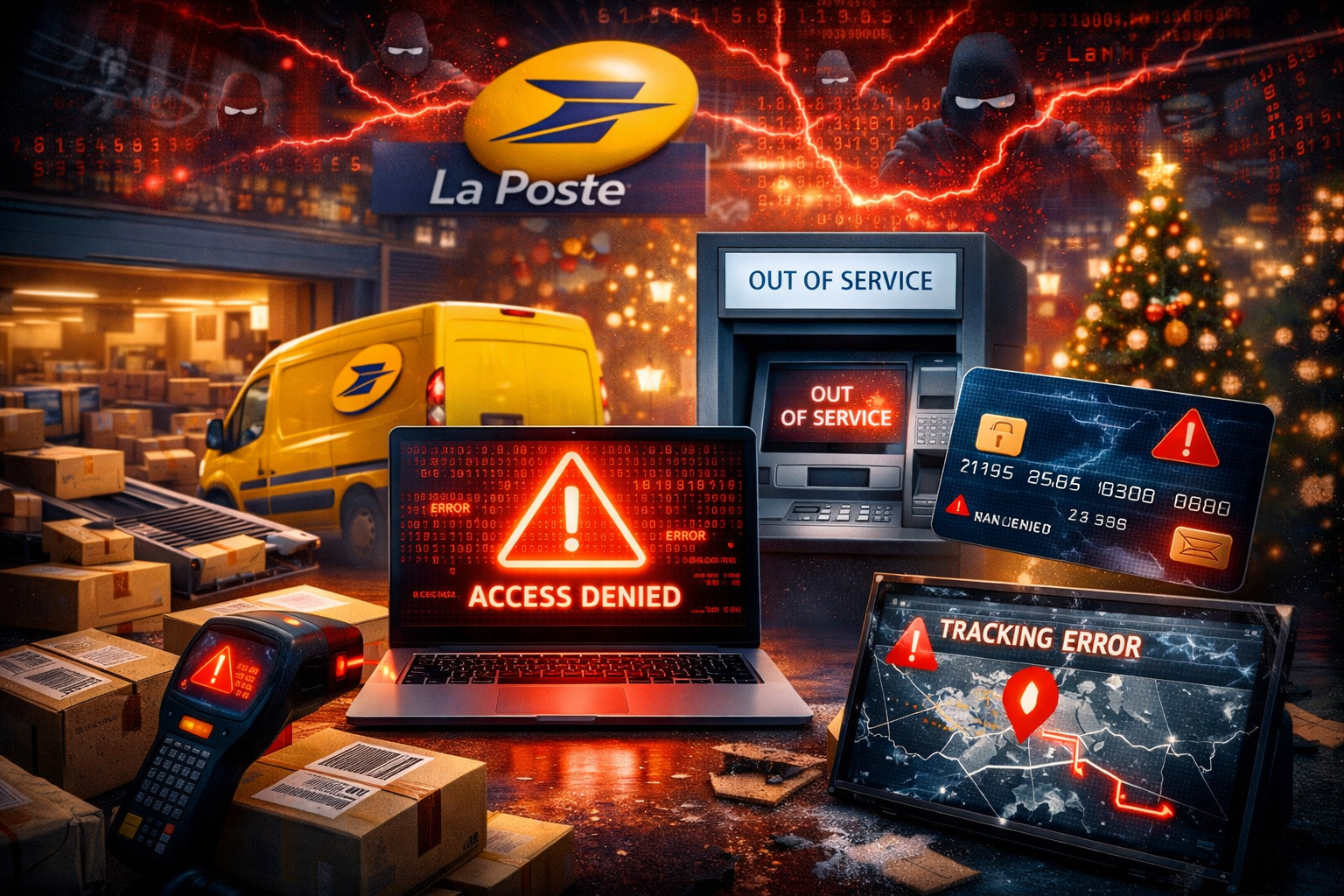
What the La Poste cyberattack is disrupting
On Monday, December 22, 2025, a major online disruption hit France's national postal operator, La Poste, and its banking arm, La Banque Postale, during the final push before Christmas.
La Poste described the incident as a distributed denial-of-service attack, the kind that overwhelms systems with traffic until legitimate users cannot get through. The company said customer data was not compromised, but online services became inaccessible and parts of operations slowed.
This matters because modern postal delivery is no longer just vans and sorting centres. It is barcode scans, routing updates, pickup codes, identity checks, and customer-facing tracking—much of it tied to the same digital backbone people use to manage last-minute shipments.
This piece explains what appears to have happened, what is confirmed versus uncertain, and why a “non-destructive” attack can still create serious real-world disruption.
The story turns on whether this was a contained denial-of-service disruption—or the front edge of a broader campaign aimed at trust and continuity during peak season.
Key Points
La Poste reported a denial-of-service-style incident that made its online services inaccessible and disrupted parts of mail and parcel operations.
La Banque Postale said some customers could not access online banking and the mobile app, with temporary workarounds used for payment approvals.
La Poste reported that while customer data remained unaffected, peak holiday volumes affected service availability and delivery pace.
The disruption created knock-on effects: tracking visibility dropped, some in-branch workflows slowed, and customer support pressure spiked.
No credible public attribution has been made, and no widely accepted claim of responsibility was evident as the outage unfolded.
The incident lands amid heightened sensitivity around critical services resilience in Europe, where operational disruption is increasingly treated as a strategic risk.
Background
A distributed denial-of-service (DDoS) attack is a disruption method rather than a “break-in” in the classic sense. Instead of stealing data, it floods websites and apps with requests, exhausting capacity so genuine users get errors, timeouts, or failed logins.
That distinction matters, but it does not make the impact trivial. Postal systems depend on a constant stream of digital events: labels generated, parcels scanned, routing confirmed, pickup notifications triggered, and status updates pushed to customers and retailers.
In this incident, the disruption spilt across multiple consumer-facing services associated with the La Poste group, including parcel tracking and document or account access tools tied to daily workflows. La Banque Postale reported access issues for online banking and app-based approvals, forcing customers into alternative authentication paths for certain payments.
Some users also reported earlier or intermittent service instability over the preceding days. Whether this was a connected issue, a separate technical incident, or an early warning sign of the same pressure campaign remains unclear.
Analysis
Technological and Security Implications
A DDoS attack targets availability, one of the three pillars of security alongside confidentiality and integrity. When availability fails, the public experiences it as a hard outage—especially when services are designed around “always on” digital flows.
For a postal operator, availability failures do not just stop web browsing. They can reduce visibility into parcel movement, slow exception handling, and complicate customer identity checks in branch processes that rely on central systems. Even if trucks keep moving, the system’s ability to prove where something is—and to resolve problems quickly—weakens.
For a retail bank, the pain concentrates in customer authentication and approvals. When app-based approvals fail, banks fall back to alternative channels like text-message verification. That can keep commerce moving, but it also raises the stakes for fraud monitoring, customer confusion, and the volume of “Is this legitimate?” queries flooding support channels.
Two realities can be true at once: the incident can be “only” a denial-of-service event, and it can still be operationally severe. The key technical question for the coming days is whether La Poste treats this as a one-off traffic flood—or whether post-incident reviews suggest broader compromise attempts occurring in parallel.
Economic and Market Impact
A postal outage in late December is a multiplier event. The cost extends beyond just delayed delivery. It includes rework, customer refunds, missed delivery windows, retailer escalations, and surge staffing in call centers and branches.
The biggest economic hit often falls on small and mid-sized sellers. They depend on tracking links to reduce “Where is my parcel?” support tickets and to deter fraudulent chargebacks. When tracking goes dark, disputes get harder to resolve, and sellers absorb the cost.
Banks feel it differently. If payments still clear but app access is disrupted, the system’s core plumbing may remain intact while the customer experience collapses. That scenario can still drive reputational damage and temporary friction in consumer spending, especially for online purchases where app-based approvals are the norm.
The knock-on effect is trust. In a peak season, customers are not just buying gifts; they are buying certainty. A few hours of uncertainty can feel like a breach of the social contract, even when no money is stolen.
Social and Cultural Fallout
La Poste is not just infrastructure in France. It is a familiar civic interface: a place for parcels, forms, identity checks, and everyday admin. When it falters, frustration spreads quickly because the service is woven into routine.
The timing intensifies everything. Holiday logistics are emotionally charged. People are not thinking like service managers; they are thinking like parents, partners, and adult children trying to get something to the right place on the right day.
This is also the moment when opportunistic scams surge. Whenever a postal brand is in the headlines, criminals exploit the confusion with fake “redelivery” messages and phishing attempts. Even if the original incident is “just” DDoS, the secondary wave of fraud attempts can be where consumers actually lose money.
Political and Geopolitical Dimensions
Across Europe, policymakers increasingly treat disruption of essential services as more than a technical nuisance. Even when a specific incident is not publicly attributed, the pattern matters: repeated disruptions erode confidence and force public services to divert resources from improvement to defence.
France has faced heightened cyber pressure recently, including incidents affecting government systems. That context shapes how quickly a postal disruption becomes a national story rather than a routine outage.
The political constraint is attribution. Without strong evidence, officials and operators are unlikely to name an actor. But the operational response can still harden: accelerated resilience investment, deeper coordination with national cybersecurity bodies, and tougher expectations placed on critical service providers.
What Most Coverage Misses
The overlooked factor is coupling: postal logistics, identity checks, customer notifications, and banking approvals are increasingly dependent on shared digital layers—identity systems, authentication gateways, and customer-facing APIs. When one layer is stressed, multiple “separate” services can fail at once.
This coupling alters the risk assessment. A denial-of-service campaign does not need to destroy data to create chaos. It just needs to hit the seams where digital trust is generated: tracking updates, pickup codes, payment approvals, and account access.
This also alters the challenge of recovery. Restoring a website is one problem. Restoring confidence that every missed scan, delayed notification, and failed approval will reconcile cleanly afterward is a different, slower problem.
Why This Matters
In the short term, the people most affected are households waiting on final deliveries, retailers managing last-mile promises, and customers who rely on app-based approvals for online payments. In the long term, the incident reinforces a broader shift: availability and continuity are becoming as central to national resilience as data protection.
What to watch next is straightforward:
Clear statements on scope: which services were affected, and whether internal logistics systems or mainly customer-facing portals were degraded.
Confirmation on duration: when services stabilised, and whether there were repeated waves rather than one burst.
Any law enforcement or regulatory updates, including whether prosecutors opened a formal investigation and whether national cybersecurity resources were engaged.
Consumer fraud warnings: whether authorities or the operator issue alerts about phishing campaigns exploiting the disruption.
Real-World Impact
A small online retailer in Lyon ships 200 orders a day through the postal network. When tracking fails, customer emails double, and chargeback threats rise. The seller spends the next two days doing manual reassurance instead of processing new orders.
A nurse in Paris tries to approve an online purchase for last-minute gifts after a night shift. The banking app fails repeatedly. She switches to text-message approval but hesitates because she has also received suspicious “parcel problem” texts that week.
A family in Marseille is waiting on medication delivery and a holiday parcel for an elderly relative. Delivery may still happen, but without tracking updates, they cannot plan pickups or confirm whether a missed delivery card is legitimate.
A freelance designer in Bordeaux needs a bank transfer confirmation for a client invoice. Online access is down. The money may be moving in the background, but proof and reassurance are not available when needed.
What’s Next?
The immediate goal is service restoration, but the medium-term story is resilience.
There are three plausible paths from here.
One: rapid normalisation. Services return, backlogs clear, and the incident is contained as an availability shock with limited second-order damage. This becomes more likely if outages stabilise quickly and there is no sign of deeper system compromise.
Two: prolonged instability. Services return in waves, but repeated disruption causes rolling outages and customer confusion through the holiday period. This becomes more likely if attackers keep pressure on exposed endpoints and defences rely on reactive blocking rather than upstream mitigation.
Three: a broader security reckoning. Post-incident analysis reveals parallel intrusion attempts or a major spike in consumer fraud exploiting the chaos. This occurrence becomes more likely if investigators identify coordinated phishing waves, credential-stuffing spikes, or suspicious internal activity during the outage window.
The clearest signal of which path is unfolding will be the pattern of recovery: a clean return with minimal relapses suggests containment, while repeated “partial restorations” and shifting workarounds suggest the system is still under pressure.
