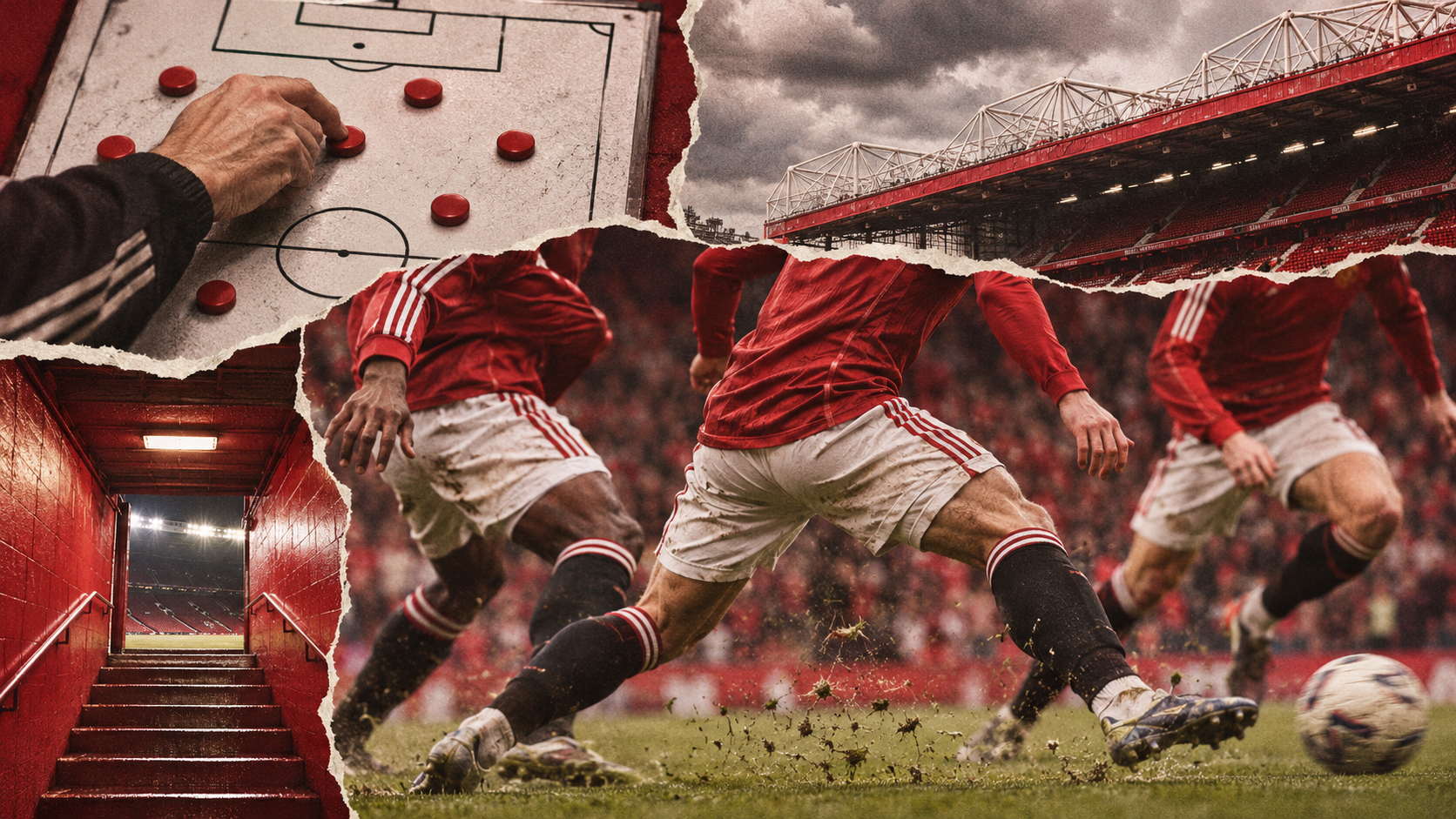
What Would Pochettino Do With Bruno Fernandes, Amad, Cunha And Mbeumo?
United Scored Four In Carrick’s Last Game And Still Needed A Stoppage-Time Equaliser.
Patrick Dorgu scored in the 96th minute against Aston Villa to rescue a point for Manchester United. Four days later, on 12 November 2026, United sacked Michael Carrick. His final afternoon at Old Trafford left a fair question for the man expected to succeed him. How do you improve a team capable of scoring four goals at home when even four are barely enough?
Mauricio Pochettino is lined up to take over, with an agreement in principle reported. United had confirmed Carrick’s departure by Thursday morning. A formal announcement appointing Pochettino was still outstanding, and the United States had Nations League fixtures against Haiti to play before his anticipated return to club football.
There is a good footballing case for the choice. Bruno Fernandes has forwards worth finding, Patrick Dorgu offers width on the left, and United have enough players comfortable in tight spaces to keep possession under pressure. Pochettino could improve the side before anyone spends another pound. His first selection, though, may involve leaving out a gifted attacker. A team sitting 18th needs somebody in position to stop the opposition’s next pass. Too often, the most attractive United line-up on paper leaves that job to whoever happens to be nearest.
Why United Sacked The Manager Who Took Them To Third
Carrick took over from Ruben Amorim in January, guided United to third place and earned a two-year contract in May. Less than six months later, he leaves with one league victory from ten games. Eight points put United a point off the bottom. Across all competitions this season, they won three of his 15 matches.
The sequence mattered as much as the totals. A 4–1 defeat at Como raised questions about how United responded when a game began to go against them. Bournemouth then won 3–0 at Old Trafford. Carrick had left Fernandes on the bench and kept him there as United slipped towards defeat. Restoring the captain at Chelsea produced a different team sheet and another afternoon without a goal. United lost 2–0.
Carrick still had players willing to respond. Against Roma, they came back from two down at half-time to win 3–2. Against Villa, two substitutes scored in stoppage time. The suggestion that the dressing room had simply stopped trying is difficult to square with those finishes. Carrick made changes that affected both games. What he could no longer give United was a convincing reason to expect the next match to begin any better.
That distinction matters for his successor. A manager inheriting a side short of effort can sometimes get a response by changing personnel or demanding more running. United have just demonstrated how hard they can run when the match is nearly lost. Pochettino’s opportunity is to make some of that work count while the score is still level.
What Pochettino’s Football Would Look Like At Old Trafford
Pochettino’s best Tottenham teams could make an ordinary pass to an opposition full-back feel like a mistake. The nearest attacker closed from inside, cutting off the easy return into midfield. A team-mate moved towards the next receiver. Behind them, the midfield and defence came forward together. The player on the ball had the touchline on one side and fewer useful passes than he had seen a second earlier.
United supporters could watch the second player in that sequence. A centre-forward sprinting towards a defender will always draw the eye. The team-mate behind him decides whether the sprint achieves anything. If that player is close enough to intercept the pass inside, United can win possession with Fernandes already near the penalty area. If he is several yards late, the opponent can turn and run at a midfield that has just stepped forward.
With the ball, Pochettino has often used advancing full-backs to give his attacking players room to come inside. That could suit a squad containing Amad, Matheus Cunha and Bryan Mbeumo. All three can threaten a defence from a position narrower than the touchline. The cost comes when several of them want the ball to feet and both full-backs go beyond them. One blocked pass can leave two centre-backs defending half the pitch.
The sensible early compromise would be to release one full-back at a time. If Dorgu goes down the left, the right-back can stay close enough to the centre-backs to help deal with a clearance. United would still have a player outside Cunha and three men behind the ball. It is an adjustment a coach could make in his first week, with consequences at both ends.
Bruno Fernandes And The Choice Between Cunha, Amad And Mbeumo
Fernandes looks the clearest fit. Play him behind a forward who threatens the space beyond the defence and his willingness to attempt an early pass becomes an advantage. A defender watching Mbeumo run towards his own goal has less freedom to step out and close the captain. Even when Bruno declines the pass, the run has bought him a moment to look up.
Carrick’s last starting attack already offered that possibility. Mbeumo led the line against Villa, with Amad, Fernandes and Cunha behind him. Pochettino could select exactly the same four. The decision that would change their football is who goes beyond the ball when Fernandes receives it. If Mbeumo comes short, one of the wide forwards has to take his place on the shoulder of the last defender. Otherwise United can complete three neat passes while every opponent moves closer to the ball.
Cunha presents the most interesting choice. He can start on the left and come towards the centre, where he can turn, carry the ball or combine with Fernandes. An overlapping Dorgu would give the opposition right-back a difficult decision. Follow Cunha and the outside lane opens. Stay wide and Cunha may receive facing goal. That pairing has an obvious attacking purpose, provided somebody covers the ground Dorgu leaves behind.
Amad offers a different route from the right. United can give him the ball wide enough to draw out the opposing left-back before asking him to combine inside. There will also be games in which Mbeumo is more valuable attacking from that side and Joshua Zirkzee gives the side a central passing option. Zirkzee’s stoppage-time goal against Villa earned him a place in that conversation. Picking him would change the jobs around him. When the centre-forward drops towards midfield, someone else has to make the run into the box.
The players fit well enough for Pochettino to have genuine choices. The criticism will come on the afternoon he puts one of them on the bench. If United need an extra midfielder to protect a lead, a good manager should be able to explain which route to goal the remaining attackers still offer. Simply picking the four most dangerous names transfers the difficult decision to the players halfway through a move.
The Midfield Pairing Will Decide How Brave United Can Be
Against Villa, Carrick started Kobbie Mainoo and Youri Tielemans together after an injury ruled out Carlos Baleba. Tielemans scored against his former club shortly before half-time. His arrival in scoring range illustrates both the appeal of that pairing and the question Pochettino would inherit. If Tielemans joins the attack and Mainoo has already moved across to support the ball, who is standing between the opposition striker and United’s centre-backs?
Mainoo can help a side escape pressure by taking the ball with an opponent close to him. Tielemans can play the pass that moves an attack from one side of the pitch to the other. Together, those qualities should help against visitors who sit deep at Old Trafford. United could draw opponents towards Mainoo, then use Tielemans to find the spare man on the far side. Asking the same pair to chase runners across open ground for an hour would give them a very different afternoon.
A fit Baleba gives the coach another option. Alongside a passer, he could close the space behind an advancing full-back or challenge for the loose ball when a forward’s press forces a hurried clearance. Even an athletic midfielder has to choose which runner to follow. If United build a team that requires Baleba to win every fifty-fifty, his first missed challenge will expose the design.
One early decision could be to pick the midfield for the opposition. Away at Liverpool, the ability to survive pressure and cover the centre may earn a player his place. At home against a team content with a draw, United may need Tielemans’s passing and an extra runner beyond him. A settled team can have different answers to those two games. Its players need to recognise which answer they are using.
Dorgu, Yoro And The Risk Behind A Higher Line
Dorgu came on after 66 minutes against Villa, equalised half an hour later and won the supporters’ player-of-the-match vote. His willingness to reach the far end of the pitch gives Pochettino something to work with immediately. Starting him at left-back, however, would ask more of him than the emergency assignment Carrick gave him at 4–2 down. At kick-off there is a point to protect and a full match for the opposition to attack the space behind him.
Leny Yoro and Harry Maguire started that game at centre-back. Ayden Heaven replaced Maguire at half-time. For any combination of those defenders, the height of the line should depend on what is happening in front. When an opposition midfielder receives with his back to goal, the defence can step up and squeeze the pitch. When the same player receives facing forward with time to pass, holding that position invites a race towards Senne Lammens’s goal.
This is where supporters might judge Pochettino unfairly in either direction. A retreat towards the penalty area can be the correct response to a press that has already been beaten. Equally, a brave-looking defensive line can be several yards too high. Watch whether the nearest United midfielder can affect the kick. That tells you more about the centre-back’s decision than a freeze-frame showing where he stood.
Lammens has a part in the solution too. If United invite pressure with a short goal-kick, he needs a viable longer pass when the opposition commits bodies forward. Mbeumo running into a channel and Zirkzee offering a ball to feet present different exits. Choosing the forward should influence what the goalkeeper practises that week. Otherwise playing out from the back can become an elaborate way of handing the opposition a throw-in near United’s goal.
The Strongest Criticism Of Pochettino Comes From Chelsea
The argument for Pochettino usually starts with Tottenham. He helped turn Spurs into title contenders and took them to the 2019 Champions League final. Several players grew into greater responsibilities under him. For a club deciding what to do with Mainoo, Yoro, Heaven and Dorgu, that record carries weight. Tottenham also finished that era without a trophy, a fair consideration for United once their ambitions extend beyond getting out of trouble.
Chelsea offers a closer comparison for the coming weeks. Pochettino inherited a talented, unsettled squad and eventually guided it to sixth in the 2023–24 Premier League. His side scored 77 league goals and conceded 63. Both numbers belong in the assessment. The attacking return shows why Fernandes and United’s forwards might enjoy playing for him. The goals conceded explain why a supporter who has just watched a 4–4 draw could have reservations about the appointment.
His subsequent work with the United States adds a more recent reference point. At the 2026 World Cup, the hosts won a knockout match against Bosnia and Herzegovina before Belgium beat them 4–1 in the last 16. International management gave him experience preparing a side with limited training time, which may be particularly relevant ahead of Anfield. It offers less evidence about managing the weekly demands of a Premier League and Champions League campaign.
The fairest expectation is that Pochettino can give United’s attackers better positions and their younger players clearer jobs. Defensive improvement is the less certain part of the bargain. His reputation rests partly on a Tottenham side built over several seasons. United would be hiring him in November, without a pre-season, with players away on international duty and league points already lost. He may have to put his most ambitious ideas aside to earn the time to use them.
What The Board Still Has To Answer For
United’s executives were entitled to conclude that one league win in ten required action. They also chose Carrick for the permanent job in May. If third place justified that decision and 18th justified reversing it, supporters are entitled to ask what the club assessed beyond the league table on each occasion. Which parts of the spring recovery did the directors expect to last? Which weaknesses did they expect the summer business to address?
The handling of Carrick’s final days made those questions more uncomfortable. He continued taking training while United’s pursuit of Pochettino was being publicly reported and senior decision-makers met in Monaco. A club considering dismissal has good reason to establish whether a suitable replacement is available. Allowing the incumbent to become the last public participant in a decision being discussed around him comes at a cost. The next coach will have seen how quickly an unresolved boardroom decision can become a question for his press conference.
January will provide a better test of the club’s planning than the unveiling of a manager. Suppose United’s greatest difficulty is getting the ball out of their own half under pressure. Another forward might increase competition for places while doing little to help the team reach any of them. Suppose instead that United consistently play through pressure and then leave the far side undefended. That points towards a different priority, possibly one the coaching staff could address with players already at Carrington.
The director of football and head coach should be able to identify the same problem before they discuss a name. Otherwise United risk buying a specialist for one manager, changing direction and asking his successor why an expensive squad still has a hole in it. The presence of so many credible attacking options makes that danger especially clear this time.
How Much Improvement Would Actually Change United’s Season?
Eight points from ten matches works out at 0.8 points per game. To reach 40, United need another 32 from their remaining 28, roughly 1.14 per game. Forty is a benchmark whose significance depends on what the sides around them do. Even so, the arithmetic makes the immediate task easier to grasp. Eight wins and eight draws would supply the missing points, with room for 12 defeats. United have time to recover without suddenly playing like one of the best teams in England.
European ambitions ask an entirely different question. Even reaching 60 points would require another 52, or approximately 1.86 per match. That figure illustrates the cost of the opening ten games. A coach could make United appreciably better, pull clear of danger and still finish well short of the position Carrick earned last spring. Supporters judging the appointment purely on the final league place could miss a genuine recovery. The board treating comfortable survival as the full extent of its ambitions would deserve equal scrutiny.
Liverpool away after the international break is an awkward first examination. One encouraging result could lift the mood across Old Trafford. One defeat at Anfield would say relatively little about whether United can put together the run they need. The more revealing afternoon may come at home, against opponents prepared to let them have the ball. Can they create a chance without sending both full-backs forward? Once ahead, can they keep a passing option upfield so that every clearance does not come straight back?
On balance, Pochettino looks more likely to improve United than to leave them playing at their opening rate. Carrick’s own spring run is evidence of how much better the club can perform, and his final selections leave the incoming coach several workable combinations. The strongest reason for caution is the type of improvement Pochettino has delivered before. A livelier attack could arrive weeks before a dependable defence. United’s place in the table makes that gap expensive.
The moment worth watching might be an ordinary one in the 75th minute, with United leading by a goal. Dorgu has gone forward, his cross is cleared and the opposition turn towards halfway. If a United midfielder collects the clearance and finds Fernandes, the crowd gets another attack. If everyone has followed the cross into the box, the centre-backs are running towards their own goal again. Carrick’s last afternoon showed how thrilling United can be when they have to rescue a match. His successor earns his money if, a little more often, they already have it won.
Sources
Reuters — Manchester United sack manager Carrick with club in relegation zone
The Guardian — Manchester United close on Mauricio Pochettino deal before settling Carrick’s fate
Sky Sports report via Mansfield Radio — Carrick dismissed with Pochettino lined up
Coaches’ Voice — Mauricio Pochettino’s tactics and formations
Premier League — How Chelsea will benefit from Pochettino’s attacking approach
Next Reads
How Many Points Do Manchester United Need to Stay Up? What 30 Premier League Seasons Tell Us — How often clubs have survived with fewer than 40 points and what those figures mean for United.
Manchester United’s Crisis in Numbers: What Must Change? — The results and performances that put Carrick under pressure before the Villa draw.
Why Does Manchester United Keep Changing Managers? The Decisions Above the Dugout — How responsibility for United’s football decisions extends beyond the head coach.
