Merchant Ship Sunk By Drones Off NATO State Bulgaria As Black Sea War Spreads West
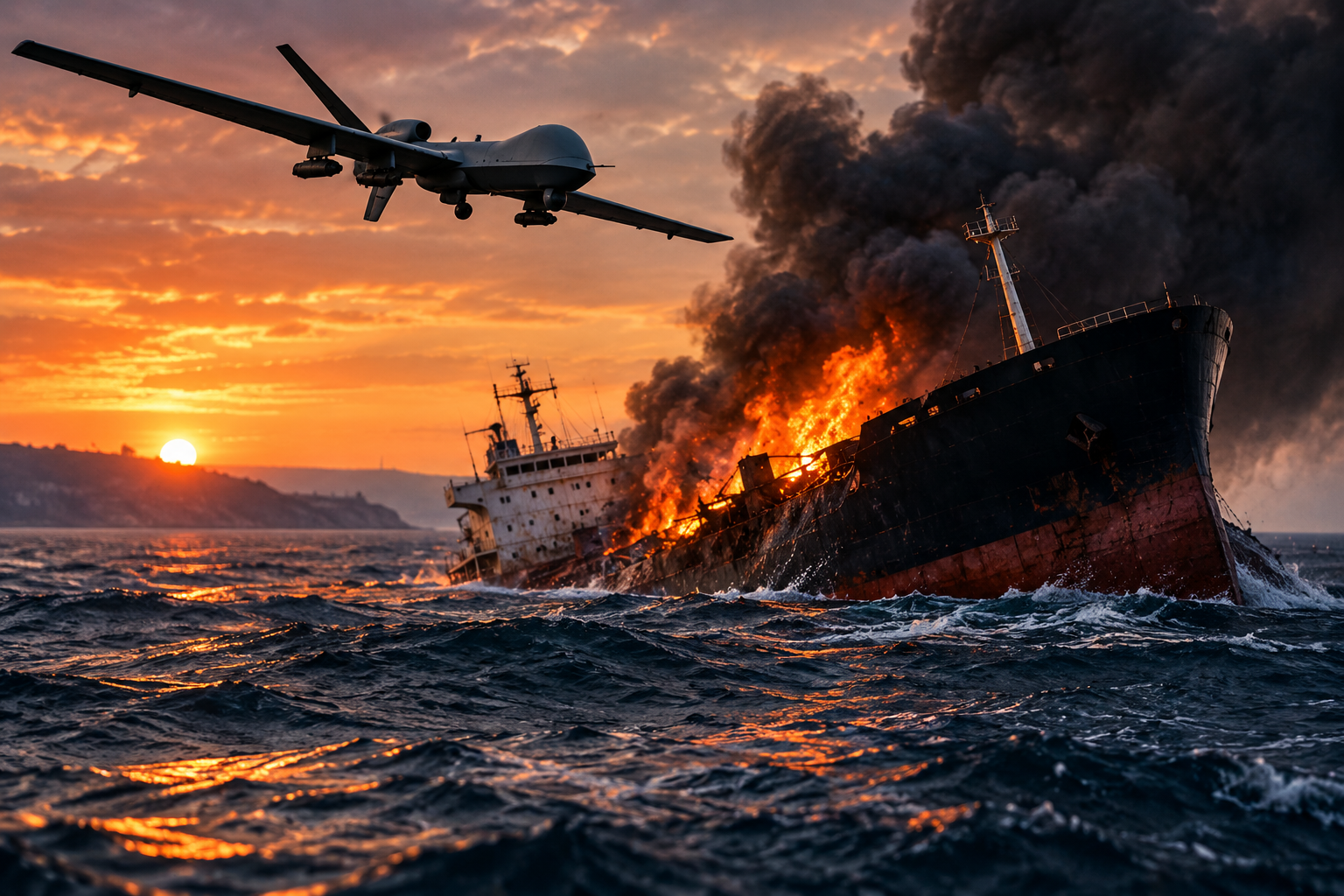
Crew Missing After Drone Attack Sinks Ship Inside Bulgaria’s Black Sea Economic Zone
Bulgaria Faces Unprecedented Black Sea Drone Attack
One vessel has sunk and its crew remains missing after drones struck two commercial ships inside Bulgaria’s exclusive economic zone, pushing the danger of the Black Sea war closer to NATO territory.
A merchant ship has sunk and its crew remains missing after drones attacked two commercial vessels in the Black Sea inside Bulgaria’s exclusive economic zone on Tuesday, 6 October.
The strikes happened roughly 70 nautical miles east of the Bulgarian coast.
Bulgarian Prime Minister Rumen Radev said both aerial and sea drones were involved.
The Togo-flagged ALFA WATAN suffered severe damage and sank. Its crew remained missing as search teams moved into the area.
A second ship, the Palau-flagged ABLE, was also hit and caught fire. All 18 people aboard were evacuated. Two were reported injured.
The attack is significant not simply because civilian ships were struck, but because it happened inside the maritime economic zone of Bulgaria — a member of both NATO and the European Union.
The attacker has not yet been publicly identified.
That distinction matters. The incident is serious enough without assigning responsibility before the evidence is clear.
Two Merchant Ships Hit In Bulgaria’s Black Sea Zone
The two vessels were travelling through Bulgaria’s exclusive economic zone when the attacks took place.
ALFA WATAN, sailing under the flag of Togo, was heading north when it was critically damaged.
Bulgarian authorities had not disclosed its cargo when the emergency response began.
ABLE, registered in Palau, was travelling south and carrying wheat.
The Bulgarian-flagged ferry DIOSCURIA was diverted towards the damaged vessel and helped evacuate the 18 people aboard.
Eleven of the rescued sailors were Turkish nationals and seven were Indian nationals.
When rescuers reached the area where ALFA WATAN had gone down, they found an overturned boat, three overturned life rafts and life jackets.
No members of the missing crew had been located at the time Bulgarian authorities began coordinating the wider search operation.
Naval vessels, aircraft and other military resources were deployed as Bulgaria searched for survivors and assessed the wreck.
The incident appears to be the first reported drone attack on merchant shipping inside Bulgaria’s exclusive economic zone.
That makes the location almost as important as the ships themselves.
Bulgaria Is A NATO State — But This Was Not Bulgarian Territorial Waters
Bulgaria joined NATO in 2004 and is also a member of the European Union.
However, the ships were not reported to have been attacked inside Bulgaria’s territorial sea.
They were inside its exclusive economic zone, commonly known as an EEZ.
The difference is crucial.
An exclusive economic zone can extend as far as 200 nautical miles from a country’s coastline. It gives the coastal state specific rights over natural resources, energy production and economic activity.
It is not the same thing as sovereign territorial waters.
That means the attack should not automatically be described as an attack on Bulgarian territory.
It also means NATO’s Article 5 collective-defence clause is not automatically triggered simply because the strike occurred inside Bulgaria’s EEZ.
Article 5 applies when a NATO member suffers an armed attack within the geographical scope set out by the North Atlantic Treaty.
The vessels struck on Tuesday were civilian merchant ships flying the flags of Togo and Palau. They were not Bulgarian naval vessels.
That does not make the attack strategically unimportant.
Far from it.
If attacks on commercial vessels begin happening repeatedly inside the economic zones of NATO states, the Alliance could face growing pressure to strengthen maritime surveillance, patrols and defensive measures across the western Black Sea.
Article 4 Could Become More Relevant Than Article 5
NATO’s Article 4 allows any member to request formal consultations when it believes its territorial integrity, political independence or security is threatened.
That threshold is much lower than Article 5.
Bulgaria does not need to have been directly attacked as a state for the incident to become a NATO security concern.
A pattern of drone strikes near Bulgarian waters, energy infrastructure or major shipping routes could be enough to trigger wider consultation.
That is why the location of Tuesday’s attack matters.
The western Black Sea has traditionally been viewed as less exposed than the waters immediately surrounding Ukraine and Russia.
That assumption is becoming harder to maintain.
Long-range aerial drones and increasingly capable unmanned surface vessels are allowing the war to reach far beyond conventional front lines.
At sea, there are no trenches.
Commercial ships move continuously between different jurisdictions, ports and economic zones.
One misidentified vessel, one navigation failure or one deliberate attack can create an international incident hundreds of miles from the battlefield.
The Attacker Has Not Been Identified
Bulgarian authorities had not publicly identified who launched the drones when the investigation began.
Prime Minister Radev condemned the incident but stopped short of assigning responsibility.
That caution is important.
Both Russia and Ukraine operate increasingly sophisticated aerial and maritime drones in the Black Sea.
Russia has repeatedly attacked Ukrainian ports, energy infrastructure and export facilities.
Ukraine has meanwhile developed a large fleet of long-range aerial drones and explosive unmanned boats capable of striking Russian military and logistical targets far from Ukrainian-held territory.
Identifying the operator behind Tuesday’s attack could require radar tracks, recovered drone fragments, electronic signatures, satellite information and intelligence collected by Bulgaria or its NATO partners.
Until that evidence is available, claiming definitively that either Russia or Ukraine carried out the attack would go beyond what has been established.
The uncertainty itself creates a problem.
Modern drone warfare allows a weapon to travel enormous distances with no pilot physically present.
Governments may therefore know that an attack has happened long before they can prove who ordered it, where the drone came from or whether the target was deliberate.
That gap between impact and attribution is becoming one of the most dangerous features of modern warfare.
The Attack Came One Day After Another Ship Sank Near Romania
The Bulgarian incident followed another deadly maritime event in the western Black Sea just one day earlier.
The civilian cargo ship ROYAD MAMMADOV sank inside Romania’s exclusive economic zone after an incident that killed two members of its crew.
Ukraine said the ship had been struck by two Russian drones.
Romanian authorities confirmed the vessel had sunk and that two sailors had died, although attribution remained a separate question during the initial response.
The sinking of ROYAD MAMMADOV near Romania had already raised concerns that risks to merchant shipping were moving beyond the areas closest to Ukraine.
The strike off Bulgaria now deepens that concern.
Two major incidents involving civilian vessels in the western Black Sea within roughly a day would be difficult for shipping companies, governments and insurers to ignore.
Even before investigators establish whether the incidents are connected, commercial operators will be asking the same question.
How safe are these routes now?
Civilian Shipping Could Become A New Pressure Point
The Black Sea remains one of Europe’s most important maritime corridors.
Ships moving through it carry grain, fuel, raw materials and industrial goods between eastern Europe, the Mediterranean and global markets.
A sustained threat to those routes would have consequences well beyond the vessels directly involved.
Shipping companies could alter routes.
Crews could demand additional compensation.
Insurers could increase war-risk premiums.
Ports could face delays.
The price of moving commodities through the region could rise.
It does not require dozens of ships to be sunk before those effects begin.
Shipping markets react to risk.
If owners believe a route has become materially more dangerous, the economic consequences can start long before commercial traffic stops entirely.
The western Black Sea had also become increasingly important as wartime dangers changed shipping patterns closer to Ukraine.
The attack off Bulgaria now challenges the idea that greater distance from the Ukrainian coast necessarily means greater safety.
Drone Warfare Is Expanding The Geography Of The Conflict
One of the defining features of the Russia-Ukraine war has been the rapid evolution of unmanned warfare.
Cheap drones have destroyed equipment worth millions.
Long-range systems have travelled hundreds of miles to strike airfields, refineries and military facilities.
Unmanned boats have attacked warships and infrastructure at sea.
The technology has steadily expanded the physical area in which both sides can operate.
Ukraine’s increasingly deep drone strikes inside Russia have demonstrated how far modern unmanned systems can travel from the conventional battlefield.
The same principle now applies at sea.
A drone does not need a nearby airbase or a crew aboard the weapon.
A sea drone can travel for hours towards a target.
An aerial drone can cross coastlines and national boundaries before anyone knows where it is heading.
That creates a much larger area of uncertainty around the war.
Bulgaria Now Faces A Difficult Security Calculation
The immediate priority remains the search for ALFA WATAN’s missing crew.
After that comes attribution.
Investigators will need to establish where the drones came from, whether the merchant ships were intentionally targeted and whether both vessels were attacked by the same operator.
Recovered wreckage could prove decisive.
Radar records may also help reconstruct the path of the aerial drones.
The maritime drones could be harder to trace, especially if they were destroyed during the attack or sank with the vessel.
Bulgaria must then decide whether the incident requires additional protection for commercial shipping inside its economic zone.
That could involve more surveillance flights, naval patrols or closer coordination with NATO forces operating around the Black Sea.
Romania has already experienced repeated drone-related security incidents near strategically important infrastructure.
Unidentified drones discovered near Romania’s Neptun Deep gas project showed how offshore energy, commercial shipping and national security are increasingly overlapping in the same waters.
The Bulgarian attack adds merchant shipping directly to that equation.
A NATO Crisis Does Not Begin With Article 5
The biggest mistake would be to reduce the significance of this incident to a simple question of whether NATO will invoke Article 5.
That is not how escalation usually works.
Security crises often develop through smaller steps.
More patrols.
More surveillance.
More consultations.
More defensive deployments.
More political pressure.
More incidents close to national boundaries.
Eventually, governments can find themselves operating much closer to direct confrontation than they originally intended.
Tuesday’s attack does not mean NATO and Russia are suddenly at war.
Nor does it prove Russia carried out the strike.
What it does show is that the geographical buffer between the war in Ukraine and the maritime territory surrounding NATO members is becoming thinner.
The western Black Sea can no longer be treated as comfortably removed from the conflict.
A merchant ship is now on the seabed inside Bulgaria’s economic zone.
Another has been damaged.
Eighteen sailors have been rescued.
Others are still missing.
And investigators are now trying to answer the question that will determine what happens next: who launched the drones?
Sources
Bulgarian Council of Ministers — Prime Minister Convenes Institutional Meeting Over Ships Hit In Bulgaria’s Black Sea Economic Zone — Official Bulgarian confirmation of the incident and government response.
Maritime.bg — Large-Scale SAR Operation In The Black Sea Following Drone Strikes — Details of ALFA WATAN, ABLE, the sinking, evacuation and search-and-rescue operation.
NATO — The North Atlantic Treaty — Official treaty text covering Articles 4, 5 and 6 and the geographical scope of collective defence.
Next Reads
Two Dead As Civilian Grain Ship Sinks Near Romania After Suspected Russian Drone Strike — The closely related sinking inside Romania’s exclusive economic zone one day earlier.
NATO State Blows Up Mystery Drones Found Beside Major Black Sea Gas Project — How unexplained drones have already raised security concerns around critical Black Sea infrastructure.
Ukraine Unleashes One Of Its Largest Aerial Attacks Of The War Deep Inside Russia — Further context on the rapidly expanding range and scale of drone warfare.
