

NATO Jets Rushed Into Action As Russian Drone Threat Reaches Alliance Airspace
The Dangerous New Front Emerging On NATO’s Eastern Border
The Headline Is About A Drone But The Story Is About Deterrence
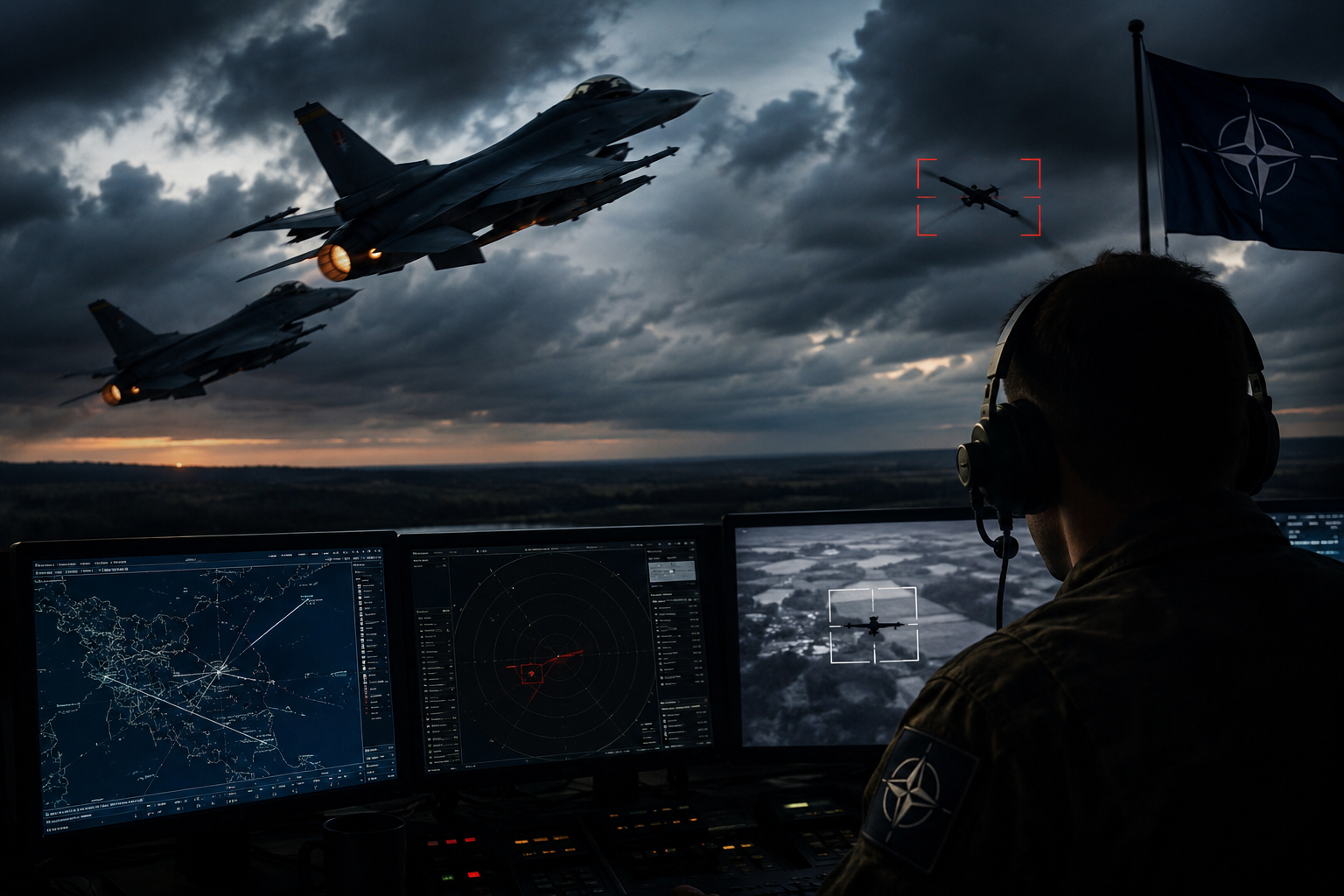
Recent reports confirmed that NATO aircraft were scrambled after a drone linked to Russia entered Latvian airspace. French fighter jets operating under NATO's Baltic Air Policing mission were launched as authorities issued alerts to residents near the border. The immediate objective was simple: identify and neutralise a potential threat before it could create a larger security incident.
At first glance, this can look like a minor border violation. A drone enters airspace, military aircraft respond, and the situation ends. Yet that interpretation misses the larger strategic reality. The importance of these incidents is not the size of the aircraft involved. It is the question they force NATO to answer every single time: how quickly, how confidently, and how aggressively will the alliance respond?
The Real Battle Is Over Credibility
Military alliances depend on credibility. NATO's power does not come solely from aircraft, missiles, or troop numbers. It comes from the belief that member states will defend each other when challenged. That credibility is the foundation of deterrence.
Every drone incursion creates a small but significant test. If the response is slow, critics argue the alliance looks vulnerable. If the response is aggressive, the risk of escalation increases. The result is a constant balancing act in which even relatively inexpensive unmanned aircraft can force difficult strategic decisions.
This is why modern drones have become so valuable. They can gather intelligence, create uncertainty, test response times, and generate political pressure at a fraction of the cost of traditional military operations. The drone itself may be expendable. The information gathered from the reaction is not.
Why Poland Remains At The Centre Of The Story
Although the latest incident occurred in Latvia, Poland has become one of the most important reference points for understanding the broader trend. In September 2025, multiple Russian drones entered Polish airspace, triggering NATO fighter responses and resulting in drones being destroyed inside alliance territory. It was widely described as an unprecedented moment in the Ukraine-era security environment.
The consequences extended beyond the immediate military response. Poland invoked NATO consultations, eastern air defences were strengthened, and alliance planners accelerated efforts to improve counter-drone capabilities. NATO subsequently launched Operation Eastern Sentry to enhance protection along the alliance's eastern flank.
The significance was psychological as much as military. For decades, NATO prepared for conventional threats involving aircraft, missiles, and large military formations. The drone age has introduced a challenge that is cheaper, harder to track, and capable of creating political effects far beyond its physical size.
The Drone Problem Is Getting Harder Not Easier
One uncomfortable reality is becoming increasingly clear. The technologies used to disrupt, jam, or redirect drones are becoming more sophisticated. Several recent incidents involving drones entering NATO territory have been linked to electronic warfare interference, navigation disruption, or loss of control during combat operations.
This creates an environment where attribution becomes harder. Was a drone deliberately sent into alliance territory? Was it accidentally diverted? Was electronic warfare responsible? Was it intended as a test? The answers are not always immediately obvious.
That ambiguity can be strategically useful. Modern competition between states increasingly operates in grey zones where actions fall below the threshold of open conflict but still create pressure. Drones fit perfectly into that environment because they generate uncertainty while forcing expensive defensive responses.
The Bigger Question Is What Happens Next
European security officials are increasingly focused on the possibility that Russia could continue probing alliance responses through limited actions that remain below the level of direct military confrontation. Recent defence assessments have warned that NATO's cohesion and response mechanisms could face further testing in coming years.
The challenge is that repeated incidents can gradually change expectations. What begins as an unusual event can become routine. What once triggered headlines can become normal background noise. Yet normalisation does not reduce risk. In some ways it increases it because complacency becomes easier.
Every scramble, interception, and investigation becomes part of a larger pattern. Military planners are not merely examining individual incidents. They are studying whether those incidents collectively reveal a deliberate effort to map alliance behaviour and identify weaknesses.
The Future Of Conflict May Already Be Visible
The most important lesson is not about Latvia, Poland, or any individual drone. It is about the changing nature of power itself. Modern security competition increasingly rewards actors that can create uncertainty cheaply while forcing their opponents to spend heavily defending against it.
A drone costing a tiny fraction of a modern fighter aircraft can still trigger alerts, military deployments, intelligence activity, political discussion, and international headlines. That imbalance is reshaping how states think about deterrence, defence, and escalation.
The real significance of NATO jets rushing into the sky is not what happened to one aircraft. It is what the response reveals about the future battlefield. The next era of geopolitical competition may not begin with tanks crossing borders or fleets crossing oceans. It may begin with a radar screen, an unidentified object, and a question nobody can afford to answer incorrectly.
