Niamey Airport Gunfire: A Fast-Moving Instability Test
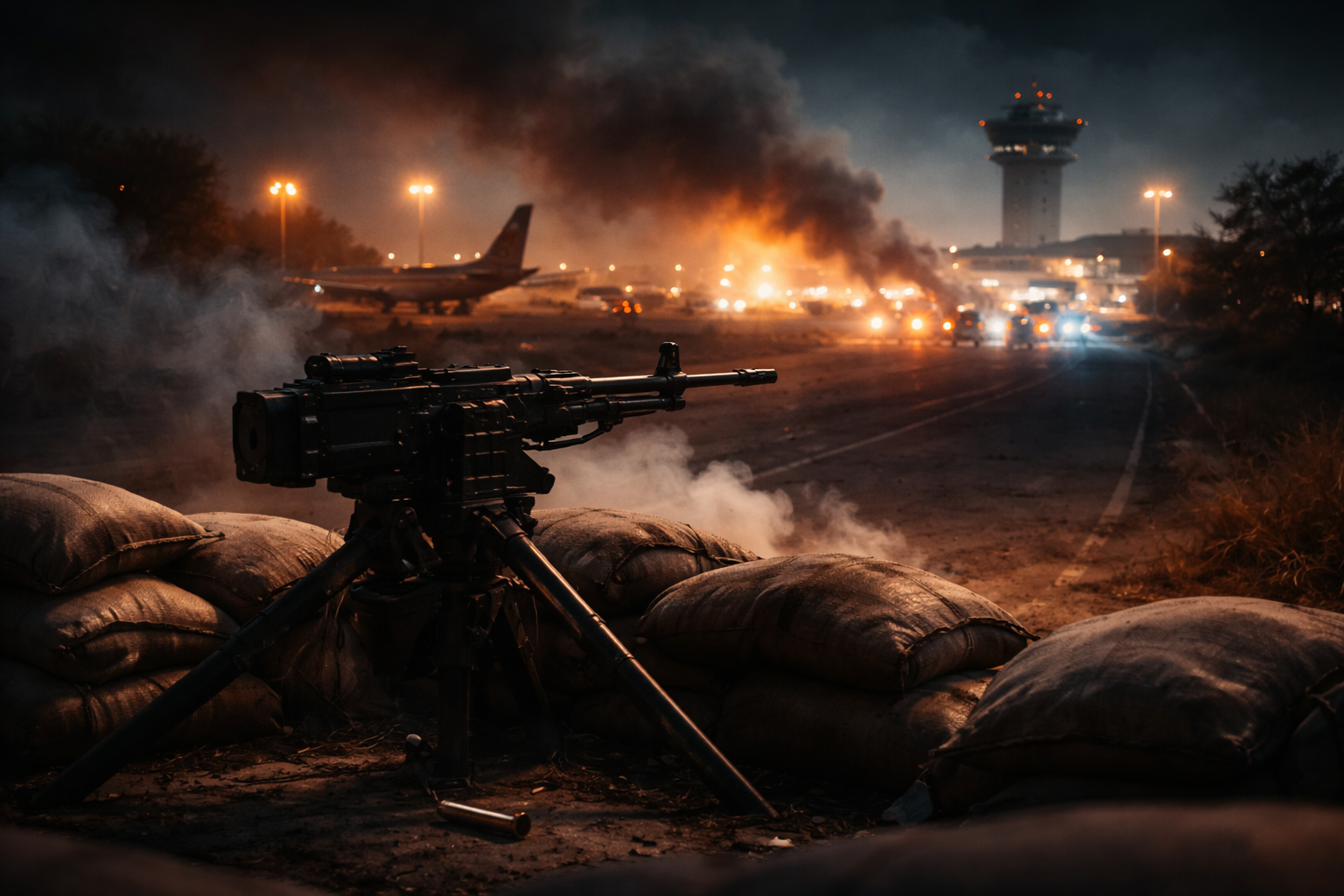
Reports cite gunfire near Niamey’s airport. Here’s what’s confirmed, what’s unverified, and the escalation signals for the next 6–12 hours.
There have been reports of sustained gunfire and loud blasts in Niamey, primarily near Diori Hamani International Airport. The reports describe a burst of intense fire beginning shortly after midnight local time, with calm returning within roughly two hours.
The most important part is still unclear: who fired, what they aimed at, and why. In Niger, that uncertainty is not a detail—it is the whole risk signal, because the airport zone is tied directly to military basing and regime security.
The story turns on whether this was a contained security incident — or an attempt to seize a strategic control node.
Key Points
Reports describe heavy gunfire and explosions near Niamey’s international airport, with no immediate, reliable public accounting of casualties.
The strategic value of the airport is unusually high due to its linkage to military infrastructure and its proximity to the capital's core power center.
Online videos and claims are circulating, but key footage remains unverified, and attribution of actors and intent is not confirmed.
The most important early indicators are control signals: access roads, airport operations, official communications, and visible security posture around ministries and the presidential area.
Even if the shooting has stopped, the event can still mark a shift—because brief firefights near regime-critical sites often precede arrests, purges, or escalatory security measures.
The next steps to watch are official statements, confirmation of who controls the airport perimeter, and whether the government frames it as terrorism, criminality, or an internal threat.
Background
Niger has been governed by a military leadership since a July 2023 coup, in a region where state security crises can move quickly from rumor to reality. The Sahel context matters: Niger and its neighbors face persistent militant violence, and governments frequently respond with emergency measures that can blur the line between counterterrorism and internal power protection.
Niamey’s main airport is not just a civilian transit point. It is a strategic site: it supports state mobility and logistics and sits close enough to the center of power that disruption there reads as a message—intended or not—about who can reach what, and when.
Analysis
What’s Confirmed So Far
The confirmed core is narrow but important:
Gunfire and blasts were reported near Niamey’s international airport in the early hours of January 29. The firing was described as sustained, then later as subsiding after a relatively short window. Beyond that, confirmation collapses quickly: no verified casualty count, no verified identity of participants, and no verified target set.
That slim fact pattern is still meaningful because of where it occurred. Violence in the airport zone is not “background noise” in a capital; it is a stress test of control.
Why the Airport Location Matters
In many capitals, an airport incident is mainly an aviation story. In Niamey, it is potentially a regime-security story because the airport zone sits at the intersection of:
Command and movement: aircraft, fuel, and secured perimeter space that can enable fast movement of forces or leadership.
Symbolic legitimacy: airports are a country’s front door; disruption signals fragility instantly.
Constraint and leverage: if the airport area becomes contested, it can constrain decisions for both the state and any challengers—because it is a hard-to-ignore node.
The point is not to assume an attempted takeover. The point is that the same location can serve many motives — and some motives are far more destabilizing than others.
What Claims Are Circulating (Unconfirmed)
Online footage has circulated showing streaks of light in the night sky and flashes consistent with tracer fire, along with claims about explosions and vehicles burning. Some accounts also assert flight diversions or interruptions.
Treat these as unconfirmed unless matched to a verifiable official notice or consistent reporting from multiple independent outlets. In events like this, social media rapidly fills the information vacuum with confident labels: “coup,” “terror attack,” “foreign involvement,” “false flag,” “inside job.” Those labels are usually narrative first, evidence second.
A useful discipline is to separate each claim into two parts:
Observable: sounds of sustained gunfire, visible fire, emergency vehicles, and disruptions.
Attribution: who fired, who was hit, and why it happened.
Right now, the observable layer is stronger than the attribution layer.
How to Read “Control” Signals in a Capital
If you want to understand whether this is escalating, ignore the loudest rumor and watch for “control signals” — the things governments cannot fake for long:
Road dominance: checkpoints on the main arteries to the airport, the presidential zone, and ministries. Expansion of checkpoints often signals fear of movement by rivals.
Airport operating posture: diversions, runway closure, perimeter lockdown, or rapid reopening. A clean reopening implies restored control; a prolonged disruption implies uncertainty or damage.
Communications behavior: a fast official statement with specific facts suggests confidence; silence or vague messaging can signal internal friction or an unclear picture.
Ministry security footprint: heavy guarding of interior ministries, defense buildings, state media, and telecom facilities suggests concern about a challenge to the information and command layer.
Arrest pattern in the following hours: if authorities announce detentions tied to the incident, it often indicates the event is being treated as political security, not routine crime.
None of these prove a particular storyline. They tell you whether the state is acting like it feels secure.
Regional Security and Spillover Risk
Niger’s security environment is already pressured by militant violence across the Sahel. That matters in two ways.
First, it increases the baseline probability of non-state violence. Second, it increases the chance that any sudden incident becomes politically exploitable: factions can frame it to justify crackdowns, reshuffles, or emergency restrictions.
Regionally, neighbors and partners will watch for two immediate spillovers:
Border posture changes (tightening, closures, or alerts)
Military redeployments that shift counterinsurgency capacity away from vulnerable areas
A short, sharp incident in Niamey can still translate into wider instability if it triggers redeployment decisions or internal distrust.
Diplomatic Implications
Diplomacy reacts to two variables: safety of nationals and predictability of the governing authority.
If the event is treated as an isolated security episode and order is visibly restored, diplomatic reaction may stay procedural: travel advisories, embassy security posture, and consular notices.
If the event is framed as an internal threat—or if messaging becomes inconsistent—diplomatic partners may read it as a regime-stability question. That can affect recognition dynamics, security cooperation, and regional coordination, even without a formal change in government.
What Most Coverage Misses
The hinge is simple: the airport is not just a target—it is a diagnostic.
Mechanism: Airports concentrate three things at once—military capability, state symbolism, and movement control. When violence erupts there, the key question is not “what happened?” but “who can hold the perimeter, keep systems running, and communicate clearly afterward?” That combination reveals whether the state’s control is merely armed—or operational.
Signposts to confirm in the next hours:
A specific official account that names the type of incident (attack, accident, clash) and outlines immediate measures.
Clear evidence of normalization (airport operations, perimeter security, road access) without an escalating security footprint across the city.
What Happens Next
In the next 6–12 hours, the situation will clarify in one of two broad directions:
De-escalation indicators:
A prompt statement that is specific (location, duration, response action) and consistent across agencies.
Visible return to normal patterns: controlled traffic flow, stable security posture, and no rolling closures.
Aviation normalization: confirmed resumption of flights and routines.
Expansion indicators:
Prolonged silence or contradictory statements.
Citywide tightening: widespread checkpoints, restrictions, and unusual deployments near ministries and the presidential zone.
Reports of continued fire, new flashpoints, or follow-on incidents elsewhere in Niamey.
The main consequence line is straightforward: markets, diplomacy, and daily life react less to the gunfire itself than to whether the state can demonstrate stable control afterward, because confidence is a security asset.
Real-World Impact
A logistics manager in Niamey pauses shipments for a day because drivers cannot predict which roads will be blocked, raising costs immediately.
An airline operations team reroutes crews and passengers, because even short bursts of violence near an airport create safety uncertainty that ripples across schedules.
A business owner delays opening in the morning, not because of confirmed danger, but because rumors plus checkpoints make customer flow unpredictable.
Families near the airport keep children home, because the most rational response to uncertainty is to reduce exposure—even if the incident has ended.
The Next 12 Hours Are a Control Test, Not a Rumor Contest
The temptation is to label this quickly: coup attempt, militant attack, or internal clash. That label will feel satisfying—and might be wrong.
The disciplined read is narrower: gunfire near a strategically loaded site, followed by an information gap. In political-security terms, that is a live test of whether the authorities can do three things at once: secure the node, manage movement, and communicate clearly. Watch those signals, and you will understand the trajectory before the narratives harden.
If the state shows clean control and fast normalization, this becomes a scary night and a brief disruption. If control signals wobble, this becomes the kind of moment that reshapes a capital’s political weather in days, not months.
