Nightfall in downtown LA: 50 arrests after anti-ICE protests—and the filings that will decide the story
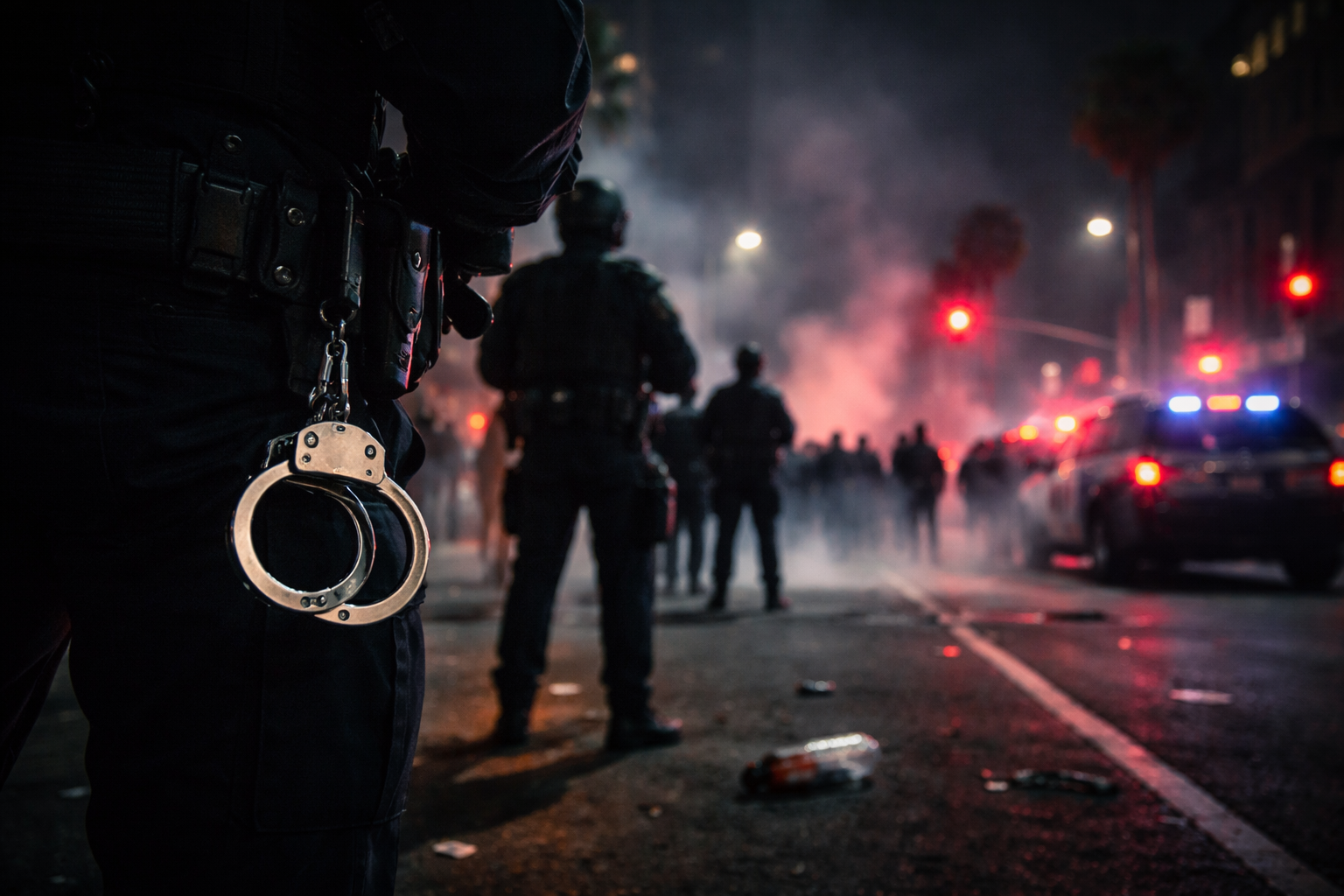
LA protest arrests after anti-ICE demonstrations: what’s confirmed, what’s disputed, and the legal next steps to watch over the next 48 hours.
Arrests after LA protests: what’s confirmed, what’s disputed, what’s next
Multiple outlets and officials report arrests following large anti-ICE demonstrations in downtown Los Angeles, including near federal facilities.
The basic shape of the story is clear: daytime crowds were largely peaceful, then smaller late-night clusters clashed with law enforcement, dispersal orders were issued, and arrests followed.
One procedural detail matters more than most coverage suggests: until charging documents and arrest reports surface, “arrest counts” are a rough headline—not a full legal picture.
The story turns on whether most arrests were “failure to disperse” processing—or whether prosecutors pursue a smaller set of higher-intent charges tied to specific violence, property damage, or federal jurisdiction.
Key Points
Officials reported 50 arrests after a Saturday-night downtown protest, with most tied to failure to disperse and additional arrests tied to more serious allegations, including assault with a deadly weapon and vandalism.
After the prior night’s unrest, officials reported eight arrests (including one for alleged assault with a deadly weapon on an officer, one curfew-related arrest, and others described as failure to disperse).
“Detained,” “arrested,” “cited and released,” and “booked” can describe very different legal outcomes—and the paperwork usually clarifies this only later.
Organizers and local reporting described the daytime crowds as overwhelmingly peaceful, while police described late-night “agitators” throwing objects and triggering dispersal orders and tactical alerts.
The next verification step is concrete: booking data + charging decisions + First court appearances (often within a tight window) will separate headline noise from legal reality.
Background
The demonstrations in Los Angeles were part of a broader “ICE Out” wave tied to opposition to federal immigration enforcement and calls for coordinated protest and economic pressure. Local reporting describes a major downtown gathering that moved toward federal detention facilities, with tensions rising later in the day.
Police updates and local coverage describe dispersal orders and a declared unlawful assembly near federal buildings after reports of fireworks and objects being thrown, followed by arrests and overnight closures in the downtown area.
Analysis
Timeline of events (confirmed facts)
On Jan. 30, thousands gathered downtown; reporting describes the daytime demonstration as largely peaceful, with a dispersal order issued later as night fell and clashes followed near federal facilities.
On Jan. 31, reporting describes continued downtown protest activity and escalating nighttime tension. Police reported dispersal orders and an unlawful assembly declaration, with arrests occurring in the same time window.
By the end of the weekend’s protests, police reported 50 arrests tied to Saturday night, while separate reporting earlier in the night referenced at least two dozen people detained as the situation developed—suggesting the count moved as processing continued.
Arrest numbers and what they mean legally
An arrest total can compress several different outcomes:
Some people are cited and released quickly with a promise to appear in court. Others are booked (fingerprints, records check, formal entry into custody) and then released later. A smaller subset may be held for review or for bail decisions, especially if there are allegations of violence, property damage, or prior case complications.
matters because two people can both be “arrested,” but one walks out in an hour with paperwork while another faces a longer custody chain and stricter conditions.
Police statements vs organizer claims (kept separate)
Police framing (official and reported): The Los Angeles Police Department described late-night activity involving objects thrown (including fireworks, rocks, and bottles), dispersal orders, and an unlawful assembly near federal buildings, with arrests following—many tied to failure to disperse.
Organizer and local-reporting framing: Local reporting described the daytime downtown demonstration as overwhelmingly peaceful, with clashes associated with smaller nighttime groups. Broader organizer descriptions emphasize coordinated protest activity across locations, including a “day of action” and calls for economic shutdown tactics.
These two frames can both be true at once—because they often describe different time slices of the same day.
What evidence would settle disputed points
If any part of the narrative is contested (for example, who initiated force, whether dispersal orders were audible/clear, or whether specific individuals committed specific acts), the stabilizing evidence tends to be boring and procedural:
Body-worn camera footage, fixed security video, time-stamped dispersal order audio, incident commander logs, booking timestamps, and—most decisive—charging documents that specify probable cause allegations.
In practice, the first public “settlement” of disputes often comes from the charging choices: whether prosecutors stick to mass-processing misdemeanors or elevate a smaller set into felony-level or federal filings.
Law and procedure: the next-steps lens
“Failure to disperse” in California is commonly tied to Penal Code provisions that criminalize remaining at an unlawful assembly after being lawfully warned to leave; the statutory text for unlawful assembly and refusal to disperse is straightforward, but applying it cleanly depends on warnings, timing, and individual conduct.
For low-level misdemeanors in Los Angeles County, release can follow structured pre-arraignment categories like “cite and release” or “book and release,” and the protocol notes arraignment timing typically occurs within a short window (with practical weekend/holiday effects).
Where the federal layer becomes real is location and conduct: events near federal buildings and allegations involving attacks on federal officers or serious interference can be routed into federal statutes—especially if the government frames acts as civil disorder connected to federally protected functions.
What Most Coverage Misses
The hinge is simple: the legal story won’t be defined by the crowd size—it will be defined by charging selection.
Mechanism: when police report large numbers arrested for failure to disperse, many cases can resolve quickly (cite/book-and-release, short court calendars, dismissals, or pleas). But if prosecutors identify a smaller set tied to specific acts—property damage, weapon allegations, assaults, or federal-facility conduct—the procedural tempo changes: longer detention risk, higher bail exposure, and a more aggressive litigation posture.
Signposts to watch: within days, look for (1) the first batch of charging documents describing specific conduct and (2) whether filings land in local misdemeanor court versus federal court. Those two signals will tell you whether this becomes a mass-processing episode or a targeted prosecution campaign.
What Happens Next
In the next 24–72 hours, the key events are administrative, not dramatic: booking outcomes, release conditions, and the first wave of court dates. If many arrests were for failure to disperse, a significant portion may be resolved through citations, releases, or quick initial appearances.
Over the next few weeks, the fork becomes clear: either the system treats the weekend as primarily a misdemeanor-level public order issue, or prosecutors pursue a narrower set of escalated cases (including potential federal filings where conduct is alleged near federal property or against federal personnel). This matters because it changes cost, risk, and deterrence dynamics for everyone involved.
For the city, the near-term pressure point is operational: extended deployments and tactical alerts strain staffing and budgets and may drive sharper enforcement decisions if more demonstrations are expected.
Real-World Impact
A family member spends the night refreshing jail and hospital dashboards, not knowing whether “detained” means a citation or a booking delay.
A small business owner boards up early, not because they expect mass violence, but because a single late-night clash can bring closures and broken windows.
A working professional with no prior record learns—fast—that misdemeanor processing can still mean fingerprints, missed shifts, and multiple court dates.
A legal observer or journalist recalibrates where to stand and how to document dispersal orders, because the most consequential facts are often the ones that never make the first viral clip.
The 48-Hour Verification Window
Right now, the verified core is narrow: large demonstrations happened, dispersal orders were issued after reported late-night clashes, and officials report arrests—many framed as failure to disperse, with a smaller number tied to more serious allegations.
What remains contested is the granular “who did what, when,” and whether police actions and protester actions escalated in predictable sequence or in contested ways. That won’t be settled by louder commentary. It will be settled by timestamps, video, and filings.
If there is a historical marker here, it will be that public protest moved into a procedural contest: the outcome will be written less by chants and more by charging choices, court calendars, and whether the next demonstrations stay broad and peaceful—or narrow into nighttime confrontation that invites escalation.
