Putin’s Logistics Network Is Under Attack as Ukraine Expands Its Drone War Across Russia
Ukraine Takes Its Drone Campaign Deeper Into the Russian Economy
Ukraine Destroys Russia’s ‘Amazon’ Warehouse Again as Deep-Strike Campaign Moves Into a New Phase
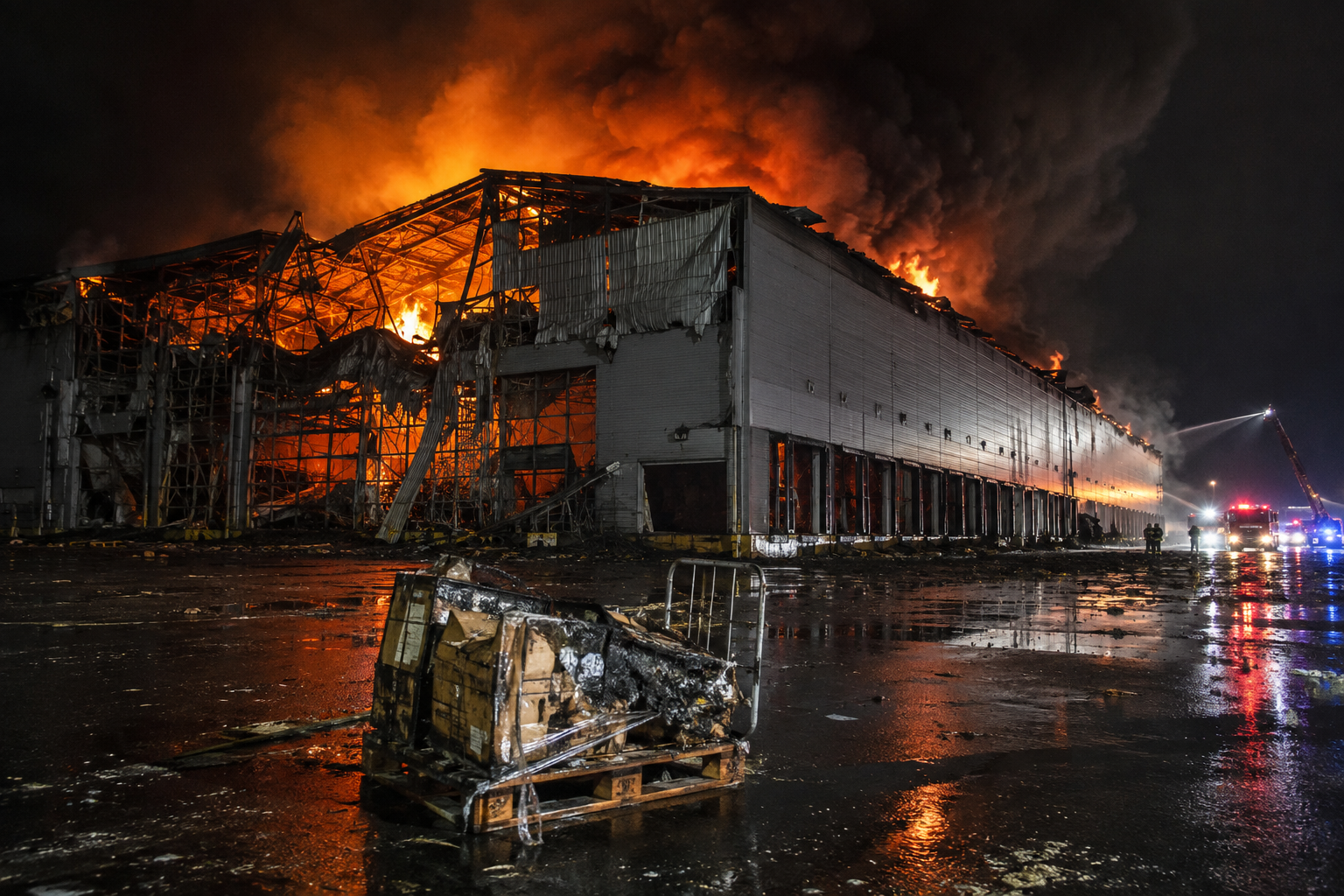
A huge logistics centre belonging to Russia’s biggest online retailer has been completely destroyed after a Ukrainian drone attack, delivering another blow to a company increasingly caught in Kyiv’s widening deep-strike campaign.
The Wildberries complex in Kotovsk, in Russia’s Tambov region, was consumed by a fire covering roughly 100,000 square metres — an area equivalent to about 14 football pitches. It was the second attack on the same depot in five weeks, and it came as Ukraine struck military, energy and logistics targets across Russia during another intense wave of long-range operations.
The Warehouse Was Completely Destroyed
Tambov Governor Yevgeny Pervyshov said the logistics centre was completely destroyed by the fire following the overnight attack on August 25–26. Wildberries confirmed that its facility had been attacked and evacuated, while new deliveries to the site were suspended.
Two people were injured. Russian authorities said a 19-year-old man suffered a concussion while a 49-year-old woman sustained a broken finger. The scale of the destruction was nevertheless enormous: earlier reports from the governor said flames had engulfed approximately one million square feet of warehouse space.
The facility had already been attacked on July 18. Seven Wildberries employees were killed in that earlier strike, meaning Ukraine has now returned to a target it had previously damaged rather than simply moving on after the first attack.
That is an important detail. Repeatedly attacking the same logistics infrastructure can frustrate attempts to restore operations, force companies to reroute supplies and make investment in repair more difficult to justify while the threat remains.
Why Wildberries Has Become Such a Significant Target
Wildberries is Russia’s biggest online retailer and has become so dominant that it is frequently compared with Amazon.
What once looked like an unusual choice of target has now become a recognisable part of Ukraine’s campaign. Wildberries facilities have been repeatedly struck since mid-July, while Ukraine has recently widened its focus to include Ozon, the company’s principal e-commerce rival.
By mid-August, Ukrainian authorities said seven of Wildberries’ ten largest logistics centres had been struck and knocked out of operation during the campaign. That included the company’s enormous 250,000-square-metre hub at Koledino in the Moscow region.
Ukraine argues that goods passing through or sold by these commercial networks include equipment and technical components used by Russian military forces. The exact military relevance of every warehouse and shipment cannot be independently established, so it would be wrong to treat every product inside a commercial depot as military cargo.
But the wider strategic logic is becoming difficult to miss.
Warehouses are the connective tissue of an economy. Destroying one does not just eliminate a building. Inventory must be redirected, trucks must travel different routes, neighbouring depots absorb extra demand, delivery schedules become less predictable and companies have to decide whether reconstructed facilities will simply be attacked again.
Ukraine Is Turning Logistics Into a Battlefield
The most important part of this strike may therefore be the pattern surrounding it.
Wildberries is no longer the only major online retailer experiencing repeated attacks. Ozon facilities in several regions have also recently been hit, demonstrating that Ukraine’s pressure on Russia’s logistics economy is broadening beyond a single company.
That represents an evolution from the better-known campaign against oil refineries.
For much of the deep-strike war, Ukraine concentrated heavily on petroleum infrastructure because Russia’s energy sector generates export revenue, supplies domestic fuel and supports the military economy. Refineries also contain specialised equipment that can be difficult and expensive to replace.
That campaign has not stopped.
On the same night as the Kotovsk warehouse attack, Ukraine’s General Staff said its forces struck a major Lukoil refinery in Kstovo in the Nizhny Novgorod region. The plant has annual processing capacity of roughly 125 million barrels, and Ukrainian authorities said a fire followed the attack.
The difference now is that energy facilities are increasingly only one part of the target set.
Zelenskyy Says 16 Russian Targets Were Hit in One Day
President Volodymyr Zelenskyy said Ukrainian forces struck 16 targets inside Russia over the previous 24 hours.
He identified oil infrastructure, airfields, a missile unit, a military facility and logistics infrastructure among the categories attacked. Zelenskyy described the oil strikes as attacks on the financial base that helps Russia fund the war and said Ukraine intends to increase the cost imposed on Moscow.
That fits a strategy Zelenskyy made unusually explicit earlier this month.
On August 10, the Ukrainian president said there would be more Ukrainian deep strikes and revealed that military commanders had adjusted their targets and priorities. He pointed to an attack on oil-refining infrastructure in Tobolsk, Siberia, more than 2,500 kilometres away, as evidence of how far Ukrainian systems could now reach.
Distance, in other words, is becoming less useful as a Russian defence.
Russia once enjoyed an enormous structural advantage from its geography. Factories, oil installations, military bases and logistics centres hundreds or thousands of kilometres from Ukraine could operate largely beyond the conventional battlefield.
Long-range drones are eroding that assumption.
Russia Cannot Defend Everything
This is the strategic problem Ukraine is trying to create for Moscow.
Russia is the largest country in the world. That gives it extraordinary geographical depth, but it also creates an immense number of potential targets that must now be considered vulnerable.
Oil refineries need protection. Military airfields need protection. Ammunition infrastructure, ports, industrial plants, rail hubs, warehouses and major cities need protection.
Every air-defence battery moved to guard a logistics centre cannot simultaneously protect an airfield somewhere else. Every interceptor fired at a relatively inexpensive drone consumes resources. Every company forced to construct shelters, electronic-warfare defences or physical protection incurs another cost.
Ukraine does not need every drone to penetrate Russian defences for this strategy to matter.
Russian officials said 426 Ukrainian drones were shot down overnight across 15 Russian regions and occupied Crimea during the wider attack. Such figures cannot independently establish either the total launched or the real interception rate, but the claimed scale alone demonstrates the defensive burden Moscow says it is confronting.
The question increasingly becomes not whether Russia can defend an individual building, but how many important buildings it can protect simultaneously.
Putin Has Already Responded
The consequences have reached the Kremlin.
President Vladimir Putin has authorised the Russian state to take temporary control of critical infrastructure where private owners fail to protect facilities adequately from drone attacks or fail to restore damaged sites. The measure effectively increases pressure on companies themselves to harden vulnerable infrastructure and return damaged assets to operation.
That response is revealing.
A deep-strike campaign does not have to collapse an economy to impose meaningful costs. If businesses must spend more on air defence, insurance, reconstruction, alternative warehouses, rerouting and redundancy, Ukraine is forcing economic resources into protection rather than productive activity.
The effect becomes more significant when several sectors are pressured simultaneously.
Oil facilities create one repair problem. Warehouses create another. Airfields require hardened shelters and air defence. Military-industrial sites require dispersion or additional protection. Ports and railways create still different vulnerabilities.
Russia can respond to all of them.
Doing so cheaply is much harder.
Civilians Are Also Being Killed
There is another side to the expanding campaign that cannot be ignored.
The attacks are increasingly occurring around large commercial sites, industrial districts and populated areas. Russian authorities said two people were killed in the neighbouring Lipetsk region when a drone fell onto a house and started a fire during the same overnight wave. A woman was also reported killed in Belgorod.
Russia continues to launch its own large-scale missile and drone attacks against Ukraine, where thousands of civilians have been killed since the full-scale invasion began. On Wednesday, Ukrainian emergency authorities said a woman and a four-year-old child were killed in a Russian strike on a residential building in the Chernihiv region.
But the widening range and volume of Ukrainian operations inevitably raises the danger to civilians inside Russia as well.
That risk becomes particularly acute when the target is not an isolated military base but a huge commercial facility employing civilian workers.
Ukraine’s Deep-Strike Campaign Is Becoming a System
The significance of Kotovsk is therefore larger than the warehouse that burned.
A single destroyed depot could be repaired, replaced or bypassed. A campaign repeatedly attacking major warehouses across a continent-sized logistics network creates a different problem.
Russia must decide which facilities matter most, which can be defended, which should be dispersed and which companies will have to absorb the cost themselves.
At the same time, Ukraine continues attacking refineries, airfields and military infrastructure.
This is increasingly a campaign built around accumulation rather than one spectacular strike. The aim appears to be to force Russia to defend more territory, spend more money, rebuild more infrastructure and accept that the economic rear of the war is no longer reliably beyond reach.
That does not mean Ukraine can cripple the Russian economy through drones alone. Russia retains huge industrial capacity, extensive transport infrastructure and the ability to repair and reroute around damaged assets.
But the strategic equation has changed.
When the same 100,000-square-metre warehouse can be attacked twice in little more than a month — and the second attack ends with the facility completely destroyed — rebuilding is no longer the end of the problem.
The next question is whether the replacement can survive the next wave.
