RAF Fairford Mystery Deepens After Suspect Apparently Called Police Before Local Farmer Raised Alarm
RAF Fairford Mystery Deepens
A Strange New Twist In The RAF Fairford Investigation
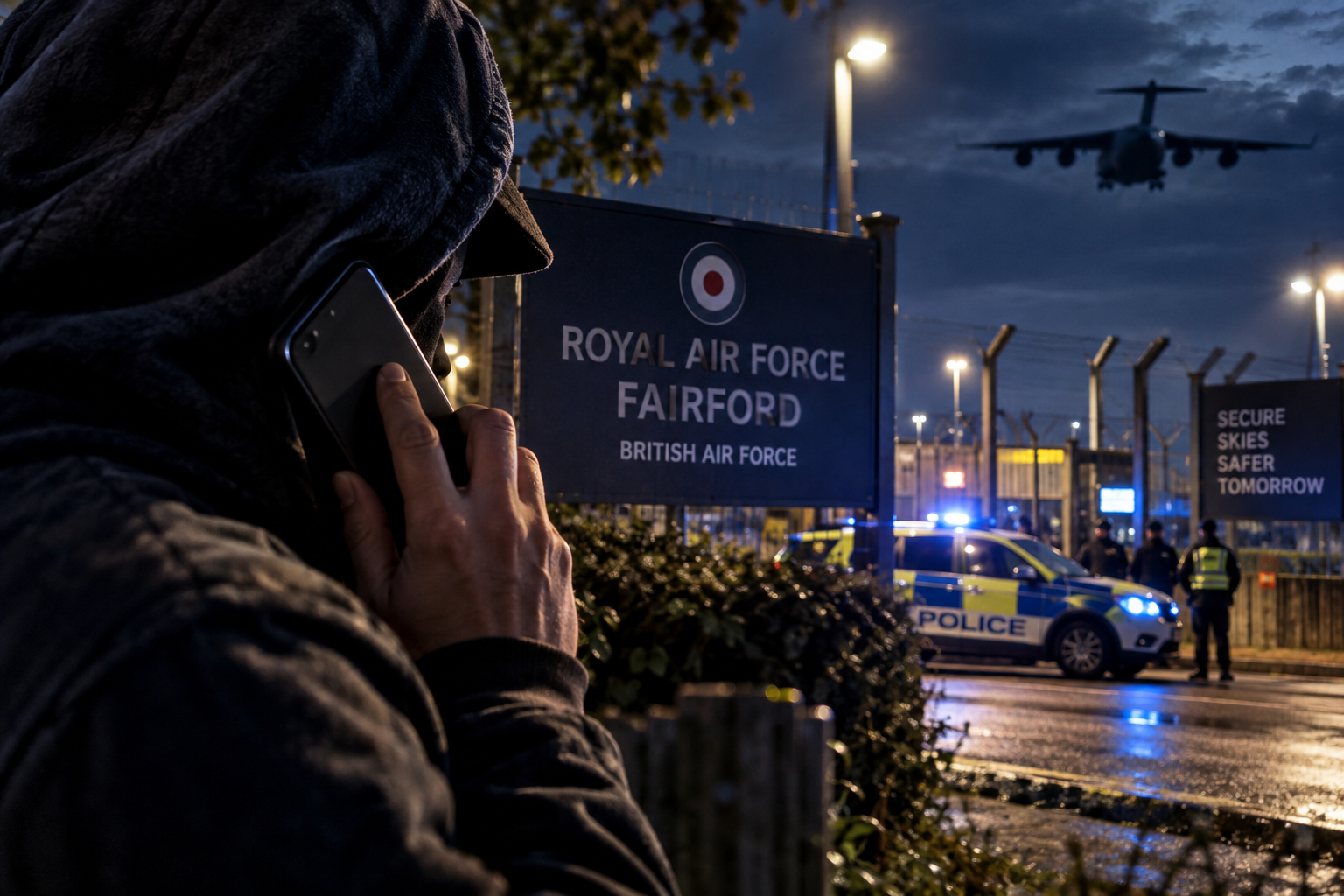
One of the five men arrested near RAF Fairford is understood to have contacted police before the farmer whose 999 call became one of the defining moments of the case.
That detail changes the public timeline of an incident that has already produced more questions than answers. The man, in his 20s and from London, is understood to have contacted police roughly an hour before the farmer called 999 at 1.36am on Sunday, 27 September.
Police have not publicly explained why the suspect called, what he said or whether he was reporting the same events later witnessed by the farmer.
That gap now matters.
The First Call Came Earlier Than Many Realised
The first official police account said officers received information at around 12.45am about three suspicious vehicles that appeared to be travelling towards RAF Fairford.
Armed officers responded. Five men were arrested in the Whelford area, initially on suspicion of offences under the Explosives Act and later on suspicion of preparation of a terrorist act under Section 5 of the Terrorism Act.
The farmer’s account became prominent because of what she said she saw.
She described encountering three white vans blocking the road near her farm before seeing a group of hooded or masked men. She said she first tried to contact Ministry of Defence police, then called 999 at 1.36am.
The new information means police had already been contacted before that emergency call.
One of the suspects is understood to have made that earlier contact.
Exactly why remains unexplained.
Why The Suspect’s Call Matters
A suspect contacting the police does not automatically point towards innocence, guilt, confusion or any particular motive.
Without knowing what was said, there are many possible explanations. Investigators will be able to examine the call itself, its timing, the phone used, the caller’s location and whether anything said during it matches what officers later found.
The important point is narrower.
The call may help detectives reconstruct what was happening before the arrests and may explain why the police response developed as quickly as it did.
Counter Terrorism Policing has said that the response was activated because of a range of information received. That wording is now significant because the public story initially focused heavily on the farmer’s intervention.
The earlier call shows the operation cannot be understood through one tip-off alone.
It also makes the precise sequence of events more important.
Taylor Tailored’s earlier examination of what police were trying to establish from the three vans centred on the same problem: the physical scene can be documented, but intent is harder to prove.
The unexplained call sits directly inside that evidential gap.
Petrol Was Found, But No Explosive Devices
The investigation has also changed in another important way.
Counter-terror investigators have said no improvised explosive devices were found during examinations connected to the three vans.
A quantity of petrol was recovered.
That distinction is substantial.
The men were arrested on suspicion of explosives offences and later on suspicion of preparing a terrorist act, but an arrest records suspicion at that stage of an investigation. It is not a charge, a conviction or proof that a workable explosive device existed.
The absence of an improvised explosive device does not end the inquiry either.
Police can investigate suspected preparation, intent, reconnaissance, coordination, foreign-state activity or other alleged conduct even when no completed device is recovered. Equally, the seriousness of the original arrests does not establish what the final evidence will show.
All five men were released on police bail on Monday under stringent conditions and remain under investigation.
Taylor Tailored has already examined why suspects can be released on bail during a serious counter-terror investigation.
Their release did not close the case.
The Farmer’s Account Still Matters
The earlier call does not erase the importance of the farmer’s account.
Her 999 call gave police a direct account from someone at the scene who said she had encountered the vans and seen a group of masked or hooded men.
She has also said she believed she saw more people than the five who were later arrested.
That claim has not been established as proof that additional suspects escaped. It remains one part of the evidence investigators may need to test against CCTV, mobile-phone records, vehicle data and witness accounts.
The existence of an earlier call instead makes the timeline more complicated.
Police may now have at least two separate strands of information from the period before the arrests: the suspect’s apparent contact with police and the farmer’s later emergency call.
How those calls relate to each other is one of the unanswered questions.
RAF Fairford Makes The Case More Sensitive
The location has ensured that the investigation carries consequences far beyond one Gloucestershire road.
RAF Fairford is a strategically important military site used by United States forces and has supported operations connected to the conflict involving Iran.
That has placed the incident inside a much wider national-security debate.
British investigators have been examining whether anyone involved could have been acting knowingly or unknowingly on behalf of a foreign state. Iran has denied involvement.
The broader issue is explored in Taylor Tailored’s analysis of why the Fairford investigation has triggered wider concern around military bases and state-backed threats.
Foreign involvement remains a question for investigators, not something established by the suspect’s phone call.
The same caution applies to theories that the men were conducting surveillance, testing security or preparing some other kind of operation. Those possibilities may be examined, but they should not be turned into facts before evidence supports them.
What Investigators Will Want To Know
The suspect’s call may ultimately be important because it can be compared against almost every other part of the case.
Investigators can establish where the caller was when the call was made. They can compare his account with the movements of the vans. They can identify whether he referred to other people. They can test his words against CCTV, mobile data and the later testimony of witnesses.
They can also determine whether the call came before, during or after whatever activity first caused concern around the vehicles.
Most importantly, police will know what the public does not yet know: what the caller actually said.
That may eventually make the strange detail easier to understand.
For now, it does the opposite.
The public version of the RAF Fairford incident began with three suspicious vans, a local farmer and a rapid armed response. The emerging timeline now shows that one of the men later arrested had apparently contacted police himself before the farmer raised the alarm.
Until investigators explain why, that call remains one of the most unusual unresolved details in the case.
Sources
Counter Terrorism Policing — Update on RAF Fairford investigation, 28 September 2026 — Confirms five arrests, subsequent police bail and that the response followed information received about suspicious vehicles.
The Guardian — Suspect in RAF Fairford case called police to report incident — Supports the report that one suspect called police before the arrests and details the unresolved reason for the call.
The Independent — RAF Fairford suspect called police an hour before farmer raised alarm — Supports the reported timing of the suspect’s call relative to the farmer’s 1.36am 999 call and the finding of petrol but no explosive devices.
Next Reads
Three Vans, A Bomb Robot And An RAF Base: What Police Are Trying To Establish At Fairford — A deeper look at the physical evidence, intent and unanswered questions at the centre of the investigation.
Five RAF Fairford Terror Suspects Released On Bail — Why Police Let Them Go And What Happens Now — Explains what police bail means in a serious counter-terror inquiry and why release does not end an investigation.
Britain’s Military Bases Are Now On Alert For A Threat That Could Reach Far Beyond RAF Fairford — Places the Fairford incident inside the wider security debate around military sites and possible state-backed threats.
