

Russia’s 20-Hour Assault: The War Crosses a New Line as Strikes Hit Rescuers Mid-Operation
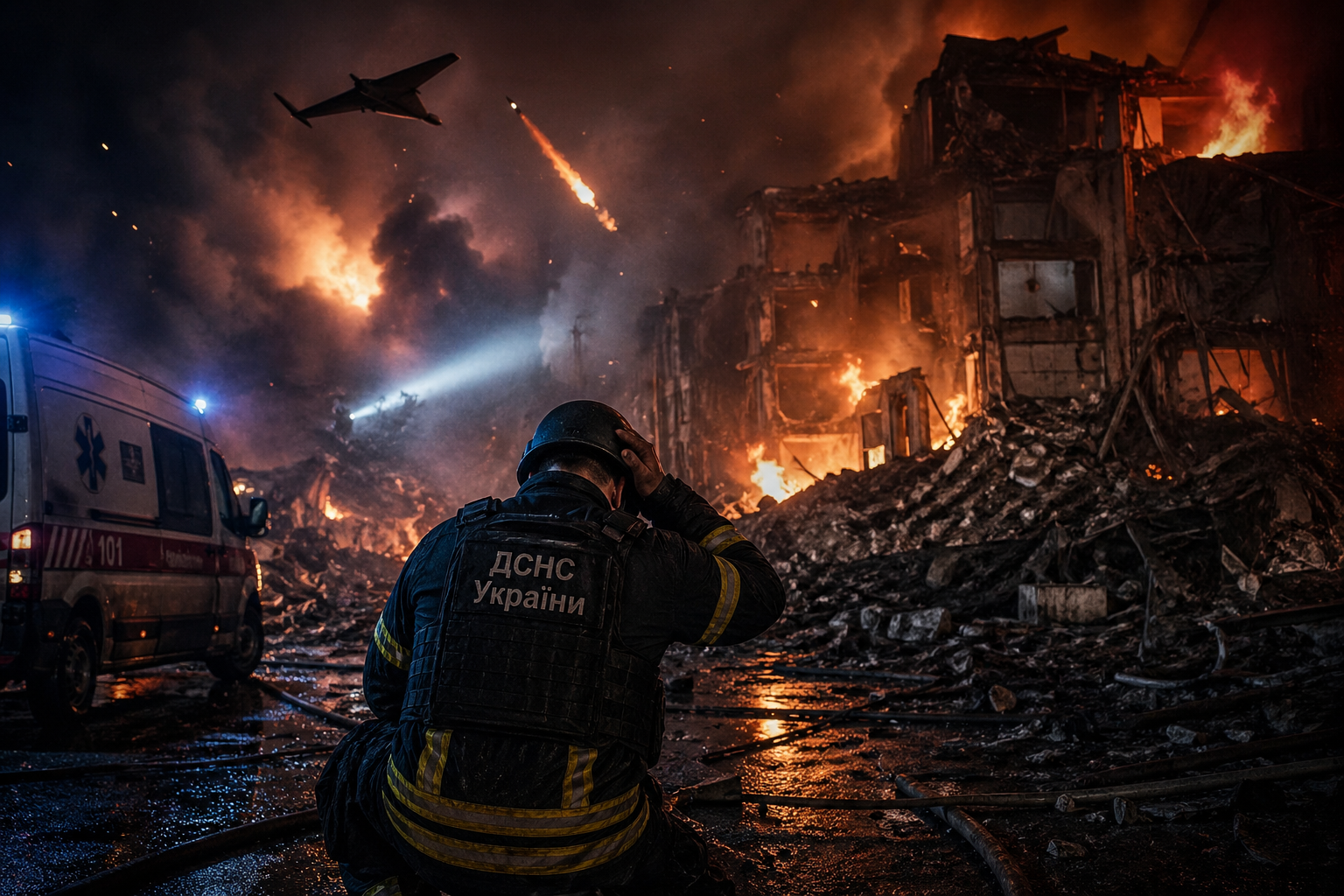
Inside the 20-Hour Bombardment That Redefined Escalation
The Second Strike: When Rescue Efforts Became Targets
A prolonged, multi-wave bombardment that struck the same site twice—including during rescue efforts—signals a calculated escalation in both tactics and psychological warfare
For more than 20 relentless hours, one Ukrainian city was not simply attacked — it was systematically revisited.
Missiles and drones came in waves. Not a single overwhelming strike, but a sequence. Impact. Pause. Impact again.
And then, at the most revealing moment of all, the second strike hit the same location—while rescuers were already digging through the rubble.
That detail changes everything.
This was not just an attack. It was a pattern.
What Actually Happened
The assault unfolded over an extended period, stretching from overnight into daylight hours. Hundreds of aerial weapons — including drones and missiles — were launched in coordinated phases.
Residential buildings were hit
Emergency services deployed immediately
Survivors began to be pulled from debris
Then the site was struck again
The repeated targeting was not incidental. It followed a rhythm: initial destruction, then disruption of response.
Casualties mounted into the dozens, with deaths confirmed and many more injured across the region.
This was one of the most sustained and intense attacks the city has faced since the war began.
Why the Second Strike Matters More Than the First
The first strike destroys everything.
The second strike sends a message.
When a site is hit again during rescue operations, the objective expands beyond physical damage. It begins to target:
Emergency response systems
Medical capacity under pressure
Civilian morale
Decision-making under fear
In military logic, this is about denying recovery.
If responders cannot safely operate, every initial strike becomes more lethal. Every delay costs lives.
And every rescue becomes a risk calculation.
The Shift Toward Multi-Wave Warfare
This was not an isolated incident — it reflects a broader shift.
Recent attacks show a move away from single, concentrated barrages toward layered, time-staggered strikes that stretch across hours.
The difference is subtle but significant:
Old pattern: overwhelm air defences in one surge
New pattern: sustain pressure, exhaust systems, then strike again
This creates a different kind of battlefield.
Not just one moment of chaos, but prolonged instability.
Air defense systems must remain active for longer. Civilians remain exposed. And the line between “attack phase” and “aftermath” disappears.
What Media Misses
The focus often stays on numbers — how many drones, how many missiles, how many casualties.
But the real shift is structural.
This is about time as a weapon.
A 20-hour attack does something a 20-minute attack cannot:
It drains response capacity
It creates psychological exhaustion
It forces continuous exposure rather than a single shock
The second strike is not just another explosion. It is the confirmation that the attack is not over—even when it appears to be.
That uncertainty is the strategy.
The Wider Escalation Signal
This attack did not happen in isolation.
Across the conflict, aerial warfare has intensified:
Hundreds of drones launched in single operations
Missile strikes coordinated with drone swarms
Increasing reach, including incidents near or beyond borders
Recent operations have involved hundreds of drones and dozens of missiles in a single wave, stretching defensive systems and testing regional stability.
At the same time, retaliatory strikes have reached deep into opposing territory, hitting infrastructure far from the front lines.
The result is a widening battlefield—not just geographically, but tactically.
The Strategic Logic Behind It
At its core, this pattern reflects three overlapping goals:
1. Overwhelm Without One Decisive Moment
Instead of a single, massive strike, the aim is to stretch defenses thin over time.
2. Deny Recovery
By hitting the same location again, the ability to respond becomes part of the target.
3. Sustain Psychological Pressure
The uncertainty of “when the next wave comes” becomes a weapon in itself.
This is not just about destruction. It is about control — of time, space, and reaction.
What Happens Next
If this pattern continues, three developments become likely:
Most Likely
More multi-wave attacks targeting urban centers, combining drones and missiles in staggered phases.
Most Dangerous
Repeated strikes on rescue operations become normalized, increasing casualties beyond initial impact.
Most Underestimated
Long-duration attacks begin to strain not just military systems but civilian resilience—power, healthcare, and emergency response.
The battlefield expands without moving.
The Real Meaning of the Strike
This was not simply one of the largest attacks on a single city.
It was one of the clearest signals yet that the war is entering a phase where timing, repetition, and disruption matter as much as raw firepower.
The first explosion destroys buildings.
The second destroys certainty.
And once certainty is gone, the entire system—response, safety, and recovery—begins to fracture.
That is the deeper shift.
And it is far harder to defend against.
