Six Killed As Missiles And Hellfires Turn Global Shipping Lanes Into A War Zone
Iran War Spreads To Sea As Deadly Ship Attack Rocks Global Trade
Six People Were Killed Near Yemen
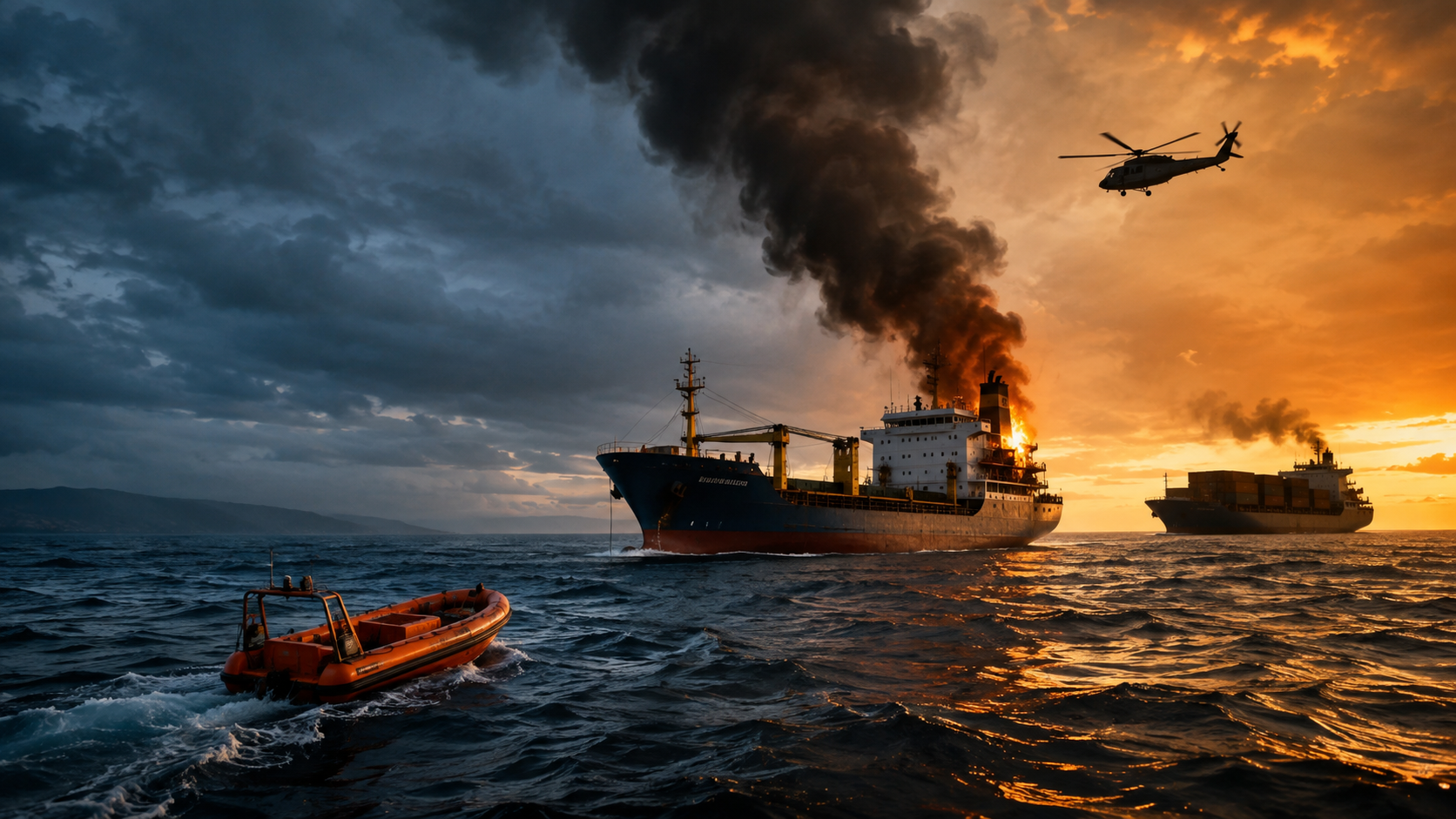
Six people were killed when the cargo ship Tihamah came under attack in the Bab al-Mandeb Strait on Tuesday, August 11. Yemen’s internationally recognized government blamed the Iran-aligned Houthi movement, saying three ballistic missiles struck the vessel and triggered a major fire.
The dead included three Pakistani crew members and one Indonesian sailor. Two Yemeni rescuers were also killed after emergency personnel arrived at the stricken vessel, according to Yemen’s Coast Guard. Ten other people were injured, including seven crew members and members of the rescue force.
The alleged second strike is especially disturbing because it appears to have hit the area while casualties were being evacuated. If the official account is confirmed in full, the attack was not merely another attempt to damage a commercial ship—it turned a rescue operation into part of the battlefield.
The Houthis subsequently said they had attacked a ship carrying Saudi military equipment, but did not identify the vessel. That cargo claim has not been independently established. Available shipping information instead connects the Tihamah to Egyptian and Yemeni commercial interests, while the vessel was reportedly sailing under the Tanzanian flag.
American Hellfires Struck Another Commercial Ship
Hours away by sea, another confrontation was unfolding in the Gulf of Oman. US forces fired two Hellfire missiles at the Panama-flagged container ship Vela Nova, which Washington accused of ignoring repeated warnings and attempting to violate its blockade of Iranian ports.
US Central Command said an MH-60 Navy helicopter targeted the ship and disabled its steering equipment. A fire broke out aboard the vessel, but all 17 crew members were accounted for and no fatalities were confirmed.
The incident occurred approximately 71 nautical miles from Pakistan, far beyond the immediate entrance to any Iranian harbor. Its location demonstrates how widely the maritime front has expanded: commercial vessels can now encounter military enforcement across the Gulf of Oman, the approaches to Hormuz and parts of the Arabian Sea.
The earlier confrontation involving the Vela Nova already showed that President Donald Trump’s blockade was not an empty threat. The latest confirmation makes the position even clearer. Ships that refuse American orders while approaching Iran could be physically disabled, regardless of their flag.
Two Global Chokepoints Are Now Under Fire
The attacks occurred near opposite ends of the Middle East’s most strategically important maritime system. Bab al-Mandeb controls access between the Gulf of Aden and the Red Sea, connecting Asian shipping with the Suez Canal. The Gulf of Oman leads directly toward the Strait of Hormuz and the energy-producing states of the Persian Gulf.
Hormuz is the most important oil chokepoint in the world. Before the war, approximately 20 million barrels of oil and petroleum products passed through it each day—equivalent to roughly one-fifth of global consumption. Around one-fifth of worldwide liquefied-natural-gas trade also used the route, according to official US energy data.
Bab al-Mandeb has become even more important because Saudi Arabia has been redirecting oil toward its western coast to reduce its dependence on Hormuz. The latest US energy outlook estimates that petroleum flows through Bab al-Mandeb increased to an average of 8.1 million barrels per day during the second quarter of 2026.
That creates a dangerous strategic trap. Hormuz is being squeezed by Iran and the American blockade, while one of the principal alternative routes is exposed to Houthi missiles. The escape route from one crisis is moving directly into another.
Civilian Crews Are Becoming Front-Line Targets
The six deaths aboard and around the Tihamah mark the first confirmed fatalities in a Houthi maritime attack since the US-Israel war against Iran began on February 28. They also expose the people carrying the true physical risk of a conflict increasingly fought through blockades, shipping restrictions and attacks on commercial infrastructure.
Merchant sailors are not abstract pieces on a geopolitical map. They are civilian workers operating fuel tankers, container ships and bulk carriers through waters where a radar warning, suspected cargo connection or misunderstood instruction can now precede missile fire.
The danger has been building for months. Three crew members were initially feared dead as the Red Sea crisis turned lethal, before authorities established the higher toll of four sailors and two rescuers.
Shipping companies must now calculate far more than fuel and journey time. They must consider war-risk insurance, crew refusal, naval instructions, missile threats and whether a vessel’s previous ports of call could attract military scrutiny. Those calculations can redirect ships around Africa, delay cargoes and increase the cost of everything from energy to manufactured goods.
The Iran War Is Building A Maritime Siege
Iran has used restrictions around the Strait of Hormuz as leverage against Washington, while the United States has imposed its own blockade on Iranian ports. The Houthis have separately threatened a maritime embargo against Saudi Arabia, creating overlapping pressure zones stretching from the Persian Gulf to the Red Sea.
This is why the Iran war cannot be understood through airstrikes alone. Its economic center of gravity lies at sea, where relatively small numbers of missiles, drones and warships can influence the movement of vast quantities of energy and cargo.
Ship-tracking estimates show how severe the disruption has become. Only eight vessels were tracked through Hormuz on Tuesday, compared with the roughly 130 to 140 daily transits recorded before the war. Bab al-Mandeb remained busier, but the fatal attack has given shipping companies another reason to reconsider that route.
The world is therefore confronting something more dangerous than two isolated attacks. A commercial ship has burned with sailors aboard near Yemen. Another has been disabled by American missiles in the Gulf of Oman. Between them sit oil fields, ports, naval forces and waterways that the global economy cannot easily replace.
Six people have already paid the price. The next consequences could travel far beyond the Middle East.
