The AI Shares Fell, but South Korea’s Chip Orders Told a Different Story.
A share trader and a semiconductor manufacturer can look at the same data centre and see different things. The manufacturer has an order for memory chips. The shareholder wants to know whether the company building the centre will eventually earn enough to justify the bill. The Bank of Korea drew attention to both sides of that divide on Thursday, when it raised its base rate from 3% to 3.25% and substantially increased its forecasts for economic growth.
The quarter-point increase on 26 November resumed the bank’s tightening after an October pause. Reuters reported that 32 of 34 analysts it surveyed had expected the move. The larger change came in the economic outlook. In August, the bank had expected the South Korean economy to grow by 2.9% in 2027. It now expects 4.1%. That revision of 1.2 percentage points helps explain why officials saw a reason to raise borrowing costs even as technology shares had been falling.
Where the Growth Is Coming From
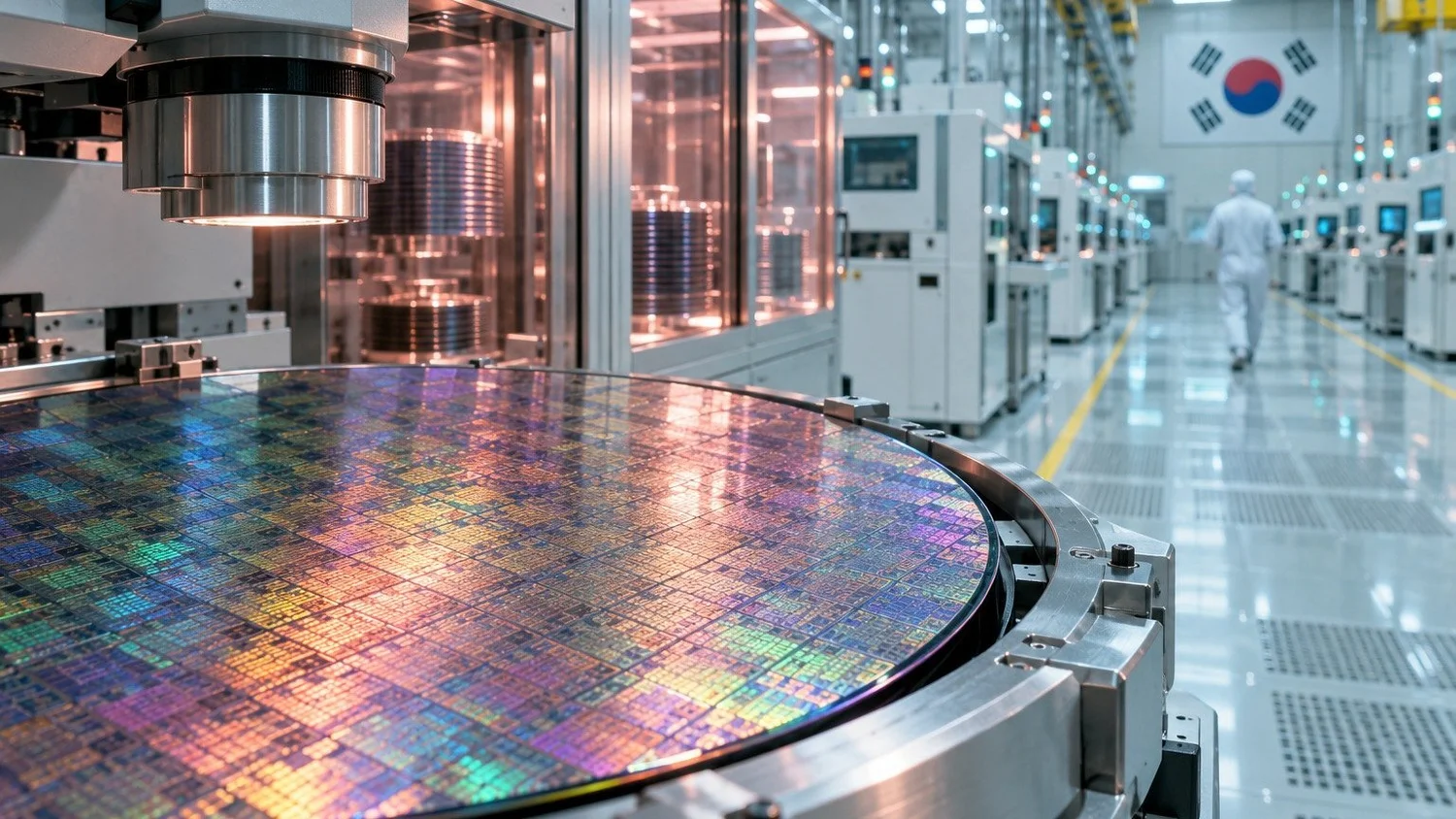
The bank identified exports and investment as the principal sources of current strength, with semiconductors expected to sustain both. South Korea sits on the manufacturing side of the international race to build AI infrastructure. Orders placed abroad can keep domestic production lines busy and give suppliers a reason to invest in equipment. The economic effects arrive as businesses manufacture, ship, hire and spend.
There is a second step before that expansion becomes a broadly felt rise in living standards. Export income has to reach domestic demand through wages, purchases from other firms, taxes or investment. The bank expects improving incomes and government spending to help consumption recover. It also explicitly identifies the extent of the spillover from semiconductors as an uncertainty. A stronger national output figure can coexist with a household that sees little improvement in its monthly budget.
The revisions for the two calendar years illustrate the scale of the shift. The bank raised its 2026 growth estimate from 3.3% to 3.9%, a rise of 0.6 percentage points. The revision for 2027 was twice that size. A projection of faster growth next year incorporates an expectation that some of today’s momentum will persist. It is also the part of the forecast most exposed if overseas customers change their plans.
Why Raise Rates When a Major Industry Is Doing Well?
To a worker at a successful exporter, a rate rise can feel like a penalty for the company winning business. Monetary policy works across the economy. The board must consider the balance between spending and the ability of businesses to supply what customers want. If demand spreads at a time when firms are already passing on higher costs, price increases can persist beyond the original shock.
October’s consumer price inflation was 2.8%. So was core inflation, which excludes food and energy. The bank highlighted increases in personal services and durable goods. That detail matters because a policymaker deciding whether to wait for an oil shock to pass needs to know what is happening elsewhere in the shopping basket. Similar headline and core readings gave the board grounds to look beyond petrol and imported fuel.
The forecasts make the board’s concern more precise. It expects consumer price inflation of 2.7% this year and 2.4% next year. It projects core inflation of 2.6% in both years. A lower headline figure next year would still leave underlying pressures that officials expect to last. The outlook depends partly on oil prices and the exchange rate, but also on wages and the strength of domestic spending.
What Does a Quarter Point Mean for a Borrower?
A rise of 25 basis points is a rise of one quarter of a percentage point. On an illustrative outstanding balance of 100 million won, passing that increase through in full for an entire year would add 250,000 won in simple interest, or just under 21,000 won a month. The example holds the balance constant and leaves out fees. An actual repayment loan has a changing balance, and a fixed-rate borrower may see no immediate change at all.
Funding conditions influence the rates banks offer and the decisions borrowers make, but the central bank does not reset every mortgage contract on announcement day. That delay is part of the policy problem. Officials deciding how much restraint is needed must allow for earlier rate moves that are still reaching households, alongside new borrowing being agreed at today’s prices.
The board reported that growth in household lending had accelerated. Housing-related loans and other borrowing both contributed. Home prices in Seoul and nearby areas were rising more slowly, yet expectations of further increases remained high. Those observations can coexist. A slower increase is still an increase, and someone who expects to be priced out later may still be willing to borrow heavily now.
What Could Change the Bank’s View?
The immediate risk for the chip economy is the difference between an order already on the books and the next round of spending. A technology company can honour its current commitments while deciding to build its next data centre more slowly. That would reach suppliers on a different timetable from the movement in its share price. The bank’s November statement acknowledged both a correction in stock prices and continuing strength in semiconductor demand.
For a supplier, it also matters which chips are in demand. Capacity devoted to high-value memory for AI equipment cannot instantly fill every order from a maker of ordinary consumer electronics. The pressure on memory supplies helps explain why customers of the same semiconductor industry can report very different conditions in the same quarter.
There are risks in the other direction too. If export growth feeds more strongly into wages and consumer spending, price pressure can broaden even as the cost of energy eases. If oil prices rise or the won weakens, imported goods can become more expensive before households enjoy much benefit from the export boom. The next policy decision will turn partly on which of those changes reaches Korean firms and families first. Thursday’s increase records where the board believes those competing pressures stand today.
Sources
- Bank of Korea — Monetary Policy Decision, November 26, 2026 — The rate decision, GDP and inflation forecasts and assessment of household debt.
- Reuters — South Korea’s central bank raises rates, upgrades 2027 growth outlook — The analyst survey and policy context.
- Financial Times — Bank of Korea raises interest rates amid AI chip boom — The sequence of earlier rises and the memory-export backdrop.
Next Reads
- South Korea’s $3.5 Billion Chip Fund Reveals A Much Bigger Global Power Play — Examine Korea’s public investment in chipmaking.
- Short-Term Memory Chip Shortage: How AI and Gadget Demand Are Squeezing Supply — See why memory shortages can hit buyers unevenly.
- US Targets Remote Access to AI Chips in Five-Country Rule — Follow the international rules governing access to advanced chips.
