

Spain Builds a Floating Wall After Ceuta Border Rush Leaves 67 Dead
The Ceuta Disaster Has Forced Europe to Confront the Border Crisis It Tried to Contain
Fifty Thousand Crossings, 67 Deaths and a Floating Barrier: Inside Spain’s Ceuta Emergency
Spain’s new floating barrier may stop swimmers reaching Ceuta, but it cannot contain the political shock unleashed when tens of thousands crossed from Morocco and at least 67 people died.
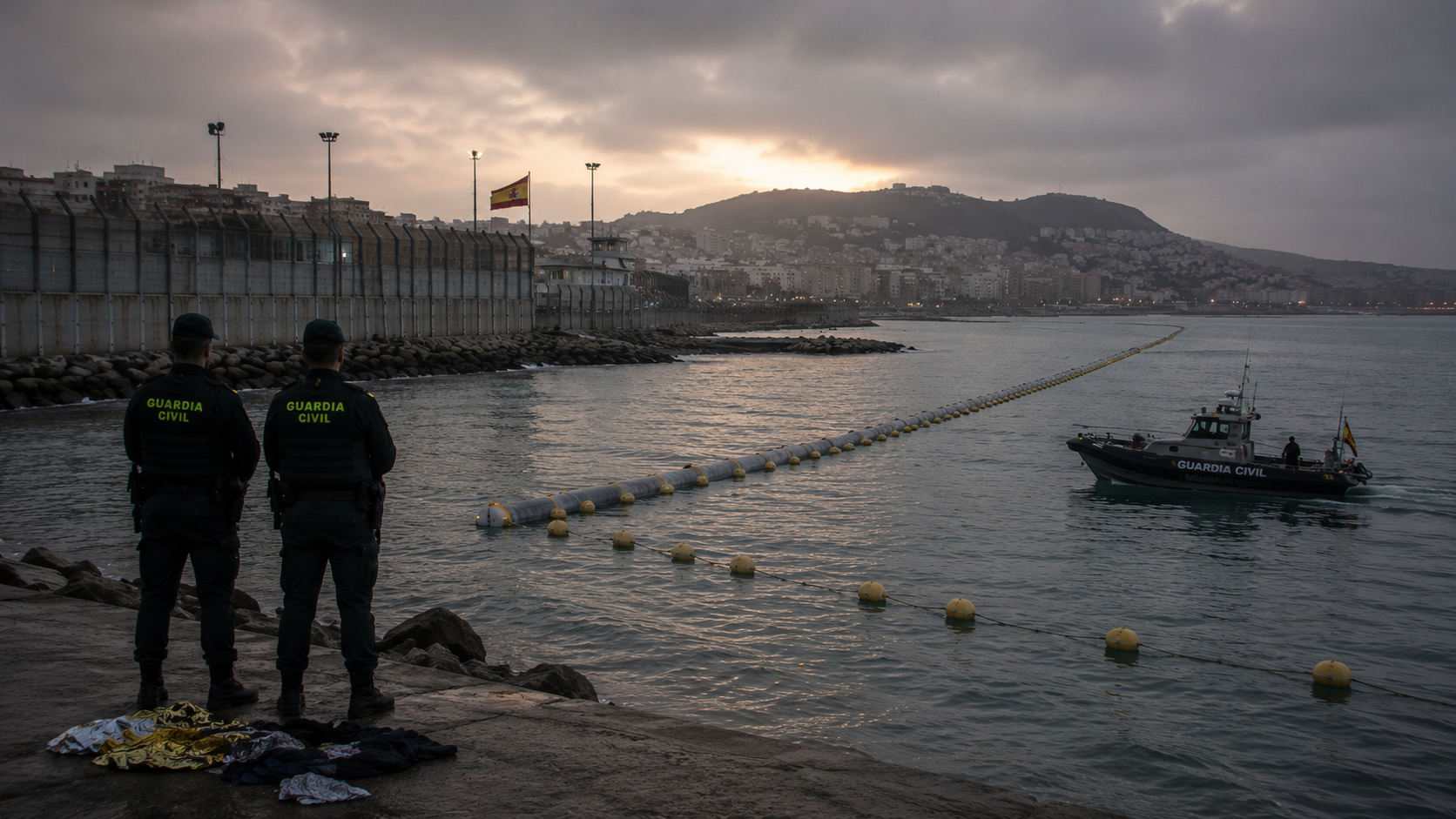
Spain began installing a 500-metre containment barrier beside the Tarajal breakwater on Saturday, 1 August, after an extraordinary rush across the border between Morocco and the Spanish enclave of Ceuta.
The structure consists of a pneumatic barrier rising between 30 and 70 centimetres above the water and extending as much as one metre beneath it. A line of anchored naval buoys will reinforce it, while a channel between the barriers is intended to allow Spain’s Civil Guard patrol boats to operate.
It is a physical answer to a crisis of staggering scale.
Spanish authorities estimate that approximately 50,000 people entered Ceuta by land and sea from Thursday, 30 July. Ceuta’s local president put the possible total as high as 60,000. More than 48,000 were reported to have returned to Morocco within roughly 48 hours.
At least 67 bodies had been recovered on the Spanish side of the frontier by Saturday. Some people drowned in the attempt to swim around the coastal defences. Others were crushed during a rush towards the breakwater and border fence. Officials have warned that further casualties may exist on the Moroccan side.
The immediate surge appears to have subsided. The deeper emergency has not.
A Border Breach Almost Without Precedent
Ceuta is a small Spanish territory on the North African coast, surrounded by Morocco and separated from mainland Spain by the Strait of Gibraltar.
Alongside Melilla, it forms one of the European Union’s only land frontiers with Africa. That geography has made both enclaves recurring flashpoints in the struggle between irregular migration, national sovereignty, humanitarian law and Europe’s dependence on neighbouring states to control its external borders.
What happened this week was not an ordinary increase in arrivals.
Spain said roughly 50,000 people crossed in a matter of days. That number is equivalent to well over half of Ceuta’s usual population, overwhelming the territory’s accommodation, food supplies, policing and administrative systems. Reuters reported that soldiers and police were deployed while Moroccan forces used batons, tear gas and water cannon as crowds gathered near the frontier. Burnt vehicles were later visible around the Moroccan border town of Fnideq.
Many of those attempting the journey were Moroccan, although people from sub-Saharan Africa were also among the crowds. Some entered by walking or running through border positions. Others climbed barriers or entered the water and attempted to swim around the breakwater.
The sea route proved lethal.
Strong currents, exhaustion, overcrowding and panic turned a short geographical distance into a death trap. The confirmed fatalities included people who drowned and others caught in the crush near the coastal barrier.
The floating structure now being placed offshore is designed to close precisely that weakness: the point at which a land fence reaches the sea and can potentially be bypassed by swimming around it.
The Barrier Solves One Problem — Not the Crisis
The new structure is likely to make the immediate coastal route more difficult. It creates a visible obstacle above the water, extends beneath the surface and gives patrol vessels a designated channel in which to intervene.
Yet barriers alter routes more readily than they eliminate the pressures behind them.
Spain’s Interior Minister, Fernando Grande-Marlaska, has blamed people-smuggling networks and misleading information circulated online. He said vulnerable people had been encouraged by distorted interpretations of a recent Spanish Supreme Court ruling concerning the summary return of migrants intercepted at sea where no physical border barrier existed.
The government’s explanation matters because the rush appears to have contained an element of collective expectation: the belief that reaching Ceuta might create a legal or practical route into mainland Spain and the wider Schengen area.
That belief collided with Ceuta’s unusual status.
Madrid insists that irregular entry into the enclave does not grant unrestricted onward movement into mainland Spain or another Schengen country. Travellers leaving Ceuta by sea or air face identity checks, creating an additional layer of control behind the border with Morocco.
Spain has also rejected claims that its broader programme to regularise undocumented migrants encouraged the rush. The government says applicants must prove that they were already living in Spain before 1 January 2026 and meet a continuous-residence requirement, meaning a new arrival in Ceuta would not automatically qualify.
The speed with which tens of thousands nevertheless moved towards the frontier demonstrates how rapidly legal rumours, social-media instructions and hopes of onward passage can become operational facts on the ground.
A border policy does not need to say that entry will be rewarded. It merely needs to be widely interpreted that way.
Why So Many People Returned
One of the most striking elements of the crisis is not only how many people entered Ceuta, but how rapidly most reportedly returned.
Spanish officials said more than 48,000 had gone back to Morocco. The government characterised the returns as voluntary and said they took place without a major new confrontation.
Interviews conducted by the Associated Press presented a harsher picture of the circumstances surrounding those decisions. Returning migrants described hunger, a lack of shelter, nights spent outdoors and severe overcrowding. Some alleged mistreatment by Spanish police; those individual allegations have not been independently adjudicated.
The accounts suggest that Ceuta itself became a containment mechanism.
Those who arrived found that crossing the border was not the same as reaching continental Europe. With accommodation overwhelmed, food scarce and onward travel restricted, the enclave offered few of the opportunities many apparently expected.
That creates an uncomfortable dual reality.
Spain can reasonably argue that it prevented a mass breach from becoming unrestricted onward movement across Europe. Humanitarian organisations and migrants can equally question whether deprivation, confusion and coercive conditions made the supposedly voluntary returns genuinely free choices.
Both questions deserve scrutiny.
The deaths should not be used merely as ammunition in an ideological argument over migration. They require an investigation into what warnings existed, how the crowd formed, why security systems failed to anticipate its scale and whether either Spanish or Moroccan actions contributed to the fatal crush.
Morocco Remains the Indispensable Partner
The crisis also exposed Europe’s dependence on Morocco.
Grande-Marlaska publicly described Morocco as a “fully reliable partner” and rejected suggestions that Rabat represented a threat to Ceuta. He credited bilateral cooperation with reversing the situation within approximately 24 hours.
That defence is politically significant.
Spain cannot realistically secure Ceuta through barriers and Spanish personnel alone. Effective control depends on Moroccan authorities stopping large groups before they reach the frontier, disrupting smuggling networks, sharing intelligence and accepting or facilitating returns.
This gives Morocco substantial leverage.
European border policy often presents itself as a system of laws, fences, surveillance and official procedures. In practice, much of it depends on agreements with governments outside the European Union. When that cooperation weakens, even temporarily, the physical border can become vulnerable remarkably quickly.
The Ceuta rush therefore represents more than a local security failure. It is a demonstration of how migration can become a form of geopolitical pressure, whether deliberately instrumentalised by a state or simply enabled by a temporary collapse in enforcement.
Spain says it had no intelligence warning that an operation of this scale was imminent. That admission raises an obvious question: how did tens of thousands of people mobilise while the authorities responsible for one of Europe’s most sensitive borders remained unaware?
The Crisis Has Already Escaped Ceuta
The political consequences spread across Europe almost immediately.
Leaders from 22 European Union countries called for an emergency meeting and warned that uncontrolled mass crossings could undermine confidence in the bloc’s migration system and encourage further attempts. They requested consideration of additional support from Frontex, the European Border and Coast Guard Agency, and a review of cooperation with Morocco.
Italy moved to restore checks on people arriving from Spain by air and sea. Rome’s intervention effectively treated the Ceuta breach not merely as a Spanish problem, but as a potential risk to the wider passport-free Schengen area.
Spanish Prime Minister Pedro Sánchez condemned calls to suspend Spain from Schengen, describing such reactions as divisive, legally questionable and driven by misinformation or political interest. He argued that securing the European Union’s external frontier should be a shared responsibility rather than a burden placed solely on frontline states.
On that central point, Spain has a strong case.
Ceuta may be Spanish territory, but the pressure behind the border is European. If the crossing had created a reliable route into mainland Europe, the consequences would not have stopped at Madrid. Every Schengen country would eventually have had an interest in the outcome.
Yet Spain’s European critics also have a legitimate concern. A shared border system requires confidence that each participating state can control entry into the wider zone. When tens of thousands cross one external frontier within days, political reassurance alone will not restore that confidence.
The argument is therefore not simply between compassionate and restrictive governments.
It is about who carries the cost of border control, who accepts responsibility when control fails and whether Schengen can survive without more centralised protection of Europe’s external perimeter.
A Floating Symbol of Europe’s Dilemma
The barrier at Tarajal will be presented as a practical security measure. Visually, however, it will become something larger: a floating dividing line between African hardship and European territory.
Supporters will see it as a necessary defence installed after an unprecedented breach and dozens of preventable deaths. They will argue that a controlled frontier is safer than allowing large groups to gamble their lives in dangerous currents.
Critics will see another hardening of Europe’s borders without an equivalent expansion of safe, lawful migration routes. They will warn that closing the Tarajal route may redirect desperate people towards longer and more dangerous journeys.
Both interpretations contain part of the truth.
A state that cannot control its border eventually loses public confidence and the political space required to maintain a humane asylum system. But a barrier without diplomacy, legal clarity, intelligence cooperation and credible migration pathways merely moves the danger elsewhere.
Spain has closed a physical gap. Europe still faces a strategic one.
The decisive test will not be whether the floating wall prevents another swimmer reaching Tarajal beach this weekend. It will be whether Spain, Morocco and the European Union can prevent the same combination of desperation, misinformation and institutional unpreparedness from producing another mass movement — and another death toll — somewhere else along Europe’s southern frontier.
