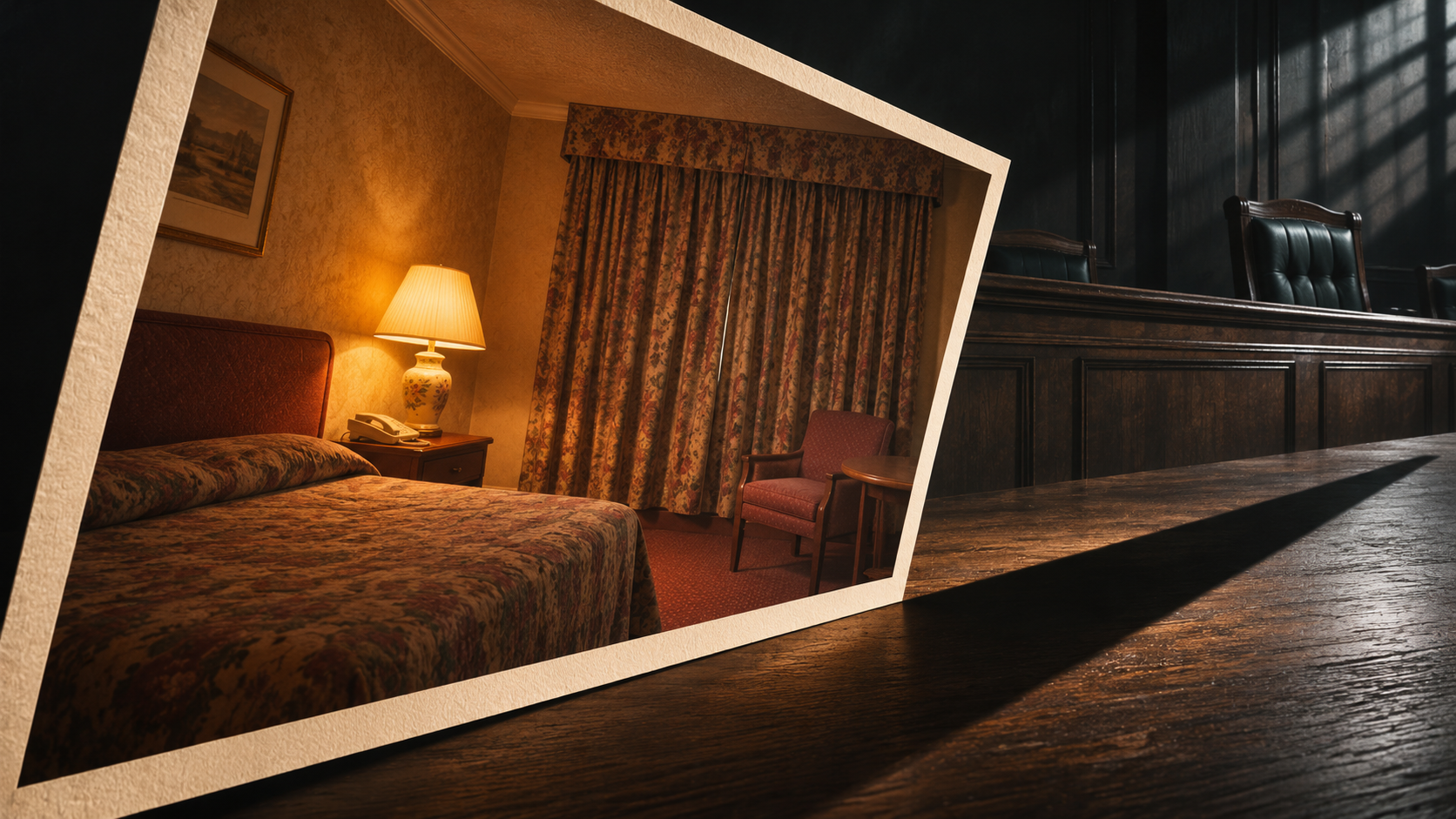
The Hotel Photographs and the Reported Apology
What Did The Jury Hear About The Encounters Themselves?
A photograph placed Russell Brand in a Bournemouth hotel room in 1999. A woman told the jury what she said happened in that room after she took the photographs. Those are two different pieces of evidence. The photographs preserved a detail both sides could check decades later. On the central question of consent, it was the woman’s testimony and Brand’s account that jurors had to assess.
That distinction shapes this ranking. It puts evidence closest to the alleged acts first, followed by material that can establish particular details or supply context. The order says nothing about which witness jurors should believe. On the morning of Thursday 5 November 2026, the jury at Southwark Crown Court resumed deliberations for a third day. Brand has pleaded not guilty to all seven charges involving six women.
1. The Women’s First-Hand Evidence About The Alleged Acts
The accounts given by the women rank first for directness. In the Bournemouth allegation, for example, the woman described inviting Brand back to her hotel to continue a conversation after a performance linked to the Labour Party conference. She described their earlier interaction as playful. She then told the court that he pushed her onto the bed, that she said no and that his weight left her feeling trapped. Her evidence addressed the precise point in dispute: what happened between them once they were alone.
Ian Winter KC, defending Brand, put a different account to her. He suggested that she had consented and later regretted the encounter. She rejected that suggestion. Asked why she had not gone to the police at the time, she described feeling ashamed and believing she would not be believed. Jurors therefore heard both the challenge over the delay and her own explanation for it.
A separate complainant drew a distinction within her own account. She described willingly taking part in an earlier sexual encounter with Brand and alleged that he raped her days later at his north London home. The question for jurors concerns the later occasion. Her account of the first encounter explains how they knew each other. Consent on that occasion cannot answer what she agreed to days later. Brand denied raping her.
These examples also explain why the number of complainants makes a poor ranking method. The seven charges concern alleged events spanning 1999 to 2009, in settings including a hotel, workplaces, a bar and a private home. A photograph relevant to the hotel allegation and a conversation relevant to the allegation at Brand’s home answer different questions about different occasions.
2. The Bournemouth Photographs
The photographs are among the most concrete items described in court reporting. Jurors could see Brand shirtless in the hotel room and compare the images with the woman’s recollection. That comparison mattered to both sides. The pictures supported her account that she had photographed him there. They also gave the defence a specific detail to challenge: she had initially described him as being in his underwear, whereas the photographs showed him wearing trousers.
Why place the photographs second when a photograph can be checked more readily than a decades-old memory? Because of when the images were taken. The woman said the alleged rape happened afterwards. The camera recorded what Brand was wearing at one moment. The jury still had to assess the competing accounts of what followed. Calling the pictures simply “evidence against Brand” would also overlook the use his barrister made of them.
3. The Fifth Complainant’s Account Of A Text Exchange
The fifth complainant told police about contact with Brand months after the alleged rape at his home. In interviews played in court, she described receiving a message from him after they had crossed paths at the Edinburgh Festival. She said she challenged him about how he had treated her, telling him, “you treated me like an animal”. According to her account, he replied, “I’m sorry.”
Two details matter here. First, the public report describes the woman recalling the words in her police interviews. Describing jurors as having inspected an original message thread would go beyond what that report establishes. Second, the wording leaves open what the apology referred to. In cross-examination, Winter put that ambiguity to her directly. He suggested that Brand could have treated her badly while disputing that he had raped her. She maintained her allegation.
The exchange belongs above more general accounts of Brand’s behaviour because, as she recalled it, it was a conversation between the two people involved about his treatment of her. Its evidential limit is equally specific. The two-word reply contains no description of the act to which he was responding.
4. Mark Pinheiro’s Account Of Leaving Bournemouth
Mark Pinheiro, a former friend of Brand, gave evidence about the 1999 trip. He described an abrupt departure from Bournemouth and said Brand wanted the group to return to London. Pinheiro also supplied a detail that matters to any fair reading of that episode: according to him, Brand said he had an audition to attend.
Pinheiro could describe the change of plan because he was there for the journey. His evidence gave jurors another person’s recollection of the surrounding events. It could help them reconstruct the chronology, but the departure alone cannot establish Brand’s reason for wanting to leave or what happened privately in the hotel room. A headline describing Brand as having “fled” would supply a motive the witness’s account leaves unresolved.
5. Brand’s Evidence About Fame, Sex And His Conduct
In the witness box, Brand acknowledged using his fame to gain sexual access to women and said he had been wrong to do so. He also acknowledged marking the fifth complainant’s contact details with a letter he used to denote casual sexual partners. Those admissions gave jurors his own account of how he approached some relationships and how he recorded this particular contact.
They rank last here because their reach is limited. Brand’s attitude towards casual partners and his use of celebrity are broader questions than whether he committed a particular offence. His defence made that distinction central to its closing argument. Brand denied all seven charges. He said he remembered some encounters as consensual and could not recall some of the other alleged incidents. The differences in what he said he remembered matter more to an accurate account of his defence than a blanket claim that he offered the same explanation for everything.
Why The Order Matters
The easiest details to remember from this trial may be the photograph and the apology. Both fit into a headline. Each also loses something important when compressed into one. The photograph captured the minutes before an alleged offence and gave the defence grounds to challenge a detail. The apology came from a later conversation as one woman recalled it, and its meaning was disputed in court.
The first-hand accounts therefore come first for a straightforward reason. They address what each person said happened at the moment relevant to a charge. The photographs, the reported exchange and the account of the journey each illuminate a narrower part of that story. How much weight any of them deserves on each count is the decision now before the jury.
Sources
Associated Press — The charges, closing arguments and start of jury deliberations
The Guardian — The fifth complainant’s account of the messages and the defence challenge
Reuters — Brand gives evidence and explains his position on consent
