

The Fractured World Economy: How Sanctions, Supply Chains and Rival Blocs Are Replacing Globalization
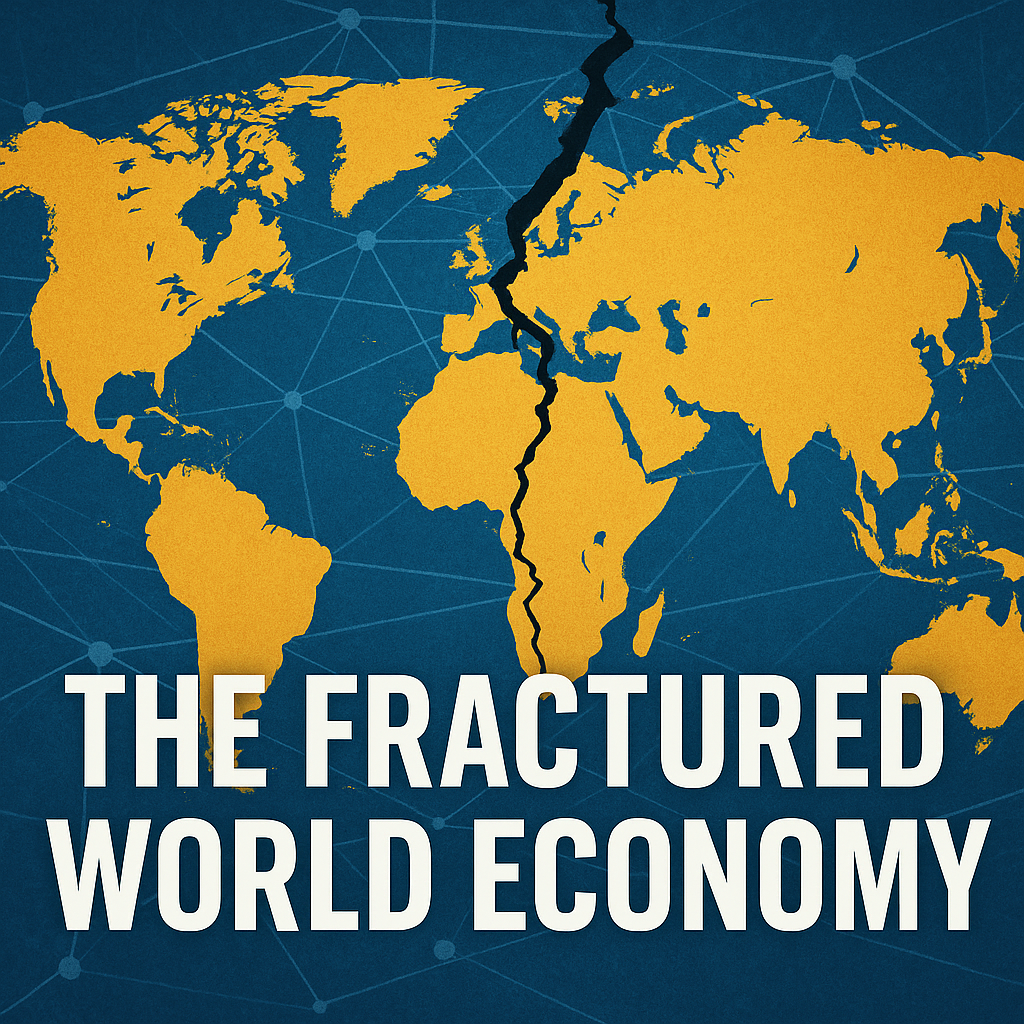
The old era of frictionless trade is giving way to a new age of dividing lines. In boardrooms and factories around the world, companies are changing course. Decisions that once focused only on cost now hinge on politics and security. A raw-materials pipeline war in Africa. A chipmaker’s order held up by border checks. A farmer watching grain ships turn away. These scenes are no longer isolated headlines – they are the new reality of a fractured global economy.
Background: The Rise and Fall of Globalization
From 1945 to the early 2000s, nations pursued ever-deeper integration. Tariffs fell, trade agreements multiplied, and supply chains snaked across continents. Asia’s factories plugged into U.S. stores; European auto parts flowed to assembly lines worldwide. By 2008 roughly one-quarter of global output was traded across borders. Key milestones included the fall of the Iron Curtain, China’s entry into the WTO in 2001, and the rise of containerized shipping. Each advance knit the world economy tighter – until cracks began to show.
Crises in the 21st century tested the system. The 2008 financial crash shook confidence in open markets. In the 2010s, rising nationalism brought protectionist talk (for example, tariffs between the U.S. and China in 2018) and the breakup of trade ties (Brexit in 2020). When COVID-19 struck, global just‑in‑time chains snapped: ports clogged and factories shuttered. Overnight, manufacturers discovered that “efficiency” was fragile. Governments began stockpiling goods and paying to relocate plants closer to home. By the early 2020s a new motto took hold: “resilience over efficiency.”
Then came 2022. Russia’s invasion of Ukraine triggered sweeping sanctions. Western nations cut off Russia from international banking and blacklisted its companies. In an instant, Western dependence on Russian oil, gas and metals became a vulnerability. (Russia supplied 45–50% of the EU’s energy before 2022) As pipelines to Europe were shut, nations raced to replace those supplies. Instead of globally cheapest oil, pay-as-you-go rules meant U.S. buyers instead tapped Texas shale or OPEC output; Europe filled ports with liquefied gas from Qatar and the U.S. Russia, cut off from old markets, turned east – redirecting its fuels to India, China and Turkey at discounted prices. Each wave of sanctions and counter-moves rewrote once-stable trade routes.
Throughout this decade, trade costs have soared. Globally, the number of new trade restrictions – tariffs, quotas and sanction lists – has jumped dramatically. One analysis finds annual interventions rose from about 600 in 2017 to over 3,000 by 2024. Tariff levels have crept up, export controls proliferated, and even rules on data and technology export are tightened. In short, multilateral trade rules are under siege and “economic security” has become a watchword. No longer does signing a shipping contract mean everything will flow uninterrupted.
Core Analysis: Sanctions, Supply Chains and Rival Blocs
Today’s global economy is cleaving along political fault lines. Sanctions and trade controls are being used as strategic tools like never before. Finance, tech and trade infrastructure are now weapons. For example, Western powers have weaponized financial systems and telecommunications: freezing assets, banning Chinese telecom gear, and cutting firms off from payment networks. Countries under sanction must find workarounds or pay a premium. In 2025, even rare earths – the high-tech minerals in everything from phones to jets – became flashpoints. China, which processes over 90% of rare earths, imposed new export curbs in October that could choke global supply. Industry watchers warn this is a turning point: “We’re likely entering a period of structural bifurcation,” a market analyst says, “with China localizing its value chain and the U.S. and allies accelerating their own”. In plain terms, two separate ecosystems are emerging for critical goods: one centered on Beijing, the other on Washington.
This split is visible in supply-chain decisions. Firms once chasing the cheapest producer now factor in geopolitics. The era of “just-in-time” inventory is ending; a “just-in-case” mentality has taken over. One survey found 43% of U.S. companies would pay 10–20% more to get supplies in one week instead of six. Suppliers are actively relocating and diversifying. Many manufacturers now adopt reshoring, nearshoring or friendshoring: moving plants back home, to neighboring countries, or to political allies. For example, Western chip firms are building fabs in the U.S., Taiwan and friendly Asian nations to avoid export bans on China. Carmakers are moving assembly from China to Mexico or Thailand to dodge possible tariffs. In key strategic sectors – semiconductors, green tech, aerospace – governments openly subsidize domestic production. U.S. laws (the CHIPS Act, the Inflation Reduction Act) pour hundreds of billions into American industries; the EU offers large grants for European chip and battery factories.
Alongside the supply-chain shift, new economic blocs are emerging. Roughly speaking, three camps have crystallized: the U.S. and allies, the China–Russia bloc, and a cautious “middle” group (mainly Europe with some Asia). Washington’s approach is one of economic security first. It insists on supply-chain alliances with “like-minded partners”Access to technology and markets now often requires political alignment. Companies outside the U.S. security orbit face barriers: export controls, investment scrutiny, even threats of exclusion from key markets. The U.S. even hints at global tariffs (oil to Asia, cars to Mexico) to leverage negotiations, prompting friends to consider retaliatory measure.
On the other side stands China and Russia, advocating a state-led multipolar order. Beijing has poured over $1 trillion into its Belt and Road projects, underwriting ports, railways and grids across Asia, Africa and Latin America. It and Moscow have built parallel institutions – the Asian Infrastructure Investment Bank, the New Development Bank – offering loans without Western conditions. Together they push new standards: in 5G and AI they promote technology models friendly to state control. They also pursue de-dollarization. BRICS members (which now include Saudi Arabia, Iran, etc.) talk of settling trade in local currencies or even a common currency. These moves aim to keep economic ties intact within the bloc and to reduce U.S. leverage.
Finally, the European Union and others chart a reformist middle path. Europe still believes in international rules, but it is retooling them. The motto is “de-risk, not decouple”: reduce strategic vulnerabilities while retaining trade. Brussels backs strict new regulations – on data flows, climate (the Carbon Border Adjustment), and industrial policy – to protect its markets. It also hedges politically: keeping close ties to Washington on security, while also maintaining massive trade with China. This tightrope is tricky. For example, the EU has imposed tariffs on Chinese electric vehicles (a $75 billion market) and threatened quotas, signaling it will push back if China floods European markets. But Brussels does this with one eye on firms that rely on Chinese inputs. In practice, the EU’s approach increases complexity: companies face more red tape, but less outright blockage than in a full decoupling scenario.
In sum, globalization is not so much ending as fragmenting. Rules-based multilateralism is fraying. The WTO’s influence is waning, while blocs of countries set their own rules. World leaders now see integration itself as a risk. Even conservative analysts note that governments are treating trade and investment through a national-security lens. As one report bluntly puts it, we’re in an age of “geo-economic fragmentation” or a “policy-driven reversal” of the old system.
Why This Matters: The Costs of a Splintered Economy
A fractured economy raises the price of almost everything. Consumers and businesses will feel it in higher costs and shortages. Shipping and compliance costs rise as goods reroute and face new fees. Data transfers and financial transactions now require more checks and approvals across different regimes. Industry analysts warn the cost could be steep: in extreme scenarios, cutting off trade entirely might shrink some economies by up to 10%. More broadly, economists note that falling back from open trade risks permanent loss of efficiency and prosperity. Historically, global supply chains generated vast consumer benefits; unwinding them means accepting more expensive products or less choice. For example, price spikes already hit food and energy in 2022 when crucial exports were cut off. Emerging markets suffer most, as they lack the industrial buffers of rich countries.
Politically and socially, the split breeds tension. Countries feel pressured to pick sides, fracturing international forums. Smaller nations find themselves squeezed: caught in trade wars, they face tariffs or loss of investment if they alienate the big powers. Technology divides mean consumers may soon have to buy hardware based on political alignment (a “Huawei or Samsung” choice for 5G, for example). Data crosses borders with more difficulty – imagine if your social media app got banned depending on which country you lived in. Even everyday actions can become political: rumors and boycotts of foreign products spread faster. All this can fuel distrust. In the worst case, the new “splinternet” could replace a globally connected internet, harming innovation and cooperation.
In the finance realm, alternatives to traditional systems are accelerating. Nations under sanctions build their own payment networks or trade through third countries. Cryptocurrencies, state-issued digital currencies and barter networks gain attention. The U.S. dollar’s dominance is being quietly challenged: a recent poll of experts found worries that advancing fragmentation could erode the dollar’s role as the world’s reserve currency. If cross-border lending and investment flows slow under the new regime, global growth could suffer. Economists at institutions like the IMF caution that policy-driven disintegration carries a risk of long-term lower growth and higher inflation.
Yet in this uncertainty there are strategic pivots. Some governments see a chance to rebuild local industry and skills. Indeed, military and tech firms have already boomed in places investing in domestic supply (for example, European defense firms surged orders when NATO blocked Russian parts). New trade ties are forming: India, Africa and Latin America are auditioning as “friend-shores” to host relocated factories. But these are slow fires. Overall, the new world order is more complex and risk-filled for business and citizens alike.
Real-World Examples
Tech manufacturers recalibrate. A leading smartphone maker, cut off by chip export bans in 2024, decided to shift part of its assembly out of China into Vietnam and Malaysia. By using factories in U.S.-friendly markets, it ensures critical components avoid new sanctions.
Automakers rewire supply lines. A German car company building electric vehicles in China learned it might face tariffs on exports back to Europe. To hedge, it began opening new plants in Mexico and Poland. That way, its next-generation cars can serve U.S. and EU buyers without paying punitive duties.
Food exporters reroute shipments. With Black Sea ports blocked by war, Ukrainian grain exporters invested in rail and river routes. In 2023 a single rail corridor to Poland took the place of dozens of cargo ships, carrying wheat and corn into Europe. Though slower, this land bridge kept bread on the table for millions.
Energy transitions accelerate. When pipeline gas from Russia ceased in 2022, a European nation fast-tracked an LNG terminal on its coast. What had been planned for five years was built in one. Homes and factories found gas in tankers from Qatar and the U.S., but at higher prices.
Everyday products become geopolitical. A Chinese consumer suddenly finds a new logo on a social media app – the old one is banned under an export control. A European shopper notices their new car’s touchscreen is made by a Korean firm, not a Chinese supplier. Even a winter jacket might have “Made in Vietnam” where it once said “Made in China,” the move reflecting a desire to avoid tariffs and political scrutiny.
Each example shows: global business is adapting in concrete ways. Factories move. Suppliers change. People pay the price. That’s the new reality of the fractured economy we live in today.
