The Gaza Flotilla Is Sailing Into a Blockade It Knows It May Not Survive
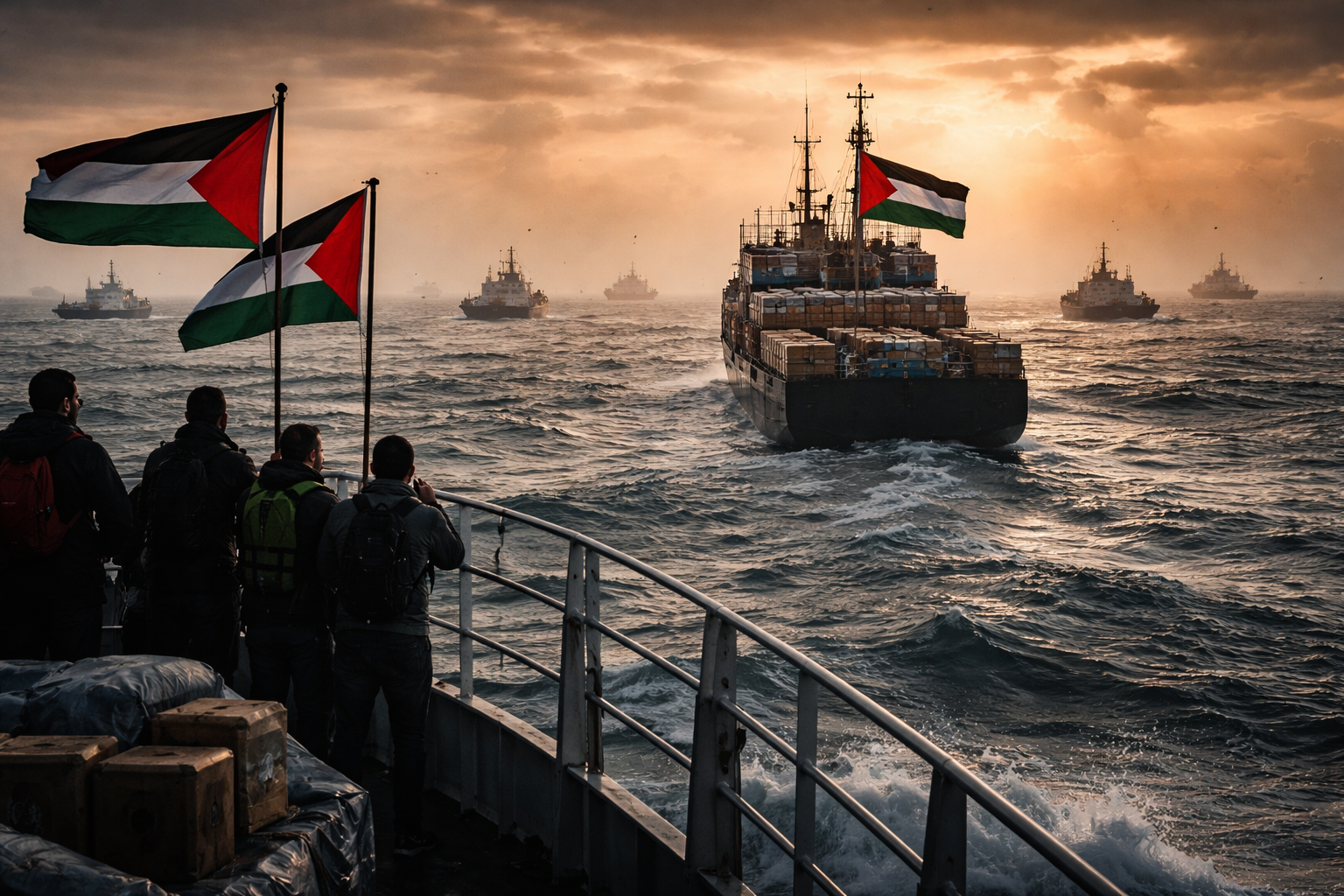
Hundreds Set Sail for Gaza—With Interception Almost Guaranteed
An international civilian fleet is moving toward Gaza carrying aid and defiance—while openly acknowledging it may be stopped before it ever arrives.
A Humanitarian Mission With a Built-In Collision Course
A flotilla of civilian vessels has begun moving across the Mediterranean toward Gaza, carrying medical supplies, aid workers, and a message that is as political as it is humanitarian: the blockade must be challenged.
Organizers say the mission is about delivering urgent relief to a population of more than two million people facing severe shortages. Critics say it is a provocation. Governments are watching closely. The flotilla itself seems to grasp one fundamental truth:
The mission is unlikely to end quietly.
The fleet—reportedly numbering dozens of vessels, with plans to expand further en route—set sail from Europe with thousands of participants, including medical professionals and activists.
Its stated aim is simple: reach Gaza, deliver aid, and establish a humanitarian corridor.
Its unstated reality is more complex: it is sailing directly into one of the most tightly controlled maritime zones in the world.
The Blockade That Defines the Risk
Israel’s naval blockade of Gaza has been in place for years, justified by Israeli authorities as a necessary security measure to prevent weapons smuggling.
From Israel’s perspective, the flotilla is not just a humanitarian convoy—it is a breach attempt.
From the flotilla’s perspective, the blockade itself is the issue.
That clash of narratives is not new. It has defined every similar mission for over a decade.
And it explains why this latest voyage carries such a high risk of interception.
Previous flotillas have been stopped repeatedly—often in international waters—by Israeli naval forces enforcing the blockade.
In 2025 alone, Israeli naval forces intercepted dozens of vessels, detained activists, and rerouted or confiscated aid.
This time, participants are not pretending the outcome will be different.
Some organizers have openly acknowledged that interception is “highly likely.”
What This Flotilla Is Really Trying to Do
On the surface, the mission is about aid: food, medicine, and medical support.
But at a deeper level, the flotilla is attempting something far more difficult—forcing a political and legal confrontation in full public view.
It is designed to create pressure.
Pressure on Israel to allow access.
Pressure on governments to respond.
Pressure on international institutions to clarify what the law actually requires.
That is why the flotilla is enormous, so visible, and so deliberately international.
It is not just a delivery mechanism.
It is a statement.
The Legal Battle Beneath the Waterline
At the center of this story is a question that remains fiercely contested:
Is the blockade—and its enforcement—legal under international law?
Humanitarian organizations argue that international law requires the free flow of essential aid to civilian populations, particularly in crisis conditions.
Israel, however, maintains that its blockade is lawful and necessary for security and that aid can be delivered through approved channels.
This disagreement is not theoretical.
It shapes what happens next.
If the flotilla is intercepted, Israel will likely frame it as enforcement of a legal blockade.
If it is stopped, organizers will likely frame it as the obstruction of humanitarian access.
Both arguments have precedent.
Neither has fully settled the issue.
Why Interception Is the Most Likely Outcome
Strip away the rhetoric, and the operational reality becomes clearer.
The flotilla is entering a zone where
Israel has repeatedly demonstrated willingness to intervene
Naval enforcement is routine
Civilian vessels have previously been boarded, redirected, or detained
There is no indication that enforcement policy has fundamentally changed.
In fact, the scale of this flotilla may increase the likelihood of a response, not reduce it.
Larger visibility raises stakes.
Higher stakes increase pressure to act.
And once naval forces are involved, the situation becomes tightly controlled, rapidly.
That is why even supporters of the mission acknowledge the risk.
Not as a possibility—but as an expectation.
What Media Misses
Most coverage frames this as a humanitarian story versus a security story.
That framing is incomplete.
This is fundamentally a power test.
Not military power—but narrative power.
Who gets to define legitimacy?
Who decides what counts as lawful?
Who controls access—not just physically, but politically?
The flotilla is not trying to overpower the blockade.
It is trying to expose it.
And that is why it matters even if it never reaches Gaza.
The Stakes Are Bigger Than the Ships
The immediate stakes are clear: whether aid reaches Gaza.
But the broader stakes are far larger.
If the flotilla is intercepted again, it reinforces the status quo—control remains absolute.
If it reaches Gaza, even partially, it sets a precedent that could shift expectations and pressure future policy.
Either outcome carries consequences beyond this single mission.
There is also a reputational dimension.
Images matter.
Narratives matter.
And this is a highly visible, highly symbolic confrontation.
What Happens Next
Three paths now appear most plausible:
1. Interception at Sea
The most likely scenario based on precedent. Vessels are stopped, boarded, and redirected.
2. Partial Breakthrough
Some ships may reach closer to Gaza or create a symbolic breach, even if full delivery is prevented.
3. Escalation of Political Pressure
Regardless of outcome, the mission may trigger diplomatic fallout, protests, and renewed scrutiny.
The flotilla is not just moving toward Gaza.
It is moving toward a moment.
The Real Meaning of the Voyage
This flotilla is not just about aid.
It is about visibility.
It is about forcing a question into the open that has remained unresolved for years.
Can a civilian mission challenge a state-enforced blockade—and what happens when it tries?
The answer may not come in words.
It may come in what unfolds at sea.
And that is precisely why the world is watching.
