

Europe’s Deadly Heatwave Is Now A Threat To Britain
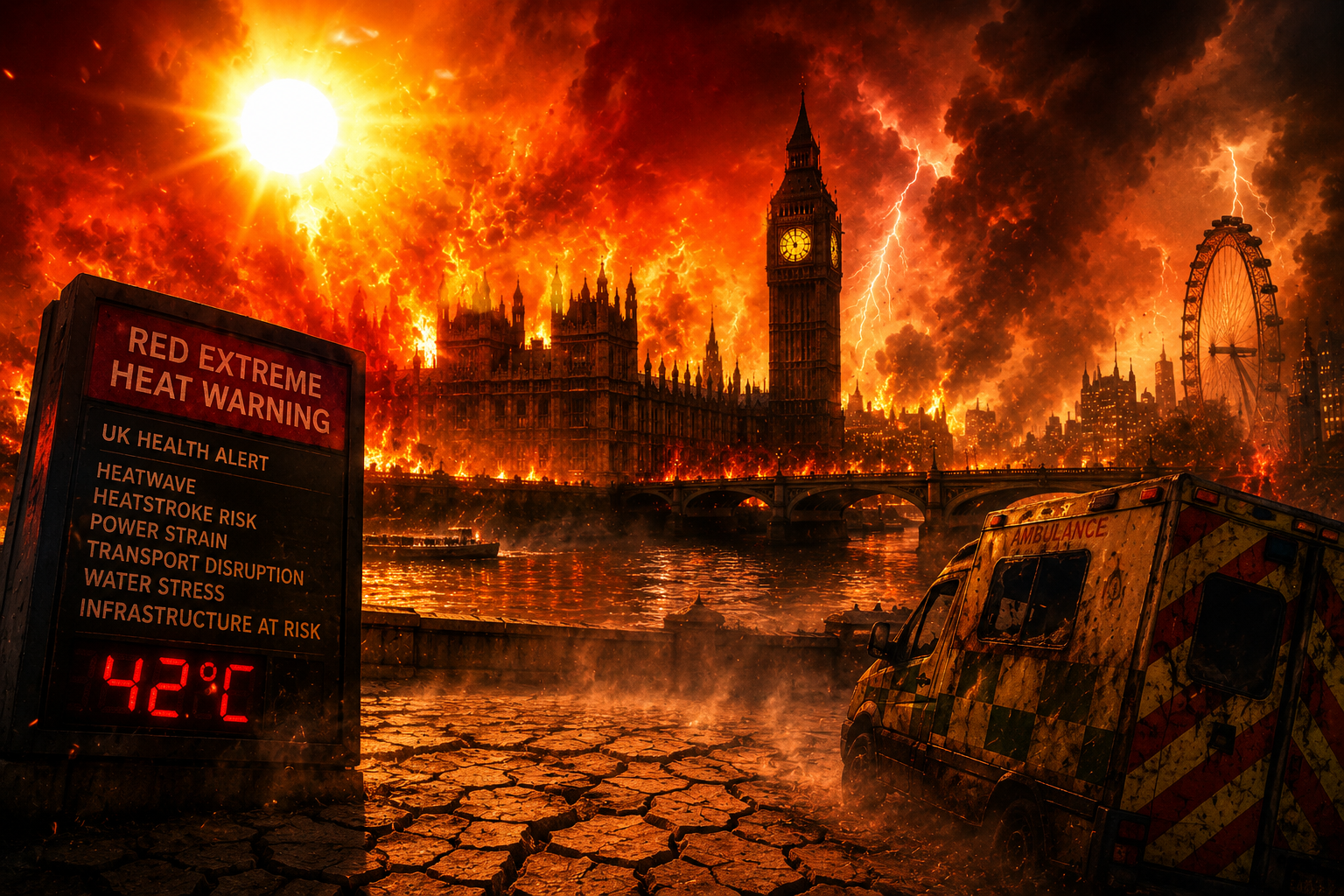
Britain Is About To Learn What Extreme Heat Really Breaks
The Heat Is Coming For Britain Next — And The UK Is Not Prepared
The Heat Emergency Is Already Deadly In Europe
Europe’s latest heat emergency has moved beyond discomfort and into consequence. France has reported deaths during the heat episode, including elderly victims linked to extreme temperatures and multiple drownings as people sought relief in water. Parts of France have been facing temperatures above 40°C, with Bordeaux forecast around 42°C, while red heat alerts and emergency measures have spread across the continent.
That matters for Britain because this is not a distant Mediterranean event. The same European heat dome is helping push hot, humid air north and west toward the UK. The Met Office has already warned that southern and eastern England sit on the edge of the continental heat, with conditions capable of becoming oppressive rather than simply sunny.
When Will It Hit The UK?
The sharpest UK risk window is Wednesday 24 June To Thursday 25 June 2026. UKHSA has issued red heat-health alerts for the East Midlands, West Midlands, East of England, London, South East, and South West, with amber alerts for the North East, North West, and Yorkshire and The Humber. Those alerts are in place from 1am on Wednesday 24 June until 11pm on Thursday 25 June.
The Met Office had already signalled the build-up: high pressure over mainland Europe allowing increasingly warm and humid air to move into southern and eastern areas, with temperatures potentially reaching 34°C or higher and a stated chance of exceeding the UK’s June record of 35.6°C. The key point is not just daytime heat. Humidity and warm nights reduce recovery time, especially in cities and badly ventilated homes.
How Will It Impact The UK?
The first impact will be health. Red heat-health alerts mean conditions are expected to create serious pressure on health and social care, not merely inconvenience. Older people, babies, people with heart or respiratory conditions, people living alone, outdoor workers, rough sleepers, and those in poorly insulated homes are the most exposed.
The second impact will be transport. Railways can suffer speed restrictions when tracks overheat. Roads can soften or deform in extreme conditions. Air-conditioned public transport becomes more important precisely when systems are already under stress. The UK can operate in hot weather, but it does not operate elegantly when heat becomes prolonged, humid, and geographically widespread.
The third impact will be water behaviour. The European deaths underline a dangerous pattern: when heat rises fast, people rush toward rivers, lakes, reservoirs, beaches, and canals. The Met Office and RNLI have warned that even in warm weather, UK sea temperatures can remain cold enough to trigger cold-water shock. That creates a grim paradox: people flee heat and run directly into another hazard.
Can The UK’s Infrastructure Handle It?
The honest answer is: partly, but not comfortably. Britain can handle short bursts of summer heat. It is far less prepared for repeated continental-style heat emergencies that affect homes, hospitals, transport, energy demand, schools, care homes, and water systems at the same time.
The UK’s infrastructure problem is structural. Much of the country was built for damp, mild, changeable weather, not sustained high heat. Many homes are designed to retain warmth, not release it. Large numbers of flats, older terraces, care settings, hospitals, and schools have limited cooling. Air conditioning is still not normal in British homes, which means heat risk moves indoors and stays there overnight.
Power demand can rise as fans, cooling systems, refrigeration, and workplace climate control all become more important. Water demand also rises as gardens, farms, businesses, and households use more. Even where systems do not collapse, pressure increases. The danger is not always one spectacular failure; it is a pile-up of smaller frictions across everyday life.
Why This Heatwave Feels Different
This is not just another hot week because the warning language has changed. UKHSA’s alert system exists to warn health and care services when adverse temperatures are likely to affect population health, and red alerts are the top end of that system. The current alert map places large parts of England under the most serious category.
The deeper issue is frequency. Europe has already seen intense early-season heat in 2026, with Copernicus describing western Europe’s late-May heatwave as unusually early and intense, including anomalies above 10°C in western France, England, and Wales. That means the UK is not simply being brushed by a one-off freak event. It is increasingly part of the same heat-risk geography as the rest of western Europe.
The Real UK Risk Is Compounding Pressure
Extreme heat rarely attacks one system in isolation. It pushes hospitals while also making travel harder. It raises water demand while making outdoor work more dangerous. It increases the risk of fires, worsens air quality, disrupts sleep, and makes ordinary homes feel unsafe for people who cannot cool them.
The UK’s weak point is not that every piece of infrastructure will fail. The weak point is coordination. A heat emergency becomes dangerous when NHS demand, care-home vulnerability, rail disruption, road pressure, power demand, water use, school decisions, and public behaviour all move in the wrong direction together.
That is why the UK should treat the next 48 hours as a live stress test. The question is not only whether Britain breaks temperature records. The sharper question is whether a country built around mild weather can protect people when European heat arrives with the force of a national emergency.
