

The Hidden War Behind “Project Freedom”—Why A Rescue Mission Could Ignite The World’s Most Dangerous Chokepoint
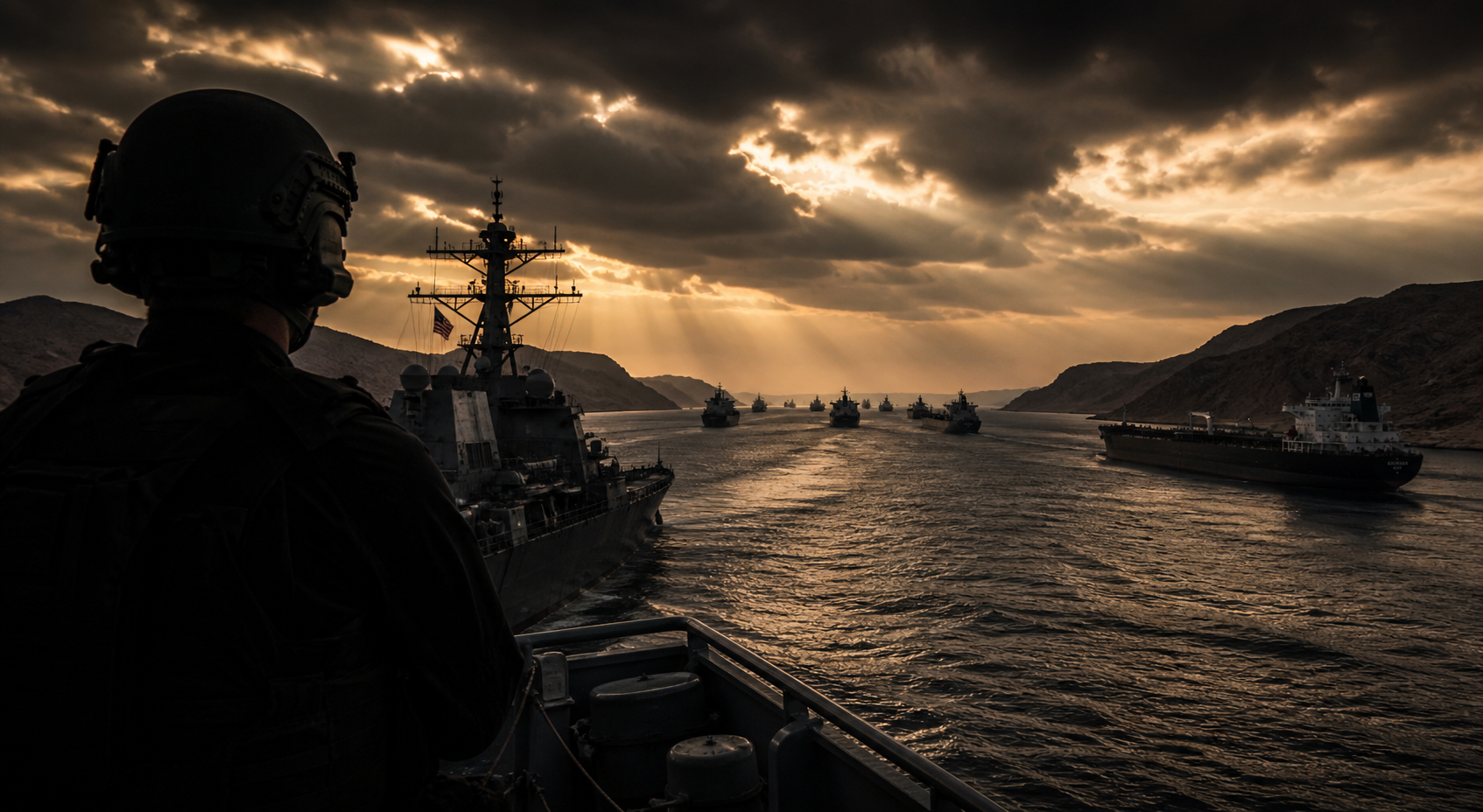
The Strait Of Hormuz Standoff: What “Project Freedom” Really Means
Project Freedom Expands: The High-Stakes Gamble In The Strait That Could Reshape Global Power
A Humanitarian Mission Is Colliding With A Geopolitical Fault Line
Hundreds of ships are stranded, tens of thousands of sailors are stuck at sea, and one of the most critical arteries of the global economy is effectively frozen. Into that vacuum steps a US-led operation with a deceptively simple name: “Project Freedom.”
On the surface, it is framed as a humanitarian mission — an effort to guide trapped commercial vessels safely through the Strait of Hormuz. But the moment it began expanding, the focus shifted beyond just ships. It became a test of power, credibility, and control in one of the most strategically sensitive places on Earth.
What Project Freedom Actually Is
“Project Freedom” is a US-led initiative designed to restore movement through the Strait of Hormuz, where hundreds of vessels have been unable to transit due to ongoing tensions between the United States and Iran.
The operation involves significant military support — including guided-missile destroyers, aircraft, unmanned systems, and roughly 15,000 personnel — even as it is publicly described as a coordination and safety effort rather than a direct escort mission.
That ambiguity is deliberate. It allows Washington to position the operation as stabilizing rather than escalatory while still projecting force in a region where presence alone carries meaning.
At its core, Project Freedom is attempting to solve a logistical crisis: how to move ships through a contested, potentially mined waterway without triggering open conflict.
Why The Strait Of Hormuz Matters So Much
The Strait of Hormuz is not just another shipping route. It is a global choke point.
Roughly one-fifth of the world’s oil supply typically passes through this narrow corridor, making it one of the most economically sensitive locations on the planet.
When that flow is disrupted, the consequences are immediate and global. Oil prices surge. Supply chains tighten. Markets react not just to what is happening but also to what might happen next.
That is precisely what is unfolding now. The blockade and counter-blockade have already stalled exports, stranded crews, and pushed energy markets into volatility.
Project Freedom, therefore, is not just about maritime safety. It is about restoring confidence in a system that depends on uninterrupted flow.
The Standoff Beneath The Surface
The operation is expanding in a context where both sides are sending conflicting signals.
On one hand, reports describe “very positive” diplomatic discussions and peace proposals that negotiators are exchanging.
On the other hand, explicit warnings exist. Iranian officials have stated that any unauthorized foreign military presence in the strait could be treated as a violation and targeted.
Meanwhile, disputed claims — such as reports of missile strikes on US vessels that were quickly denied — highlight how fragile and contested the information environment has become.
This dual-track reality creates a dangerous dynamic. Diplomacy suggests de-escalation. Military signaling suggests preparation for escalation. Both are happening simultaneously.
Why Expansion Changes The Equation
The expansion of Project Freedom is not just about scale. It is about perception.
As more assets deploy and coordination intensifies, the operation begins to look less like a temporary fix and more like a sustained presence. That shift matters.
From the US perspective, increased involvement may be necessary to ensure safe passage and deter interference.
From Iran’s perspective, it risks appearing as encroachment—a foreign military shaping activity in waters Tehran considers within its security sphere.
That gap in interpretation is where miscalculation lives.
The more visible and structured the operation becomes, the harder it is to maintain the narrative that it is purely humanitarian.
The Risk Of A Misstep
The Strait of Hormuz is a confined environment. Ships are large, slow, and vulnerable. Military assets operate in close proximity. Communication is imperfect.
That combination creates a simple but dangerous truth: small incidents can escalate quickly.
A warning shot misread as an attack. A drone was misidentified. A vessel is drifting into a restricted zone. Each scenario carries the potential to trigger a chain reaction.
The recent exchange of claims and denials around alleged missile strikes shows how quickly narratives can diverge and tensions can spike.
In an environment like this, perception often matters as much as reality.
What Most People Miss
It is easy to view Project Freedom as a crisis response—a temporary measure to unblock a shipping lane.
But the deeper story is structural.
A handful of geographic chokepoints support the global economy and cannot be easily replaced. The Strait of Hormuz is the most critical of them.
What is happening now reveals a vulnerability that has always existed but has rarely been tested at this scale.
Even if Project Freedom succeeds in moving ships, it does not solve the underlying problem: the world’s energy system relies on a narrow corridor that can be disrupted by geopolitical conflict.
That realization does not disappear when the ships start moving again.
The Strategic Endgame
For the United States, Project Freedom is about more than logistics. It is about demonstrating the ability to maintain order in a critical global system.
For Iran, the strait is leverage — a way to exert pressure without confrontation on a larger battlefield.
Neither side can easily back down without losing something: credibility, control, or negotiating position.
That is why the operation sits in a tense middle ground. It is active enough to matter, but constrained enough to avoid triggering full-scale conflict.
What Happens Next
The next phase depends on whether coordination holds or breaks.
If diplomatic channels continue to move forward, Project Freedom could become a bridge — a way to stabilize the situation long enough for a broader agreement to emerge.
If tensions rise, the same operation could become a flashpoint.
The difference between those outcomes is not defined by the ships themselves. It is defined by how each move is interpreted on both sides.
The Real Meaning Of “Freedom” In This Context
The name “Project Freedom” suggests liberation—ships moving freely, trade flowing again, and normalcy restored.
But in reality, it reflects something more complicated.
Freedom in this context is being negotiated, enforced, and contested at the same time.
It is not a given. It is a balance.
And right now, that balance is holding — but only just.
