

The Man Who Got Within Seconds of Trump: What We Actually Know About the White House Dinner Shooter
How Close the Attack on Trump Really Came
The Shooter Who Reached the Perimeter of Power
How an armed suspect reached the edge of one of the most heavily protected rooms in America—and what that says about risk, motive, and what comes next
There are moments when a story stops being about a single individual and becomes about the system around them.
This is one of those moments.
An armed man did not just fire shots near a high-profile political event—he got close enough to force the immediate evacuation of the sitting U.S. president, Donald Trump. That proximity is the real story. Not just that it happened, but that it was even possible.
What Happened
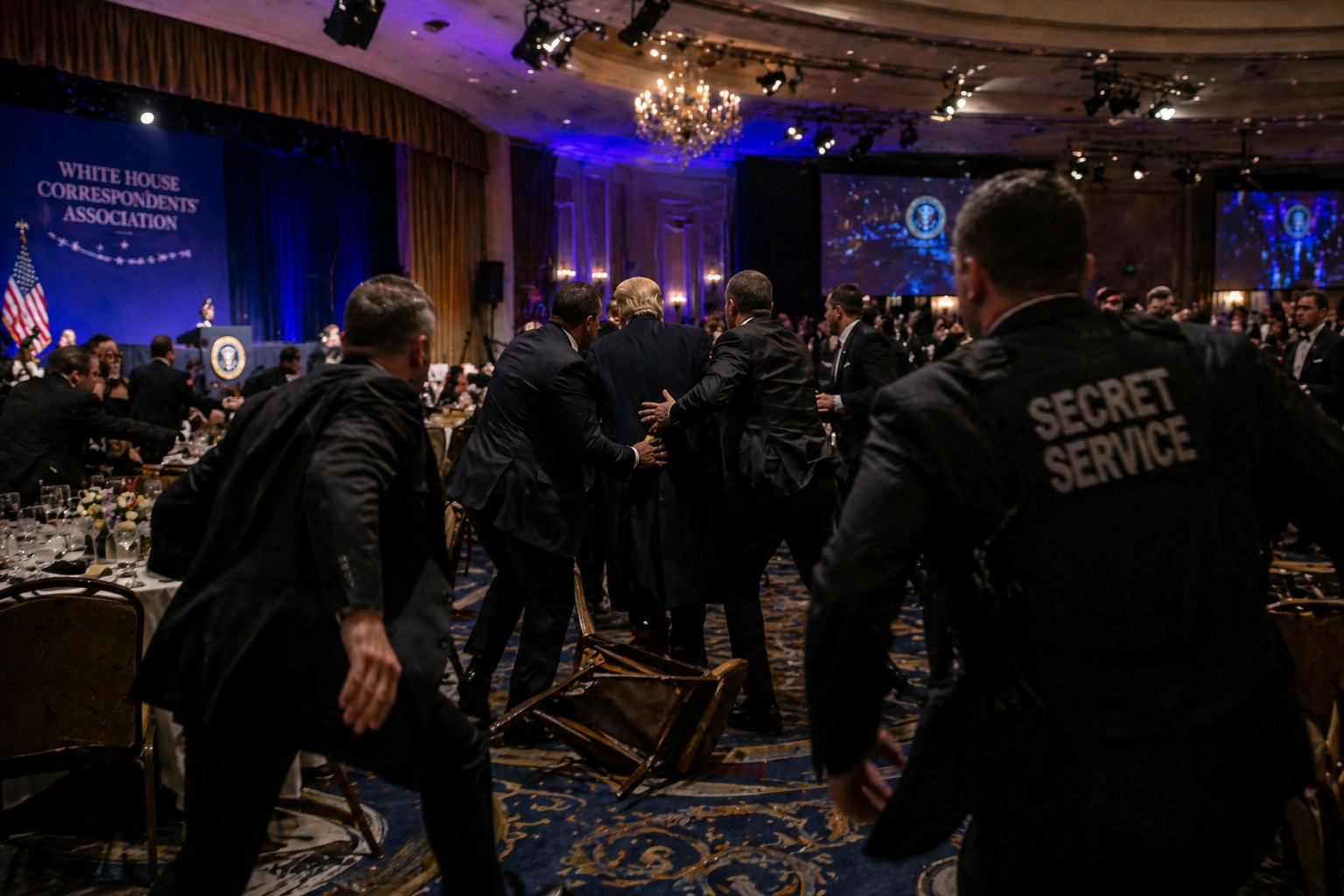
The incident unfolded at the White House Correspondents’ Dinner, one of the most security-heavy environments outside the White House itself.
An armed suspect approached a security checkpoint inside the venue—reports indicate he was carrying a shotgun, a handgun, and knives.
He then attempted to push through the perimeter. Shots were fired.
Multiple gunshots were heard inside or near the screening area
A federal officer was struck but survived due to body armour
Trump and senior officials were rushed out immediately
The suspect was subdued and taken into custody within minutes
No fatalities were reported. But that almost feels secondary.
Because the core question isn’t “what happened?”
It says, "How close did this get?”
Who the Shooter Is
Authorities have identified the suspect as Cole Tomas Allen, a 31-year-old from California.
What is known so far:
He travelled across the country to reach Washington
He had checked into the same hotel hosting the event
He appears to have acted alone
He is currently in custody and expected to face federal charges, including attempted assassination
Early reporting suggests no clear motive has been confirmed. But investigators believe he was targeting members of the administration—potentially including the president.
That matters. Because it shifts the narrative from a random act to something far more deliberate.
The Detail That Changes Everything
He “barely got past the perimeter.”
That single detail does most of the work in this entire story.
Security did not fail in the sense of allowing full access. The suspect didn’t reach the ballroom. He didn’t reach the president.
But he got close enough that shots were fired within the protective bubble.
That’s the uncomfortable middle ground:
Not a full breach
Not a complete failure
But not a clean prevention either
It’s the difference between “stopped early” and “stopped just in time.”
And those are not the same thing.
What Media Misses
What Media Misses
The focus naturally lands on the suspect—his name, his background, his motive.
But that’s the least stable part of the story.
The deeper issue is structural:
This event is now another incident in a growing pattern where high-profile targets are approached more closely than expected before intervention occurs.
The important shift isn’t just that individuals are attempting these acts.
It’s that they are increasingly able to get close enough to create real moments of risk.
That changes how these events should be understood:
Not as isolated shocks
But as signals of pressure building around the system
Why This Matters More Than It Looks
At first glance, the incident will be framed as a “failed attempt.”
And technically, it was.
But zoom out:
A suspect travels cross-country
Gains access to a high-security venue
Approaches a live checkpoint
Fires shots
Injures a federal officer
Triggers presidential evacuation
That is not a near miss in the abstract.
That is proximity.
And proximity is what changes risk calculations.
Because the closer someone gets, the smaller the margin for error becomes next time.
What Happens Next
There are three timelines that now matter.
1. Legal escalation
The suspect is expected to face serious federal charges, potentially including attempted assassination and assault on a federal officer.
2. Security reassessment
This incident will trigger a deep internal review—not just of procedures, but of assumptions.
Where did detection fail?
How did access occur?
What signals were missed?
3. Political and psychological ripple effects
Even without injury to the president, incidents like this shift perception:
Among security agencies
Among political actors
Among the public
They reinforce a sense that volatility is no longer theoretical.
The Real Meaning
This was not just about a man with weapons.
It was about distance.
Distance between a threat and a target.
Distance between prevention and reaction.
Distance between control and chaos.
And in this case, that distance was smaller than it should have been.
That’s the part that lingers.
Because events like these are rarely judged only by what happened.
They are judged by how close they came to being something worse.
And this one came close enough to matter.
