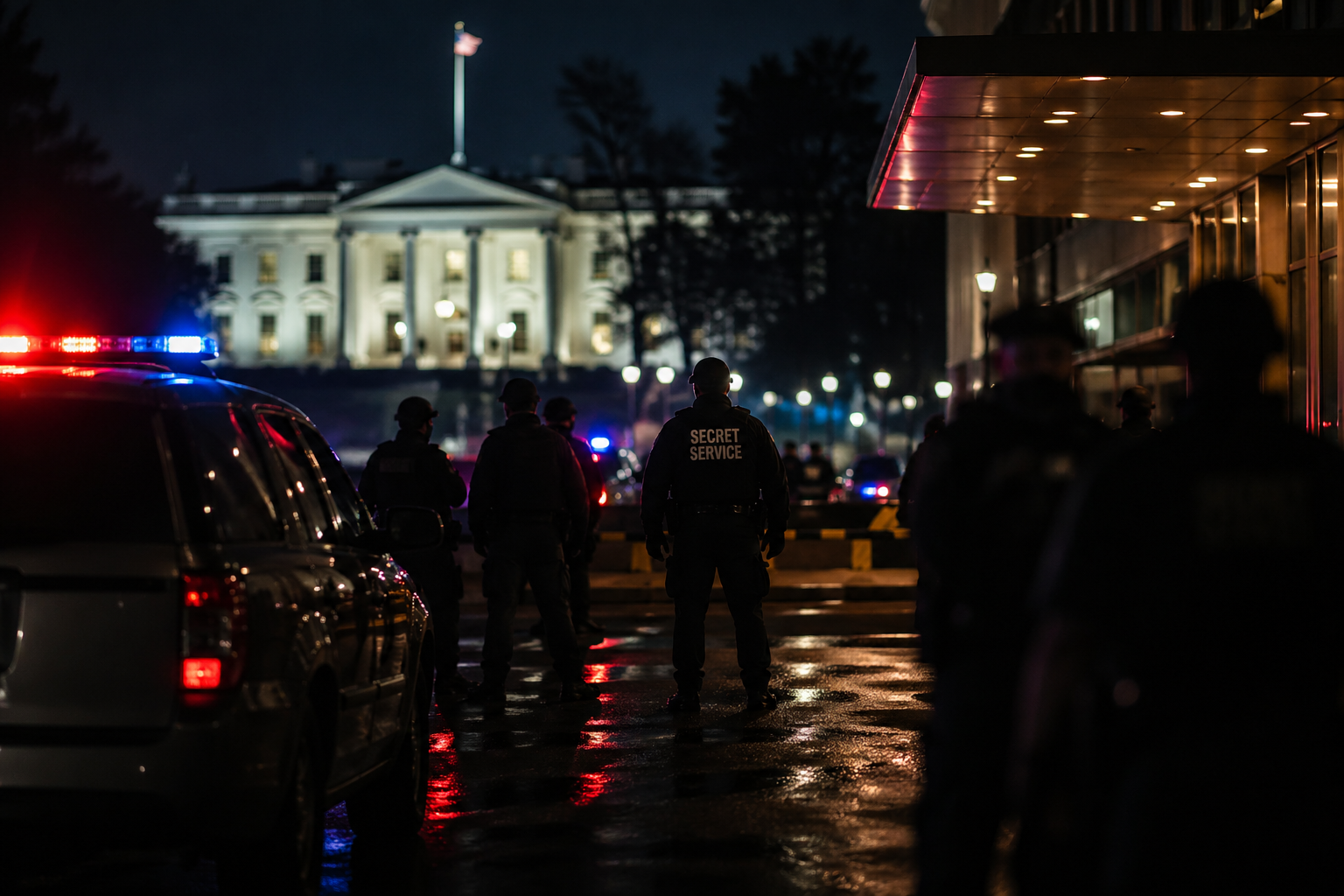
The Moment Political Violence Breached America’s Elite Circle
A Violent Breach Of America’s Most Symbolic Political Room
The illusion of distance shattered in seconds.
Inside one of Washington’s most controlled, visible and symbolic gatherings — the White House Correspondents’ Dinner — gunfire erupted. What is usually a choreographed mix of politics, media and celebrity became something else entirely: a reminder that proximity to power no longer guarantees insulation from violence.
On the evening of April 25, 2026, an armed man pushed toward a security checkpoint at the Washington Hilton, firing at least one shot before being stopped by Secret Service agents.
President Donald Trump and senior officials were rushed out. A federal agent was hit but survived due to body armour.
The attack failed in its immediate objective. But the implications extend far beyond that moment.
What Happened — And How Close It Came
The suspect, identified as 31-year-old Cole Tomas Allen, had travelled across the country, checked into the same hotel hosting the event, and approached the venue armed with multiple weapons, including a shotgun and handgun.
Witness accounts and official timelines suggest a rapid escalation. Shots were fired near the main screening area as he attempted to breach security.
The response was immediate. Secret Service agents intercepted him before he could reach the ballroom where political leaders, journalists and high-profile guests were gathered.
That timing matters.
Because the difference between an incident and a national trauma is often measured in seconds — and in this case, the system held.
The Motive Emerging From The Noise
Investigators are now piecing together a motive that appears rooted in political grievance.
Documents attributed to the suspect — including a manifesto sent to family shortly before the attack — outlined hostility toward the Trump administration and identified government officials as intended targets.
He reportedly described himself as a “friendly federal assassin” and framed the act as a form of corrective violence.
That language is not random. It reflects a mindset increasingly visible across multiple ideological extremes: the belief that violence can be justified not as chaos, but as intervention.
Authorities have been cautious in formal conclusions, but early assessments suggest the attack was politically motivated and aimed at figures associated with federal power.
What remains unclear is whether the president himself was the primary target or part of a broader list. That distinction may matter legally. It matters less symbolically.
Why This Moment Matters Now
The White House Correspondents’ Dinner is not just another event.
It is one of the rare spaces where political authority, media power and cultural influence physically converge. That convergence makes it symbolic — and therefore vulnerable.
This attack did not occur in isolation. It lands within a broader pattern of rising political tension, attempted attacks, and increasingly personalised hostility toward institutions and individuals.
The key shift is this:
Violence is no longer aimed only at abstract systems. It is being directed at visible gatherings of power.
And those gatherings are becoming harder to secure without fundamentally changing their nature.
The Security Question No One Can Avoid
The immediate response will focus on tightening security.
Reviews are already underway. Questions will be asked about how the suspect reached the checkpoint, how he travelled with weapons, and whether warning signs were missed.
But the deeper issue is structural.
Events like this are designed to be accessible enough to function — to allow interaction, visibility and proximity — while remaining secure. That balance is becoming harder to maintain.
Every added layer of protection reduces openness.
Every removed layer increases risk.
There is no clean solution.
What Most People Will Miss
The most important detail is not the weapon.
It is the framing.
The suspect did not appear to see himself as chaotic or irrational in his own narrative. His writings suggest intent, justification and targeting logic — a belief that he was acting within a moral framework, however distorted.
That is what makes incidents like this more difficult to predict and prevent.
They are not always driven by impulse.
They are often driven by constructed meaning.
And meaning travels faster than security responses.
The Information War That Followed
Within hours, the incident triggered another predictable reaction: a surge of speculation, misinformation and conspiracy theories online.
Claims that the event was staged or manipulated spread rapidly across platforms, despite no evidence.
This secondary wave matters.
Because it fractures consensus about what actually happened — and that fragmentation makes future responses harder, not easier.
Violence creates fear.
Uncertainty amplifies it.
Together, they reshape how events are interpreted, politicised and remembered.
The Broader Implication
This was not just a failed attack.
It was a signal.
A signal that even the most visible, high-security environments are being tested.
A signal that political grievance is increasingly personalised.
A signal that symbolic targets carry real-world risk.
And perhaps most importantly:
A signal that the boundary between spectacle and vulnerability is thinner than it appears.
Where This Leaves Washington
In the short term, the consequences are procedural: charges, investigations, security reviews.
In the long term, the consequences are cultural.
How close should power be allowed to the public?
How open can political life remain without becoming unsafe?
And what happens when individuals decide that visibility itself is justification for attack?personalized.
Those questions do not end with this incident.
They begin here.
The Bottom Line
The White House dinner shooting did not succeed in its immediate goal.
But it succeeded in something else: exposing a pressure point.
Not just in security.
Not just in politics.
But in the fragile assumption that proximity to power is still controlled.
That assumption is now harder to defend.
