

The World’s Most Critical Shipping Route Has Become A Battlefield Overnight
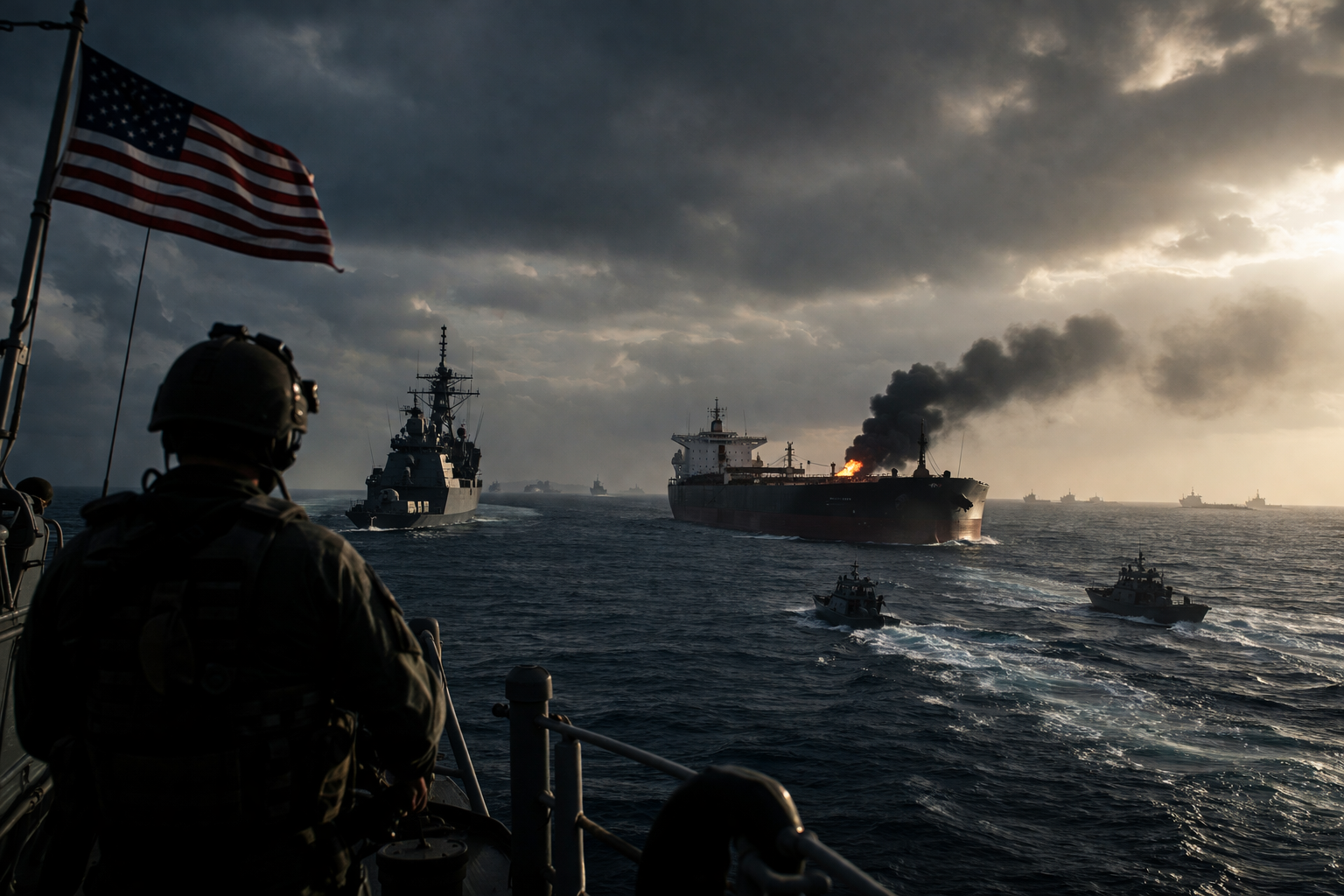
The Strait That Powers The World Is Under Fire — Here’s What Happens Next
Inside The Hormuz Crisis: Why One Tanker Strike Triggered A Global Response
A single strike on a tanker in one of the world’s narrowest maritime corridors has triggered a military and economic response far beyond the Persian Gulf. The United States is now mobilizing to protect commercial shipping through the Strait of Hormuz, a waterway so vital that any disruption ripples instantly through global energy markets.
The immediate catalyst was projectiles hitting a tanker near the United Arab Emirates, with no reported casualties but a clear escalation in risk. What matters is not just the attack itself but what it signals: the Strait of Hormuz is no longer a contested zone—it is an active conflict environment.
Within hours, Washington moved to launch a large-scale operation aimed at safeguarding commercial vessels and freeing ships stranded by escalating hostilities. This includes deploying troops, aircraft, warships, and surveillance assets to re-establish what policymakers call “freedom of navigation.”
That phrase sounds technical. In reality, it means preventing the collapse of the global energy system.
Why Hormuz Is Not Just Another Shipping Route
The Strait of Hormuz is not interchangeable with any other maritime passage. Roughly 20% of the world’s oil supply flows through this narrow stretch of water under normal conditions.
There is no meaningful alternative route. Unlike other chokepoints such as the Suez Canal, where ships can reroute at a cost, Hormuz offers no scalable workaround. Pipelines in the region can only absorb a fraction of the volume typically transported by sea.
That structural dependency turns any disruption into a global problem within days, not months.
Recent data shows just how severe the collapse has been. Traffic through the strait has dropped dramatically, with only a handful of vessels moving where over a hundred would normally pass each day. Ships are not just delayed — they are effectively trapped, with thousands of seafarers unable to leave the Gulf.
This is not a slowdown. It is a near shutdown.
The Dual Blockade That Changed Everything
The current crisis is not caused by a single actor. It is the result of overlapping military strategies that have turned the Strait into a choke point from both sides.
Iran has effectively restricted passage, warning that only certain vessels can transit safely, while deploying mines, patrol boats, and attack capabilities. At the same time, the United States has imposed its own naval blockade targeting Iranian shipping, intercepting vessels and enforcing restrictions on trade flows.
The result is what analysts describe as a “dual blockade.” Neither side fully controls the waterway, but both are capable of disrupting it.
This dynamic creates a uniquely dangerous equilibrium. Ships are no longer navigating a single threat but a layered system of risk where political alignment, insurance status, and perceived affiliations can determine whether a vessel is allowed to pass—or targeted.
The Immediate Economic Shock
The effects of this crisis are already visible in global markets. Oil prices have surged sharply, reflecting both reduced supply and heightened uncertainty.
But the real impact goes beyond petrol prices.
Energy flows underpin everything from food production to manufacturing logistics. When shipments stall, the consequences cascade through supply chains. Fertilizer costs rise. Transport costs increase. Industrial output slows. Inflationary pressure builds.
This is why the US response has been so rapid and so large. The operation is not simply about escorting ships. It is about preventing a systemic economic shock that could spread far beyond the Middle East.
Why The US Is Stepping In Now
The United States has framed its mobilization as a humanitarian and stabilization effort—aimed at freeing stranded ships and protecting civilian crews.
But the underlying logic is strategic.
If the Strait remains effectively closed, the global economy faces sustained disruption. As more countries become economically exposed, fuel prices rise, political pressure builds, and the risk of broader conflict increases.
The US is also responding to a credibility issue. Allowing a key international waterway to remain blocked would signal that Washington has historically sought to prevent a loss of control over global trade routes.
At the same time, the operation carries risk. Iran has warned that increased US involvement could escalate tensions further, potentially breaching fragile ceasefire conditions and triggering retaliation.
This is the paradox: intervention may stabilize the situation, but it could also deepen the conflict.
What Most People Are Missing
The visible story is about ships, oil, and military deployments. The deeper story is about fragility.
Modern globalization depends on a handful of critical nodes—places where geography and infrastructure intersect. The Strait of Hormuz is one of the most important of these nodes.
This crisis exposes the system's lack of redundancy. Decades of efficiency have removed buffers. Supply chains are optimized for cost, not resilience.
When a chokepoint fails, the system does not bend. It strains.
That is why a single tanker strike can trigger a military mobilization and move global markets within hours. The system is not built to absorb shocks at this scale.
The Next Phase: Stabilization or Escalation
The coming days will determine whether this situation stabilizes or intensifies.
If US-led efforts succeed in reopening shipping lanes, even partially, markets may calm and traffic could resume under heavy protection.
If attacks continue — or if either side escalates militarily — the Strait could remain effectively closed, extending the disruption and increasing the risk of a broader regional conflict.
There is also a third possibility: a fragile, negotiated arrangement where limited shipping resumes under strict conditions, maintaining tension while avoiding outright escalation.
None of these outcomes restores normality quickly.
The Bottom Line
The Strait of Hormuz is not just another geopolitical hotspot. It is the narrow hinge on which a large part of the global economy swings.
The tanker strike did not create the crisis. It revealed how far the project has already progressed.
The US mobilization is an attempt to hold that hinge in place. Whether it succeeds will determine not just the future of a shipping lane, but the stability of energy markets, supply chains, and economic confidence worldwide.
In a system so tightly connected, the difference between disruption and crisis is measured in days — not distance.
