Tim Curry Dead At 80 As Hollywood Loses One Of Its Most Unforgettable Performers
The Man Behind Some Of Cinema’s Greatest Characters
A Cult Legend Takes His Final Bow
Tim Curry, the British actor whose extraordinary voice, theatrical fearlessness and magnetic screen presence created some of popular culture’s most unforgettable characters, has died aged 80. His manager confirmed his death after Curry died at his Los Angeles home on Tuesday, August 25.
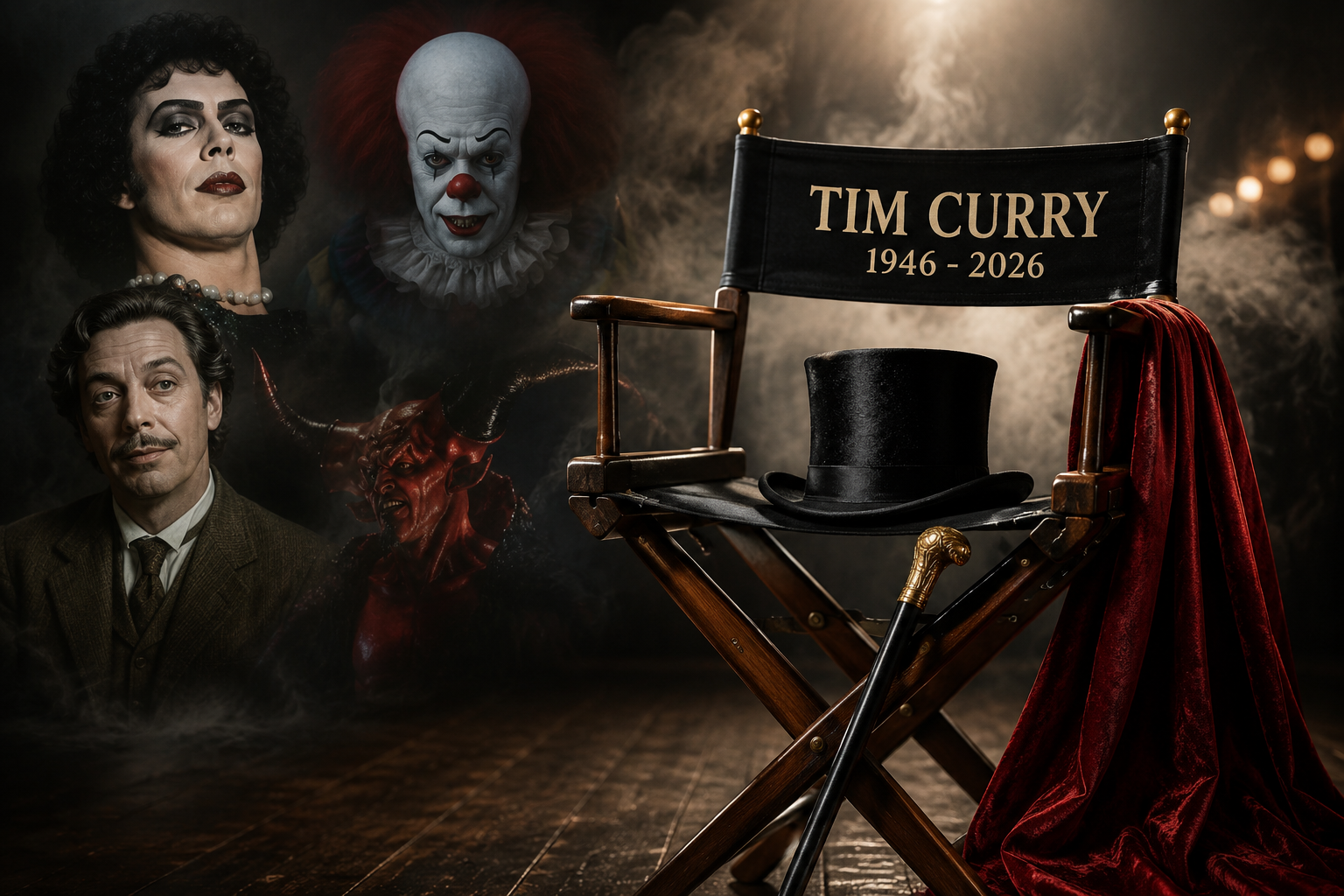
For millions, Curry will forever be Dr. Frank-N-Furter in The Rocky Horror Picture Show. For others, he will always be Pennywise lurking beneath the surface of Stephen King’s IT, the deliciously exasperated Wadsworth racing through Clue, or the monstrous Darkness towering over Ridley Scott’s Legend. Few actors managed to occupy so many radically different corners of popular culture — and make each one unmistakably their own.
The Performer Who Never Looked Like Anyone Else
Timothy James Curry was born on April 19, 1946, in Cheshire, England. His father was a Methodist naval chaplain, and Curry’s childhood involved repeated moves before the family eventually settled in Britain.
He studied Drama and English at the University of Birmingham between 1965 and 1968. Almost immediately afterwards, he entered the original London production of Hair, beginning a professional career that would eventually span theatre, cinema, television, animation, music, audiobooks and video games.
Curry did not become famous by behaving like a conventional leading man. The qualities that made him different were precisely the qualities that made him valuable: the voice, the arch delivery, the physical confidence and an ability to make theatrical excess seem completely controlled.
Then came the part that changed everything.
Frank-N-Furter Created A Cultural Phenomenon
In 1973, Richard O’Brien invited Curry to audition for his new experimental musical, The Rocky Horror Show. Curry became Dr. Frank-N-Furter, first on stage and subsequently in the 1975 film The Rocky Horror Picture Show.
It was an extraordinary performance: outrageous, funny, seductive, threatening and utterly committed. Curry did not appear to be asking the audience for permission to accept Frank-N-Furter. He simply owned the screen.
The film initially struggled to find a conventional mainstream audience, but that ultimately became part of its legend. Midnight screenings transformed Rocky Horror into a participatory cultural ritual, complete with costumes, audience responses and generations of fans who discovered it long after its original release.
Curry became inseparable from that phenomenon, but reducing his career to Frank-N-Furter misses what followed.
He was never merely the man from Rocky Horror.
Curry Became One Of Cinema’s Greatest Scene-Stealers
Where some performers disappear inside understated realism, Curry seemed capable of bending an entire production around himself.
As Wadsworth in the 1985 murder comedy Clue, he delivered one of his most beloved performances. Curry’s increasingly frantic reconstruction of the night’s murders turns the film’s final act into a showcase of physical comedy, verbal precision and controlled chaos.
The film developed its own cult following, creating another character that later generations would discover and quote decades after Curry first played him.
The same year brought something almost completely different. Under elaborate prosthetics in Ridley Scott’s Legend, Curry became Darkness, a towering horned embodiment of evil. Much of Curry’s most recognisable physical appearance was concealed, making his voice, movement and sheer presence even more important.
Then came Pennywise.
His Pennywise Traumatised A Generation
Curry played Pennywise the Dancing Clown in the 1990 television adaptation of Stephen King’s IT, creating perhaps his most frightening screen character.
The performance worked because Curry rarely treated Pennywise as simply a monster. He could be playful, sarcastic and almost amusing before suddenly becoming threatening. That instability made the character dangerous.
Long before modern visual effects could manufacture almost anything a horror director imagined, Curry relied heavily on performance. The smile, eyes, voice and abrupt changes in temperament did the work.
For a generation that encountered IT on television, Pennywise became one of childhood horror’s defining images.
It demonstrated something important about Curry. Even when makeup, costume or spectacle surrounded him, there was always a human performance underneath it powerful enough to dominate the character.
From Hollywood Villains To Muppets
Curry’s career refused to stay in one genre.
He appeared in Annie, The Hunt for Red October, Home Alone 2: Lost in New York, The Three Musketeers and Charlie’s Angels. He could play sinister, ridiculous, pompous, charming or some combination of all four.
His performance as Long John Silver in 1996’s Muppet Treasure Island became another fan favourite. Playing opposite the Muppets requires actors to commit completely to the strange world around them rather than treating themselves as the serious human presence in the room.
Curry understood that instinctively.
He performed Long John Silver with the same conviction he might have brought to a prestigious stage role, creating another oversized character without allowing him to become empty caricature.
The Stage Was Always At The Heart Of His Career
Cinema made Curry internationally recognisable, but theatre remained central to his professional life.
He earned three Tony Award nominations across his career, including recognition for playing Mozart in Amadeus, Alan Swann in My Favorite Year and King Arthur in Monty Python’s Spamalot.
His stage career demonstrated how misleading his reputation as simply a cult-film actor could be. Curry possessed the technical foundations of a serious theatre performer and could move between dramatic acting, musical theatre, comedy and extravagant character work.
Music mattered too.
Curry released three studio albums between 1978 and 1981 and toured as a recording artist. His distinctive voice was never merely an acting device; singing had been part of his life since childhood.
Yet it was another use of that voice that opened an enormous second career.
A Generation Knew Him Without Seeing Him
Curry became one of the entertainment industry’s most prolific voice performers.
He voiced Captain Hook in Peter Pan and the Pirates, winning a Daytime Emmy in 1991, and later became instantly recognisable to younger audiences as Nigel Thornberry in The Wild Thornberrys.
His credits spread across animation, audiobooks and video games.
That ability is part of what made Curry unusual. Remove the costumes, facial expressions and theatrical movement and the voice alone could still create a complete character.
It was resonant, mischievous and instantly identifiable.
That quality became even more significant after Curry’s life changed dramatically in 2012.
The Stroke That Changed Everything
Curry suffered a major stroke in July 2012.
The illness severely affected his mobility and began a long period of rehabilitation. For an actor whose physicality had been such an important element of roles from Frank-N-Furter to Wadsworth, it represented an enormous personal and professional change.
But Curry did not simply disappear.
He continued voice work and returned for selected appearances. In 2016, more than four decades after the original Rocky Horror, he appeared as the Criminologist in the television production The Rocky Horror Picture Show: Let’s Do the Time Warp Again.
His later public appearances also revealed something fans had always sensed in his performances: a dry humour that remained remarkably intact.
The stroke altered how Curry could work. It did not erase the performer.
Why Tim Curry Was Almost Impossible To Replace
There are actors with longer lists of leading roles. There are actors with larger box-office numbers. There are performers who received more conventional Hollywood awards.
But Curry occupied a stranger and perhaps more durable category.
He created characters people remember after seeing them once.
Frank-N-Furter does not feel like a role waiting for another actor. Curry’s Pennywise remains distinctive even after an entirely new screen interpretation of the character became enormously successful. Wadsworth still powers Clue. Darkness remains one of fantasy cinema’s great physical villains.
Even his smaller roles had a tendency to escape the boundaries of the films containing them.
That is not an accident.
Curry understood excess. More importantly, he understood the discipline required to make excess work.
A Cult Icon Whose Work Became Mainstream Memory
The word “cult” follows Tim Curry everywhere, and for good reason. Rocky Horror and Clue are among the clearest examples of films whose reputations grew enormously after their initial release.
But eventually enough cult classics become classics that the distinction starts to disappear.
Curry’s work crossed generations because new audiences kept finding it. Children encountered Nigel Thornberry. Horror fans discovered Pennywise. Comedy fans found Clue. Musical audiences found Rocky Horror. Theatre audiences knew a performer capable of taking on Mozart and King Arthur.
His career became less like a single trajectory and more like a collection of cultural entry points.
Different generations could know Tim Curry for completely different reasons and still immediately understand what made him special.
The Final Curtain
At the time of his death, a cause had not been publicly established. Authorities said foul play was not suspected, while Curry had lived with significant health problems since his 2012 stroke.
What is already clear does not depend on the circumstances of his death.
Tim Curry spent more than half a century refusing to be ordinary.
He could turn a clown into a nightmare, a butler into the engine of an entire comedy, a horned fantasy villain into something genuinely intimidating and a corseted extraterrestrial scientist into one of cinema’s defining cult characters.
The strange thing about losing an actor like Curry is that so much of him remains immediately accessible. Press play and the voice returns. The eyebrow rises. The joke lands. The room suddenly belongs to him.
Tim Curry has died at 80.
Frank-N-Furter, Pennywise, Wadsworth, Darkness, Nigel Thornberry and Long John Silver remain behind — a collection of characters so distinctive that it is difficult to imagine anyone else having created them quite the same way.
