Trump Threatens NATO Exit as Iran War Pushes Alliance to Breaking Point
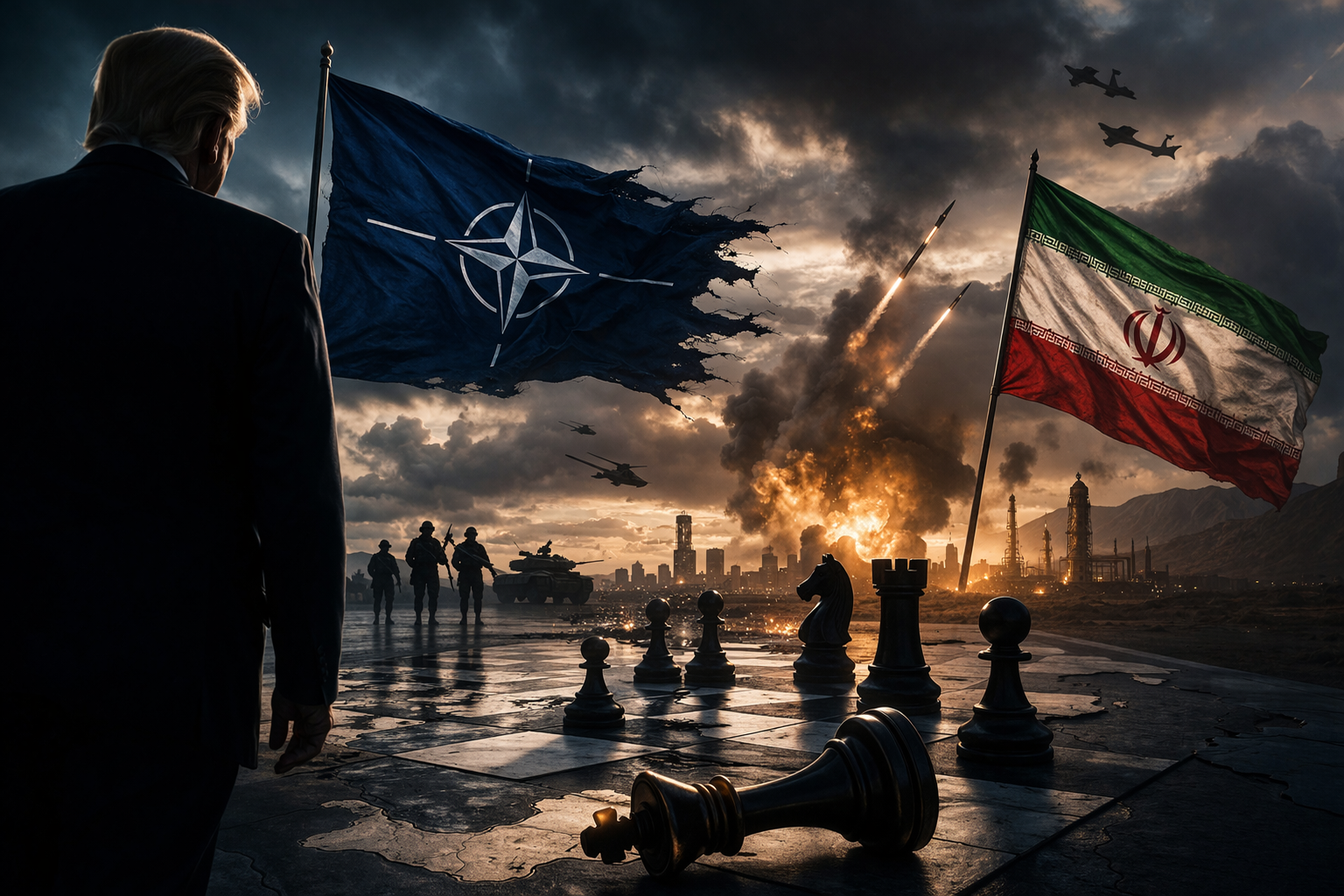
Is NATO Finished? Trump’s Iran War Gamble Raises the Question
NATO on the Brink? Trump’s Iran War Escalation Sparks Global Alarm
The United States is simultaneously escalating a war with Iran and openly questioning its commitment to NATO—a combination that would have been unthinkable even a year ago.
President Donald Trump has said he is “absolutely” considering withdrawing from the alliance, citing frustration that European allies have refused to support the U.S.-Israel military campaign against Iran.
That threat lands at the exact moment the conflict itself is expanding, with oil prices surging, the Strait of Hormuz effectively disrupted, and Iran warning of broader retaliation.
The result is not just a war. It is a test of the entire post–World War II security order.
The story turns on whether the United States is still willing to anchor that system—or is actively stepping away from it.
Key Points
Trump has explicitly raised the possibility of withdrawing the U.S. from NATO amid frustration over lack of allied support in the Iran war.
The current conflict began in late February 2026 with U.S.-Israel strikes and has since escalated into a broader regional confrontation.
European allies have largely refused military involvement, exposing a deep fracture in transatlantic coordination.
Oil markets are already reacting, with price spikes driven by instability in the Strait of Hormuz—a critical global energy artery.
U.S. law may constrain a NATO withdrawal, setting up a potential constitutional conflict between the presidency and Congress.
The combination of war escalation and alliance uncertainty creates a second-order risk: a structural shift in global power alignment.
The Break That Was Already Forming
The current rupture did not begin with the Iran war—but the war has accelerated it dramatically.
When the U.S. launched strikes on Iran in February, it did so without invoking NATO’s collective defense clause or building a coalition first.
That decision mattered.
NATO is not just a military alliance. It is a coordination mechanism. It assumes shared threat perception, shared decision-making, and shared risk.
None of those conditions held.
European governments quickly signaled reluctance to participate. Some refused airspace access. Others explicitly stated, "This conflict is not our war.”
From Washington’s perspective, that looked like abandonment.
From Europe’s perspective, it looked like exclusion.
That gap is now the central fault line.
The Iran War and the Alliance Stress Test
The war itself is evolving fast.
Trump has claimed major military success—including crippling Iran’s conventional forces—but has offered no clear timeline for ending the conflict.
At the same time, he has threatened deeper strikes on infrastructure, including oil and power systems, if Iran does not comply with U.S. demands.
Iran, for its part, has not collapsed.
It retains key capabilities, continues to threaten retaliation, and is leveraging geography—particularly the Strait of Hormuz—as a strategic choke point.
That matters because roughly a fifth of the world’s oil passes through that corridor.
When it becomes unstable, everything else follows:
energy prices rise
supply chains tighten
inflation pressure increases globally
This is why the conflict is not contained, even if the battlefield is.
The Power Shift Hidden Inside the Headline
At first glance, Trump’s NATO comments look like pressure tactics—an attempt to force allies into contributing.
But the deeper shift is structural.
For decades, the U.S. security guarantee in Europe has been unconditional.
Now it is explicitly conditional.
Support the war, or the alliance itself may be reconsidered.
That changes the incentive structure completely.
European states are no longer just weighing military risk in the Middle East.
They are weighing whether the U.S. itself is becoming an unreliable guarantor of their security.
What Most Coverage Misses
The critical hinge is not whether Trump can legally withdraw from NATO.
It is whether he needs to.
Even if formal withdrawal is blocked—and U.S. law now requires congressional approval for such a move—the alliance can be weakened in practice.
NATO depends on credibility more than paperwork.
If allies begin to doubt U.S. commitment, they adjust behavior immediately:
investing more in independent defense
forming parallel coalitions
hedging relationships with other powers
In that sense, the alliance can fragment before it formally breaks.
That process may already be underway.
Why Europe’s Response Is Rational — and Risky
From a European standpoint, staying out of the Iran war is logical.
The conflict was not coordinated through NATO structures.
The objectives remain unclear.
The escalation risks are high.
But that decision carries its own risk.
If the U.S. interprets restraint as disengagement, it may reduce its own commitments in Europe.
That creates a feedback loop:
Europe distances itself from the war
the U.S. distances itself from Europe
both sides become less aligned over time
This is how alliances weaken — not through a single decision, but through cumulative divergence.
The Legal Constraint vs Political Reality
On paper, withdrawing from NATO is not simple.
A recent U.S. law requires either a two-thirds Senate vote or an act of Congress to exit the alliance.
But the Constitution is ambiguous on treaty withdrawal powers, and past precedent suggests presidents may attempt unilateral action.
That creates a potential constitutional confrontation:
executive authority vs legislative constraint
foreign policy control vs treaty obligations
Even if courts ultimately block withdrawal, the dispute itself would deepen uncertainty.
And uncertainty, in geopolitics, is a force multiplier.
The Global Stakes Are Larger Than the War
This moment is not just about Iran.
It is about three overlapping systems under stress:
Energy system—disrupted by Hormuz instability
Security system—strained by NATO fragmentation
Political system—destabilized by unclear U.S. strategy
Each of these feeds into the others.
Higher energy prices increase domestic pressure in Western countries.
Domestic pressure reduces political appetite for prolonged conflict.
Reduced cohesion weakens alliance response.
The system becomes self-reinforcing—but in the wrong direction.
Where This Could Go Next
There are three realistic paths from here.
1. Tactical De-escalation, Strategic Damage
The war winds down, but NATO trust remains weakened.
Long-term consequence: gradual European strategic independence.
2. Continued Escalation, Alliance Breakdown Risk
The conflict intensifies, and U.S.-Europe divisions widen.
Long-term consequence: a fractured Western security bloc.
3. Forced Realignment Under Pressure
Energy disruption or escalation forces renewed coordination.
Long-term consequence: NATO adapts—but under strain.
Each path carries a different version of the same question:
Is NATO still a collective defense alliance—or becoming a conditional partnership?
The Strategic Fork in the Road
The immediate issue is war.
The deeper issue is alignment.
If the United States continues to link alliance commitment to support for specific conflicts, NATO becomes transactional.
If Europe continues to resist U.S.-led interventions without offering alternatives, the alliance becomes hollow.
The balance between those two outcomes will define the next phase of global security.
And that is why this moment matters far beyond Iran.
