Trump’s “Eliminate Them” Order: The Moment a Naval Blockade Became a Global Flashpoint
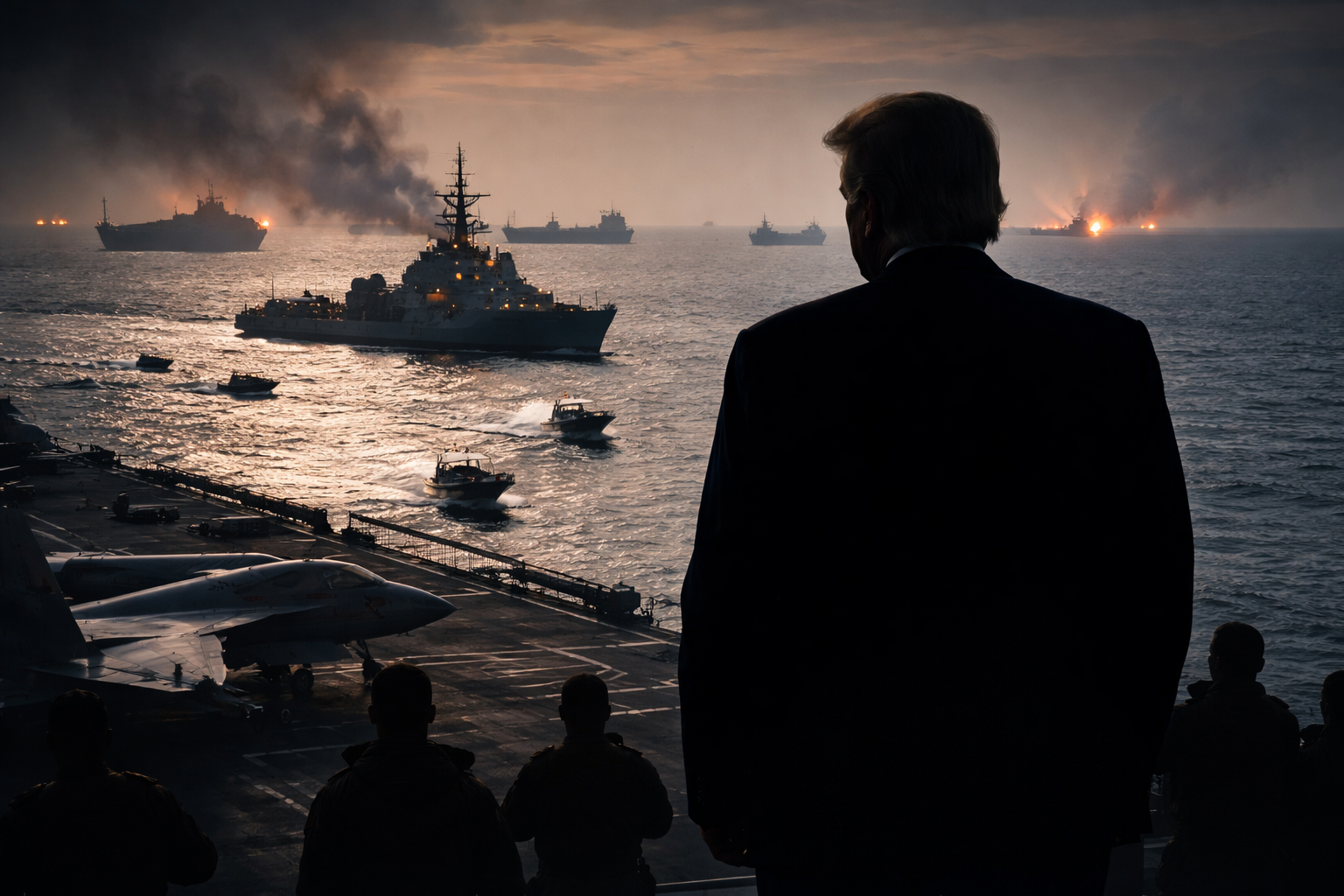
A Blockade, A Threat, A Trigger: Why This Moment Could Spiral Fast
The Line Has Been Drawn: Trump Warns Ships Will Be “Eliminated” Near Iran Blockade
An explicit threat of force turns a strategic blockade into a live risk of war in one of the world’s most critical waterways.
A Blockade With Teeth — And a Trigger
The United States has begun enforcing a naval blockade on Iran. That alone would be enough to rattle global markets and redraw the geopolitical map of the Middle East.
But the defining moment is not the blockade itself.
It is the warning that came with it.
Any Iranian vessel that approaches the blockade, Donald Trump said, will be “immediately eliminated.”
That single line transforms the operation from a strategic pressure tactic into something far more volatile: a live, rules-of-engagement scenario where miscalculation could trigger direct military confrontation within minutes.
What Is Actually Happening
The blockade, confirmed by US Central Command, targets maritime traffic entering and leaving Iranian ports, rather than fully closing the Strait of Hormuz to all shipping.
That distinction matters.
It allows global shipping to continue—in theory
It focuses pressure specifically on Iran’s economy and oil exports
It avoids, at least formally, a total shutdown of one of the world’s most critical trade arteries
But the practical reality is far messier.
The Strait of Hormuz carries roughly 20% of global oil supply.
Any military presence, interception, or threat in that corridor instantly raises risk for the following:
Commercial shipping
Energy markets
Regional military actors
And now, that risk includes explicit lethal enforcement.
The Real Escalation: From Deterrence to Engagement
Blockades are not new. They are a classic tool of economic and military pressure.
What is different here is the clarity of intent.
This is not ambiguity.
This is not strategic vagueness.
This is a direct statement: approach, and you will be destroyed.
The primary reason for this is
It removes ambiguity from the battlefield.
Iran’s naval doctrine relies heavily on asymmetric tactics—small, fast-attack vessels; mines; and unconventional maritime threats.
Those tactics thrive in grey zones.
They rely on hesitation, uncertainty, and blurred thresholds.
Trump’s statement eliminates that grey zone.
It replaces the original outcome with a binary one.
And that makes escalation more likely, not less.
Why This Is Bigger Than It Looks
On the surface, the issue is about enforcing a blockade.
Underneath, it is about something far more consequential:
Control of the global energy system.
The Strait of Hormuz is not just another shipping lane.
It is one of the world’s most critical chokepoints.
When pressure is applied there, three things happen immediately:
Oil prices spike — already pushing above $100 per barrel
Markets destabilise across continents
Governments are forced into rapid strategic positioning
This is not a regional story.
It is a global economic event with military enforcement behind it.
What Media Misses
Most coverage focuses on the blockade's escalation.
It is not.
Escalation is the rule attached to it.
A blockade without a clear trigger for force is a negotiation tool.
A blockade with an explicit kill threshold is a battlefield condition.
That distinction changes everything:
It compresses decision-making time from days to seconds
It increases the probability of accidental conflict
It removes space for de-escalation once an encounter begins
The real story is not that ships are being stopped.
It is that the consequences of getting too close have been defined in absolute terms.
The Strategic Logic — And Its Risk
From a US perspective, the logic is clear:
Force Iran to reopen maritime routes
Cut off revenue streams
Apply maximum pressure without immediate large-scale war
From Iran’s perspective, the logic is equally clear:
Challenge the blockade to avoid strategic humiliation
Maintain credibility in the region
Use asymmetric tactics to offset conventional weakness
This is where the danger sits.
Both sides have incentives to test the line.
And the line has now been made brutally clear.
What Happens Next
Three scenarios now define the immediate future:
1. Controlled Standoff (Most Stable, Least Likely Over Time)
Ships avoid confrontation.
The blockade holds.
Pressure builds economically.
2. Limited Clash (Most Likely)
A fast-attack vessel approaches.
The US responds.
A single incident triggers a contained but serious escalation.
3. Regional Escalation (Most Dangerous)
Iran retaliates across multiple fronts—shipping, infrastructure, and proxies.
The conflict expands beyond the Strait.
Experts are already warning the operation could become “open-ended” with severe geopolitical consequences.
The Aftershock
There is a moment in every geopolitical crisis where pressure becomes something else.
Where signaling becomes action.
Where deterrence becomes engagement.
This may be that moment.
Because once a threat like this is issued, it has to be credible.
And once it is credible, it has to be used if challenged.
The blockade is the headline.
The rule of engagement is the story.
And the risk now is not whether tension exists.
It is whether the first ship gets too close.
