

Trump’s World Economic Forum Speech Summary: Power, Pressure, and the World Stage
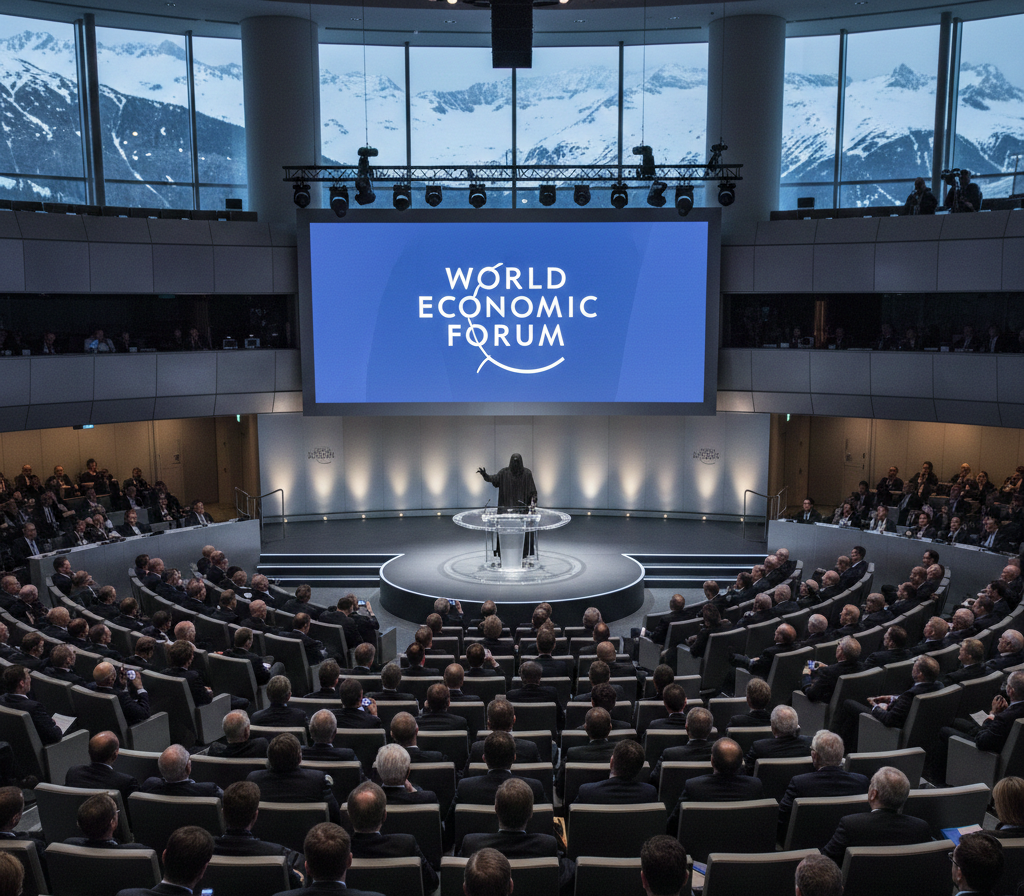
Trump’s Davos speech fused Greenland and tariffs into one pressure play. Here’s what changed, what markets fear, and what happens next.
A Test of the Global Order
Donald Trump’s World Economic Forum address in Davos landed less like a conventional “global economy” keynote and more like a live negotiation—with trade threats positioned as leverage in a sovereignty dispute over Greenland. The most market-relevant message was something other than a single tariff rate or one line about growth. The implication was that one could quickly fuse tariff pressure with geopolitical demands in public.
Trump opened with familiar domestic-economic signaling—booming markets, retirement account gains, and claims that inflation is under control—then pivoted into a tougher, more confrontational posture toward Europe. Immigration and energy policy were used as cultural and security contrasts, while Greenland was framed as a strategic necessity for “the West,” not a bilateral quarrel.
The story turns on whether tariffs become a bargaining tool for sovereignty issues—or a catalyst for retaliation that forces everyone into a faster escalation cycle.
Key Points
Trump framed the U.S. outlook as strong and improving, then used that confidence to justify a harder line on trade and alliances.
Greenland was treated as a strategic security requirement, with Trump pressing allies to accommodate U.S. aims and tying the dispute to economic pressure.
He questioned alliance reliability in a way that sharpened the signal to markets: this is not only about trade, it is about the rules governing coercion among allies.
He attacked Europe’s direction on migration and energy transition, positioning the U.S. as the alternative model.
The near-term watch is operational detail: timelines, enforcement mechanics, and carve-outs—because markets can price policy but struggle to price improvisation.
The second-order watch is Europe’s response posture: visible preparation of countermeasures is what turns rhetoric into a durable standoff.
Background
Davos typically runs on choreography: leaders signal, investors listen for guardrails, and everyone scans for stability. This week, the backdrop was already unstable because Greenland—an autonomy-and-sovereignty question within the Kingdom of Denmark—has been pulled into a broader contest over security, leverage, and alliance hierarchy.
Your live write-up reflects Trump's approach, which disrupts previously established boundaries. Trade tools are normally justified as economic policy (industrial protection, bargaining for market access, and supply-chain security). Here, the perceived linkage is starker: political compliance on a territorial-security matter, backed by a tariff threat. That linkage is what creates the “policy shock” feeling—less about the number, more about the precedent.
Analysis
The Speech served as a negotiation broadcast rather than a Davos keynote.
Trump’s structure followed a pattern: establish domestic strength first, then spend that perceived strength as leverage abroad. In Davos terms, it was a message designed to move counterparties and markets simultaneously—public lines used to shape private bargaining.
For investors, the risk is not ideological. It is execution and predictability. Tax cuts and growth claims can be modeled. Tariffs can be modeled. But tariffs deployed as conditional punishment for political resistance inject a different kind of uncertainty: governments and firms cannot easily assume the dispute stays in the “trade lane.”
Plausible scenarios:
Rhetoric-only plateau: strong language, limited near-term action.
Signposts: no dates, no formal notices, no clear scope.Fast-track action: a concrete timetable with targeted sectors or countries.
Signposts: explicit start dates, customs guidance, and draft legal instruments.Conditional bargaining: tariffs presented as reversible if conditions are met.
Signposts: “off-ramps,” private meetings, and officials emphasizing negotiation channels.
Greenland served as the central focus of the message.
Greenland was not treated as a sidebar. It was framed as strategic geography—security for the U.S. and, by extension, “the West.” That framing matters because it attempts to convert an allied sovereignty issue into an alliance “necessity” and then use economic tools to compress the timeline.
Trump also emphasized the alliance angle in a manner that escalated the risks: publicly questioning NATO solidarity transforms trade threats from mere bargaining to discipline. Even in the absence of immediate action, the signal can compel capitals to strategize for future use.
Europe’s Constraint: Unity Looks Strong Until It Costs Money
European resistance is easiest when it is rhetorical and collective. It gets harder when tariff exposure becomes uneven—when the pain is distributed asymmetrically across industries and countries. The U.S. advantage in a standoff like this is bilateral pressure: carve-outs, exceptions, and “special relationship” channels can peel cohesion. Europe’s advantage is scale, but scale requires discipline.
Plausible scenarios:
Unified deterrence posture: public solidarity, quiet negotiations.
Signposts: coordinated messaging, shared timelines, fewer divergent red lines.Quiet fragmentation: some states seek exemptions.
Signposts: bilateral deals, divergent rhetoric, selective de-escalation.Formal countermeasures: Europe prepares retaliation pathways.
Signposts: legal preparations, published contingency lists, and a wider “economic security” posture.
Money, Markets, and the Uncertainty Premium
The key market dynamic: the reaction is less about one headline number and more about tail risk—what happens when the global trade system starts to look like a tool for geopolitical coercion among allies? That uncertainty premium shows up first as volatility and hedging behavior, not as a clean “risk-on/risk-off” flip.
In practical terms, markets and firms can adapt to a tariff regime if it is stable. They struggle when the regime looks improvisational, conditional, and politically contingent. That is when investment slows, contracts get re-priced, and supply chains get redesigned for “optionality,” even at a cost.
What Most Coverage Misses
The hinge is that Trump’s Davos posture tests whether the trade system can be repurposed as a tool of territorial bargaining—openly and quickly—without collapsing alliance trust.
States build retaliation and resilience playbooks as standard operating procedures if they believe tariff threats can be linked to sovereign disputes. Firms then accelerate de-risking—not just away from one market, but away from policy uncertainty itself.
Two signposts to watch in the next days and weeks:
Whether officials explicitly describe tariff threats in political terms instead of economic ones is a key indicator to watch.
The shift from statements to visible preparations, such as legal work, countermeasure lists, and coordinated timelines, is a crucial aspect to monitor in Europe.
What Changes Now
In the next 24–72 hours, the most affected are trade-exposed firms and governments trying to prevent a spiral. The immediate consequence is sequencing: markets will respond to timetable clarity (or the lack of it) faster than diplomacy can stabilize expectations.
In the weeks ahead, the stakes widen. If tariff threats become tied to political alignment, boards and governments will treat exposure as a durability problem and spend money to reduce vulnerability—because paying for resilience can be cheaper than being trapped in the next bargaining round.
The core “because” line is simple: capital slows when rules feel negotiable, because predictable rules are the invisible infrastructure of investment.
Real-World Impact
A European exporter delays signing U.S. supply contracts because tariff assumptions could flip margins overnight.
A U.S. importer runs emergency pricing scenarios but hesitates to pass costs through too fast, fearing demand destruction.
A logistics firm reroutes capacity and adds buffers because customers are paying for optionality, not efficiency.
A government trade team reallocates staff toward contingency planning because markets react in hours, while legal and diplomatic processes move in weeks.
The Davos Signal Markets Can’t Ignore
Davos is often dismissed as talk. This year, the talk carried a different weight because it blended sovereignty, alliance credibility, and tariff leverage in the same frame. This combination compels governments and firms to strategize for a future where trade tools serve not only for economic bargaining but also for political enforcement.
Watch for three practical signposts: concrete tariff mechanics, visible EU counter-preparation, and language that turns a standoff into a timetable. If those appear, today’s “shock” becomes tomorrow’s structure—and the era changes quietly, through procurement decisions and legal memos rather than dramatic speeches.
