

Ukraine’s Micro-Ceasefire: The Thin Line Between Nuclear Safety and Battlefield Failure
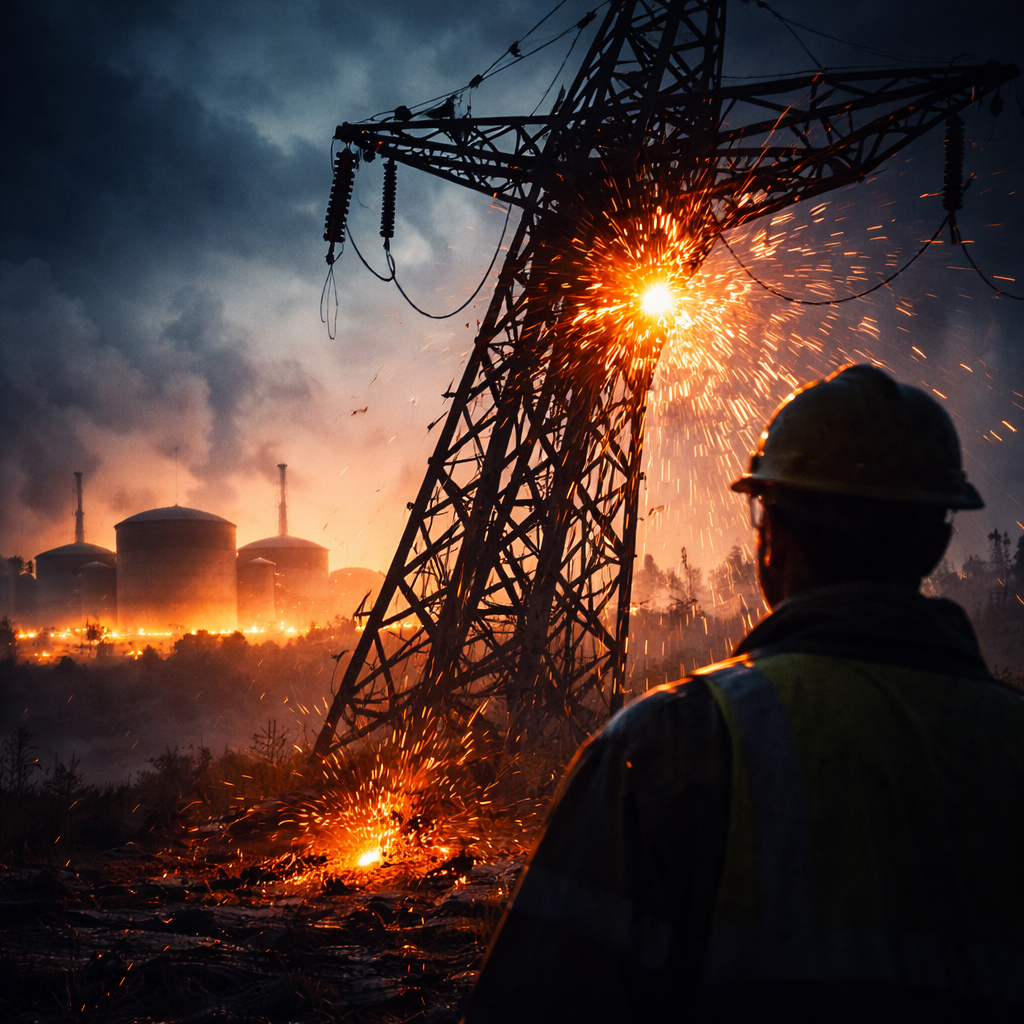
Ukraine and Russia agreed to a localized ceasefire to fix a Zaporizhzhia backup power line. Here’s what it signals—and how it could fail fast.
Ukraine’s “Localized Ceasefire” for Zaporizhzhia Power Line Repairs: The Tiny Truce That Signals Deconfliction
Ukraine and Russia have agreed to a localized ceasefire to let repair crews access a damaged backup external power line linked to the Zaporizhzhia Nuclear Power Plant (ZNPP). The point is narrow and brutally practical: restore redundancy for off-site power, so a single failure does not push the plant toward emergency measures.
This is not peace talk. It is crisis management in a war zone—an attempt to buy a small window where technicians can do work that missiles and drones keep undoing.
There is a deeper signal embedded in the tiny truce: even when the front line is frozen, the machinery of deconfliction can still operate—until it can’t.
The story turns on whether localized deconfliction can hold long enough to restore redundancy before the next strike.
Key Points
A localized ceasefire has been agreed to allow repair access for a damaged backup power line connected to the Zaporizhzhia nuclear site.
The immediate aim is to reduce the risk created by reliance on a thinner set of remaining external power options.
The agreement is “micro” by design: geographically limited, time-limited, and focused on a single technical task.
Verification is the fragile center of gravity—if the repair corridor cannot be protected, the ceasefire is just a headline.
The incentives align in a narrow band: neither side benefits from a nuclear-adjacent accident, but both benefit from ambiguity about who caused what.
The most likely failure modes are not a deliberate “break” of the pause, but drones, misfires, spoofed attribution, or deniable actors.
The next 48 hours matter most: whether crews reach the line, whether repairs progress, and whether a follow-on window is negotiated.
Background
A “localized ceasefire” is a limited pause in hostilities in a specific area, usually for a defined purpose: evacuations, body recovery, or repairs to critical infrastructure. It is not a broader ceasefire, does not imply political convergence, and does not guarantee safety beyond the agreed corridor and time window.
Zaporizhzhia is the highest-stakes case for this kind of narrow truce because nuclear facilities do not need to be “operating” to be dangerous. Even with reactors shut down, the site still requires steady electricity to run essential safety systems, including cooling and monitoring equipment, and to manage spent fuel safely. When external power is lost, nuclear sites rely on emergency backups such as diesel generators—measures that are meant to bridge short disruptions, not normalize life at the edge.
The practical issue here is redundancy. A backup line is not a luxury item; it is the engineering margin that turns a shock into an inconvenience instead of a cascading emergency.
Analysis
Political and Geopolitical Dimensions
The politics of a micro-ceasefire are about control without concession. For Russia, a narrow pause can be framed as stewardship over a site it occupies, while keeping military options intact elsewhere. For Ukraine, it can be framed as protecting national infrastructure and preventing an accident on Ukrainian territory—without legitimizing the occupation. Both can agree to the task while disagreeing on every word around it.
The IAEA’s role (when it is present and accepted) functions as a practical bridge: a way to create a channel that neither side wants to admit it needs. That channel is also a signal to external stakeholders. If deconfliction is possible for a power line, it suggests there is at least some capacity for bounded coordination under pressure.
Scenarios to watch:
Narrow compliance, fast repair, quiet exit. Signposts: repair crews reach the site; “window” holds with minimal incidents; the story fades quickly.
Compliance with friction. Signposts: delays due to demining, access disputes, or sporadic alarms; the corridor stays technically “open” but unsafe.
Early breakdown. Signposts: reported strikes in the vicinity; blame ping-pongs immediately; repairs pause and do not restart.
Economic and Market Impact
A localized pause around a nuclear-adjacent line is not a market-moving ceasefire, but it is a risk-management event. The economic value is in avoided catastrophe: preventing a nuclear safety crisis that would impose huge costs on regional logistics, insurance, energy planning, and public budgets.
It also intersects with a broader winter-energy context. Repairing a backup line is a small part of a larger reality: repeated strikes and repairs grind down equipment, crews, and response capacity. Over time, the economic impact looks less like a single outage and more like chronic fragility.
Scenarios to watch:
Stabilization-by-increments. Signposts: repeated successful micro-windows; fewer emergency power events.
Repair treadmill. Signposts: repairs completed, then re-damaged within days or weeks; escalating resource strain.
Risk premium creeps. Signposts: tighter operating constraints; public warnings about energy reliability and safety procedures.
Social and Cultural Fallout
For civilians living near high-risk infrastructure, “nuclear-adjacent” is not abstract. It shapes daily routines: preparedness behavior, trust in official information, and the baseline anxiety of living under repeated alert conditions. Even if nothing happens, repeated close calls can change a community’s psychology.
Micro-ceasefires can also inflame domestic politics on both sides. Any pause can be framed as weakness; any incident can be framed as proof the other side cannot be trusted. That creates a feedback loop where even purely technical cooperation is dragged into identity conflict.
Scenarios to watch:
Muted public response. Signposts: limited media cycle; no major political exploitation.
Politicization spike. Signposts: parties and commentators brand the pause as “appeasement” or “propaganda.”
Fear event without accident. Signposts: sudden local panic driven by rumors, alerts, or misinformation.
Technological and Security Implications
This is where the narrow ceasefire becomes a security story. Repairing a power line in a contested area is a choreography problem: route clearance, demining checks, communications discipline, air-defense posture, drone risk, and timing. It is also an attribution problem. A single explosion near the corridor can be a deliberate strike, a misfire, a drone wandering off-course, or something staged to look like any of the above.
Verification, in practice, is less about a signed agreement and more about observable behavior: fewer launches, quieter skies, less electronic noise, and safe passage for crews. The strongest verification is physical: monitors on the ground, a visible worksite, and time-bound milestones. The weakest verification is remote promises, because they do not stop a small drone.
Scenarios to watch:
“Silence” that is real. Signposts: sustained lull around the corridor; consistent crew movement; no contradictory claims.
Gray-zone harassment. Signposts: drones “near” but not “on” target; sporadic fire; plausible deniability.
Cat-and-mouse escalation. Signposts: air defenses engage drones near the corridor; both sides claim self-defense; work halts.
What Most Coverage Misses
The overlooked hinge is that micro-ceasefires are not just humanitarian pauses—they are a functional test of command-and-control. If a localized truce can be implemented, it implies someone can send a message down the chain, and someone else can enforce restraint at the tactical level, at least for a few hours.
That matters because the most dangerous failure mode around nuclear-adjacent infrastructure is not always a planned strike. It is fragmentation: units with different rules, operators with imperfect information, drones with imperfect targeting, and incentives that reward aggression more than restraint. Micro-deconfliction is the thin thread that temporarily reverses those incentives.
So the repair window is not only about electricity. It is a live stress test of whether bounded coordination still exists in a system built for maximum pressure.
Why This Matters
In the short term (next 24–72 hours), the priority is straightforward: can repair teams access the line, perform work safely, and restore redundancy without incidents? If the window holds, the immediate nuclear-adjacent risk layer decreases. If it fails, the risk layer persists—and trust in future windows drops.
In the longer term (months/years), the pattern matters more than any single repair. Repeated reliance on emergency measures normalizes fragility. Repeated successful micro-ceasefires normalize a different thing: the idea that limited technical coordination is possible even when politics are frozen.
Events to watch:
Confirmed arrival and activity of repair crews at the relevant site.
Any reported violations in the corridor area and whether work continues anyway.
Whether a follow-on repair window is requested or negotiated, implying unresolved vulnerability.
Real-World Impact
A municipal emergency planner in southern Ukraine updates contingency protocols again, because the risk profile changes if redundancy is restored—or vanishes if the repair fails.
A logistics manager reroutes deliveries away from a corridor area after rumors of strikes, even if no strike is confirmed, because “near” is close enough for insurance and safety rules.
A family living within reach of regular air-raid alerts makes practical choices—charging devices, stockpiling essentials, limiting travel—based on whether the situation feels stable for 48 hours, not whether it feels stable “eventually.”
A grid engineer works under the worst mix of constraints: time pressure, physical danger, and the knowledge that successful repairs can be undone by a single munition.
The Next 48 Hours: A Test of Deconfliction
Micro-ceasefires do not end wars. They are a tool for preventing the war from tipping into a different category of disaster.
If this repair window holds, it signals that the deconfliction channel still works when the task is concrete, bounded, and mutually survivable. If it fails, it signals something darker: that even the shared fear of a nuclear-adjacent crisis can no longer suppress the incentives to strike, probe, and deny.
Watch for the simplest signposts: crews on site, work progressing, and a lull that lasts long enough to mean something. This is how history often moves in modern war—not through grand treaties, but through whether the smallest rules can still be enforced.
