UN Probe Says Iran War May Break UN Charter as School Strike Sparks Global Shock
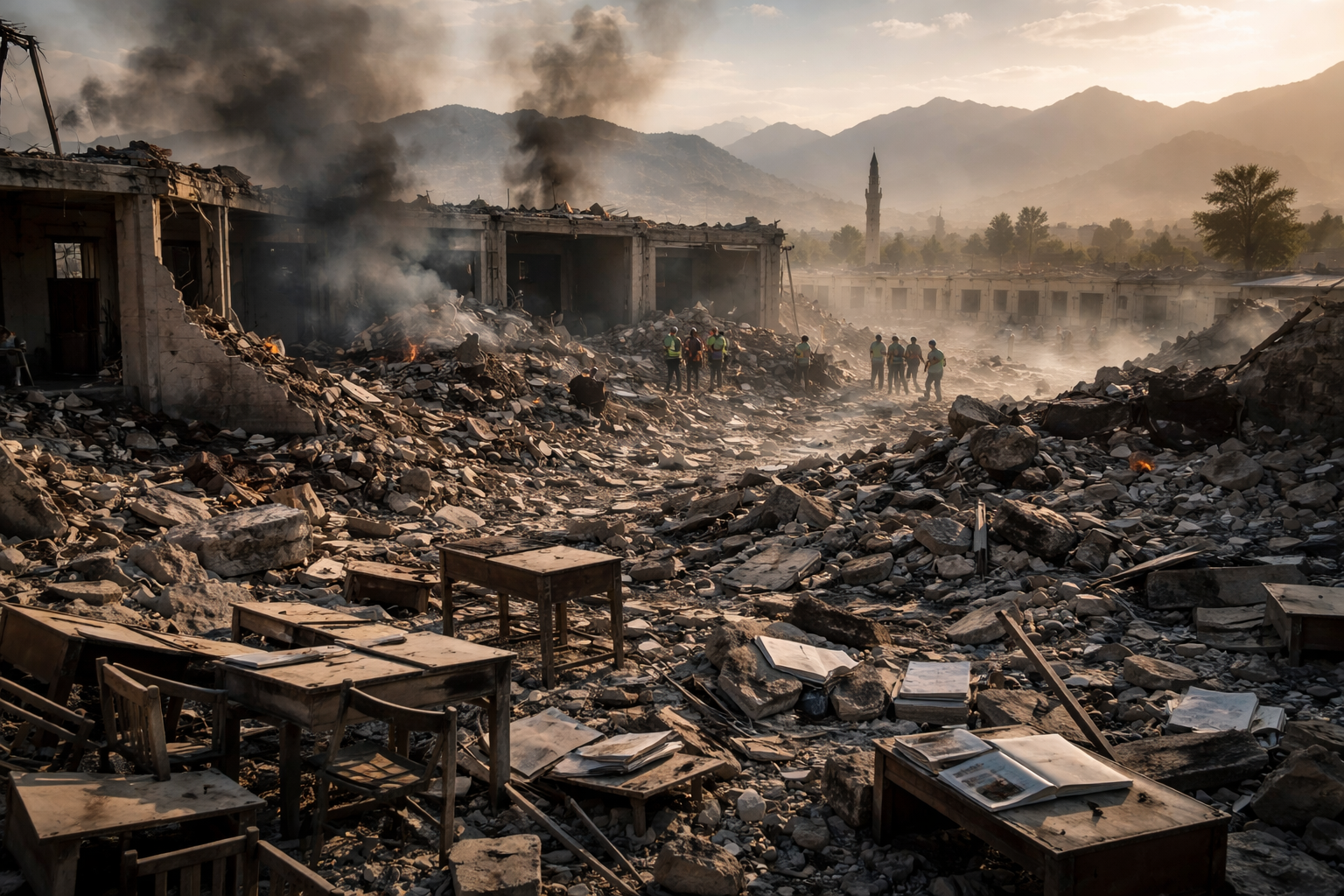
Iran War UN Charter Warning After School Strike Shock
Iran War Faces Legal Firestorm After Deadly School Attack
The expanding war involving Iran, the United States, and Israel has entered a new and volatile phase: a legal and moral confrontation at the heart of the international system.
A United Nations investigation has warned that recent military actions in the conflict appear to violate the United Nations Charter, the core legal framework designed to prevent interstate war. The warning comes amid global outrage over a devastating strike on a girls’ school in southern Iran that reportedly killed more than 160 children.
The attack on the Shajareh Tayyebeh girls’ school in Minab has become the single most emotionally charged episode of the conflict so far. The strike occurred on the first day of the broader military campaign against Iran, transforming what began as a strategic confrontation into a humanitarian crisis with worldwide attention.
But beyond the immediate tragedy lies a deeper question: whether the legal order that governs war between states is beginning to unravel under the pressure of modern geopolitics.
The story turns on whether international law still has the power to shape the behavior of powerful states once a major war is already underway.
Key Points
A United Nations fact-finding probe says recent military actions in the Iran conflict may violate the UN Charter’s prohibition on the use of force against another state.
Global outrage intensified after a missile strike destroyed the Shajareh Tayyebeh girls’ school in Minab, reportedly killing more than 160 children.
The attack occurred on the first day of U.S. and Israeli strikes across Iran as the broader regional war began escalating.
U.S. officials say they would not intentionally target a school and are reviewing reports surrounding the incident.
Israel has said it is investigating the strike as international pressure grows.
The UN probe warns that the conflict is severely testing civilian protection and the rules governing war.
The current war began on February 28, 2026, when coordinated strikes by the United States and Israel targeted military and leadership sites across Iran.
The attacks marked one of the most significant direct military confrontations involving Iran in decades.
Among the most consequential early events was the assassination of Iran’s Supreme Leader during the opening strikes, an operation aimed at crippling the country’s leadership structure.
Iran responded with missile and drone attacks across the region, including strikes aimed at U.S. facilities and allied states in the Gulf. The conflict quickly widened, drawing in additional regional actors and raising fears of a prolonged Middle East war.
A missile strike during school hours destroyed the Shajareh Tayyebeh girls' elementary school in Minab within hours of the opening air campaign. Most victims were children between seven and twelve years old.
The school had previously been located near an Islamic Revolutionary Guard Corps naval complex, though investigations indicate the building had been clearly separated from the military site for years and was functioning as a civilian institution.
The United Nations Committee on the Rights of the Child described the attack as deeply disturbing and demanded accountability and transparency regarding the circumstances of the strike.
Political and Geopolitical Dimensions
The UN’s legal criticism introduces a new dimension to the conflict: legitimacy.
Wars occur not only on battlefields but also in courts of global opinion. The UN Charter prohibits the use of force against the territorial integrity or political independence of another state except in cases of self-defense or Security Council authorization.
By raising questions about whether the current campaign meets that legal threshold, the UN investigation shifts the debate from military success to legal justification.
Three scenarios are now emerging.
One scenario is escalation. If the war continues expanding across the region, legal debates may become secondary to military momentum.
A second scenario is diplomatic pressure. Growing international concern could push governments toward ceasefire negotiations.
A third possibility is legal fragmentation, where states openly challenge the authority of international institutions in wartime.
The key signpost will be whether UN Security Council members begin proposing formal resolutions or emergency measures.
Economic and Market Impact
Even before legal debates fully unfold, the conflict is already shaking global markets.
Energy markets remain sensitive to any disruption involving Iran, a major regional energy actor. The longer the conflict continues, the greater the risk of supply shocks affecting oil and shipping routes across the Gulf.
Investors are also watching the legal framing of the war. If international institutions begin formally investigating war crimes or violations of international law, sanctions regimes and trade restrictions could expand.
That would widen the economic footprint of the conflict far beyond the battlefield.
Social and Cultural Fallout
The Minab school strike has quickly become a defining symbol of the human cost of the war.
Images and accounts of children killed during the attack have circulated globally, triggering protests, vigils, and diplomatic condemnation.
Civilian casualties have historically reshaped the political trajectory of wars. Incidents involving schools or hospitals, such as those in Vietnam and Iraq, often serve as pivotal moments in shaping public opinion.
Whether this tragedy produces similar pressure will depend on what investigations ultimately conclude about the circumstances of the strike.
Technological and Security Implications
The strike also highlights a growing challenge in modern warfare: targeting precision in dense civilian environments.
Urban and mixed-use environments complicate the distinction between military and civilian targets, despite the design of missiles, drones, and air-delivered weapons for precision.
Military analysts increasingly warn that the proximity of civilian infrastructure to military installations creates a dangerous gray zone where catastrophic mistakes can occur.
That dynamic appears to have played a role in the Minab tragedy.
What Most Coverage Misses
The most overlooked factor in the unfolding legal debate is enforcement.
International law can declare actions illegal, but it often lacks the mechanisms to stop wars already in motion.
The UN Charter provides the framework for regulating interstate conflict, yet enforcement ultimately depends on political will from powerful states, particularly those with veto power on the Security Council.
That means the UN probe may reshape global narratives about the war, but it does not automatically produce legal consequences.
The practical impact is therefore indirect but powerful. Legal findings influence alliances, diplomatic pressure, and public legitimacy.
In other words, the real battlefield for international law is not punishment—it is legitimacy.
And legitimacy can shape the outcome of wars just as much as military capability.
Why This Matters
In the short term, the investigation increases pressure on governments involved in the conflict to explain the circumstances of the Minab school strike and demonstrate compliance with the laws of war.
International organizations will likely push for transparency, accountability, and civilian protection measures.
The outcome of this legal debate may shape the conduct of future wars in the long run.
The authority of international legal institutions may be weakened if major powers carry out military operations in defiance of UN condemnation.
But if investigations trigger diplomatic pressure or negotiations, the UN system may still prove capable of shaping modern warfare.
Upcoming developments to watch include further UN investigations, Security Council discussions, and official reports into the Minab strike.
The Legal Battle Now Running Parallel to the War
The war with Iran is no longer just a military confrontation.
It has become a test of whether the global rules designed to regulate conflict still carry weight when major powers go to war.
One path leads toward escalation and normalization of force.
The other leads toward renewed pressure for legal accountability and diplomacy.
Which path prevails may determine not only the outcome of this war but also the future credibility of the international order that was built to prevent the next one.
