US-Iran Have Just Flipped From Strikes Back To Talks
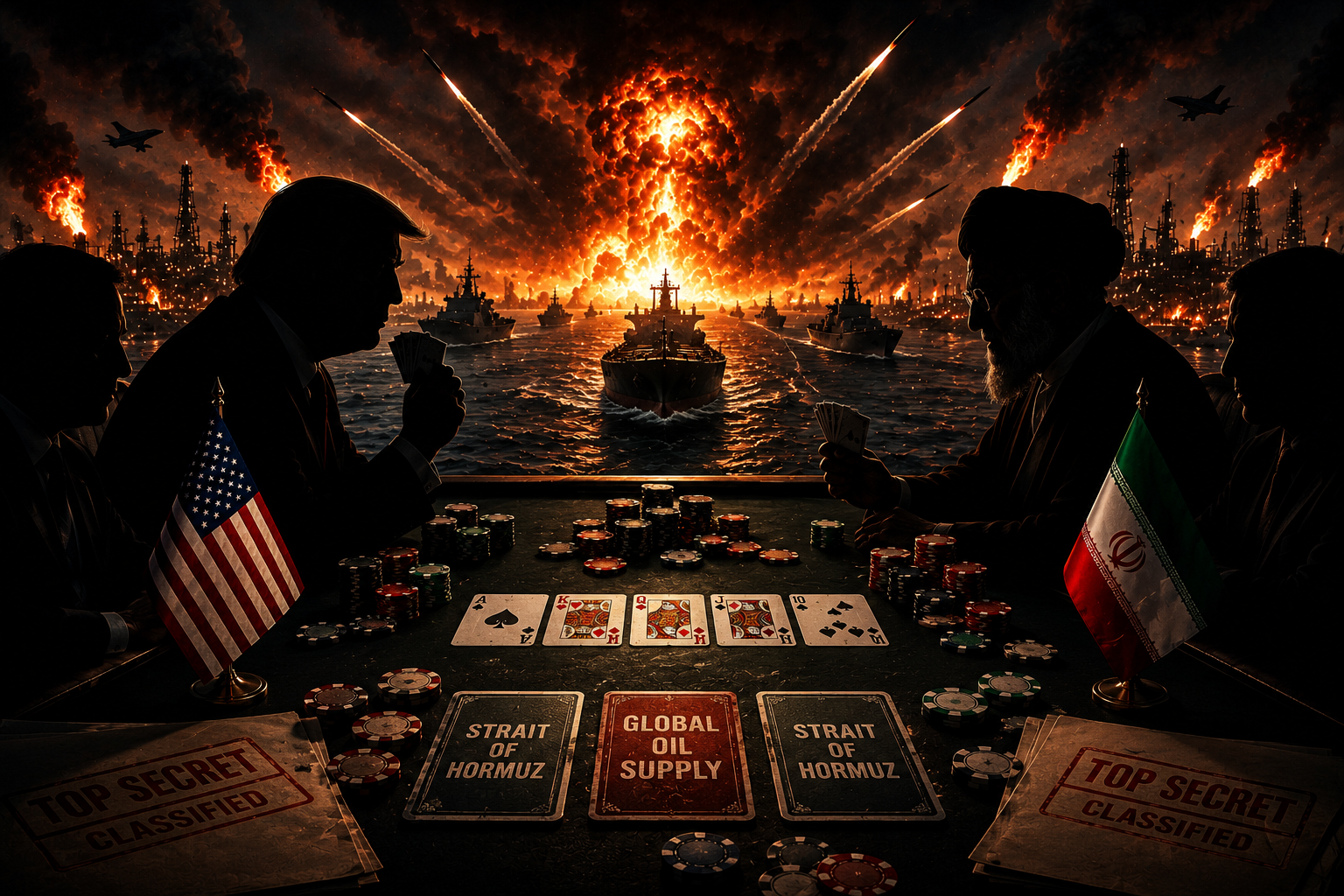
Who Blinks First?
The Gulf Crisis Has Changed Shape Again
The Gulf crisis has shifted from strikes back toward talks after the United States and Iran reportedly agreed to halt attacks and prepare for renewed discussions this week. The immediate trigger was a dangerous cycle of military action around the Strait of Hormuz, where attacks on commercial shipping, US strikes on Iranian targets, and Iranian retaliation against US-linked positions threatened to break a fragile diplomatic arrangement. A senior US official said both sides had agreed to stop "kinetic activity," with talks expected in Doha to focus on the dispute around the waterway.
That does not mean the crisis is over. It means the battlefield has changed. The argument is no longer only about who can strike whom, but whether either side can turn a pause in violence into a workable arrangement over one of the most important shipping corridors on Earth.
Why This Pause Matters More Than It Looks
The confirmed position now is that the United States and Iran have moved back toward negotiations after a weekend that tested the limits of their ceasefire. US forces struck Iranian military targets after claims that an Iranian-linked attack hit a commercial vessel in the Strait of Hormuz, while Iran later launched missile and drone attacks at US-linked military sites in Kuwait and Bahrain. The violence exposed how quickly a technical dispute over shipping can become a direct military exchange.
The deeper issue is that both sides are trying to prove they have not been forced back to the table from weakness. Washington wants to show that shipping security and freedom of navigation cannot be dictated by Tehran. Iran wants to show that control around Hormuz is not something external powers can simply impose. That makes the talks less like a peace process and more like a pressure chamber.
This is why the Strait of Hormuz keeps returning to the center of the crisis. Taylor Tailored has already covered why the Strait of Hormuz could decide the outcome, and this latest turn only sharpens that point. The geography has become political leverage, economic risk and military danger all at once.
The Real Fight Is About Control
The argument over Hormuz is not just about ships passing through a narrow stretch of water. It is about who gets to set the rules when global energy, regional security and national pride collide. Iran has repeatedly pushed the idea that Gulf security should be controlled by regional powers, while the United States has treated freedom of navigation as a non-negotiable strategic interest.
That clash creates a problem diplomacy cannot easily smooth over. If Iran accepts a route or framework that looks like US control, it risks looking weakened at home and across the region. If Washington accepts a framework that appears to give Iran authority over commercial passage, it risks looking as though military pressure has forced it to concede the world's most important oil chokepoint.
This is the contradiction at the heart of the new talks. Both sides need the violence to pause, but neither side wants the pause to look like retreat. That is why the shift from strikes to talks may be less reassuring than it first appears. Diplomacy is now carrying the same pressure that missiles and drones were carrying days ago.
The Ceasefire Was Always Vulnerable
The latest escalation exposed a weakness that was already present inside the diplomatic track. The recent US-Iran memorandum was meant to reduce conflict pressure, reopen or stabilise access through Hormuz, and create room for deeper negotiations. But the renewed violence showed that broad wording and unresolved operational details can become dangerous when warships, drones and commercial vessels are all moving through the same corridor.
That is the hidden danger of vague agreements in live conflicts. They can calm headlines before they calm behaviour. If one side believes a ship movement, escort route or maritime inspection is allowed, while the other side sees it as a violation, the agreement becomes less a settlement than a trigger point.
This is also why the US-Iran 60-day diplomatic clock matters. A negotiation window can look like progress from the outside, but inside the crisis it can become a race to define the facts on the water before the final deal is written.
Markets Know The Talks May Not Be Enough
The Gulf matters globally because the Strait of Hormuz is not a normal regional flashpoint. It is a concentrated pressure point for energy, shipping, insurance, inflation and political stability. When vessels slow down, reroute, require escorts or face new restrictions, the consequences do not stay in the Gulf.
That is why the market reaction matters even when the military picture appears to calm. Gulf markets moved unevenly after the latest exchanges, reflecting the uncertainty created by direct US-Iran attacks and the possibility that shipping disruption could continue even under a temporary halt in strikes. The risk is not only a dramatic closure of the strait, but a grinding loss of confidence that makes commercial passage more expensive and less predictable.
The world often focuses on whether Hormuz is open or closed, but the more realistic danger is messier. Ships can still move while insurers panic, crews hesitate, military escorts multiply and governments accuse each other of violating the rules. That is the kind of half-crisis that can last longer than a single strike and cost more than a single headline suggests.
The Talks Could Succeed And Still Leave A Bigger Problem
The best outcome from the new talks would be a clear operational framework: safe commercial passage, defined routes, reduced military friction, and a shared mechanism for handling disputes before they become strikes. That would not solve every part of the US-Iran confrontation, but it could stop Hormuz from becoming the immediate fuse for wider war.
The problem is that any workable deal must do more than tell both sides to calm down. It must answer practical questions that carry political weight. Who monitors the route? Who escorts ships? What happens if a vessel is accused of breaching the agreed path? What counts as a violation? Who decides before the missiles start flying again?
Those details are not bureaucratic. They are the deal. In a crisis like this, the technical language is where the real power sits.
The Dangerous Part Comes After The Handshake
The shift back to talks is still significant because it shows that both sides understand the cost of uncontrolled escalation. The United States does not want a conflict that locks it deeper into the Gulf, and Iran does not want a confrontation that invites overwhelming retaliation or further economic pressure. That shared fear is the strongest argument for restraint.
But restraint built on fear is not the same as stability. It can break quickly if either side believes the other is testing the limits. That is why the next phase may be more dangerous than the headline suggests: the public drama has moved from explosions to negotiation rooms, but the underlying contest over control has not softened.
The Gulf crisis has not flipped from war to peace. It has flipped from strikes to leverage. The question now is whether diplomacy can absorb that leverage before the Strait of Hormuz turns the next misunderstanding into another round of fire.
