US Sends Second Aircraft Carrier Into Middle East — And Opens A Dangerous Gap In The Pacific
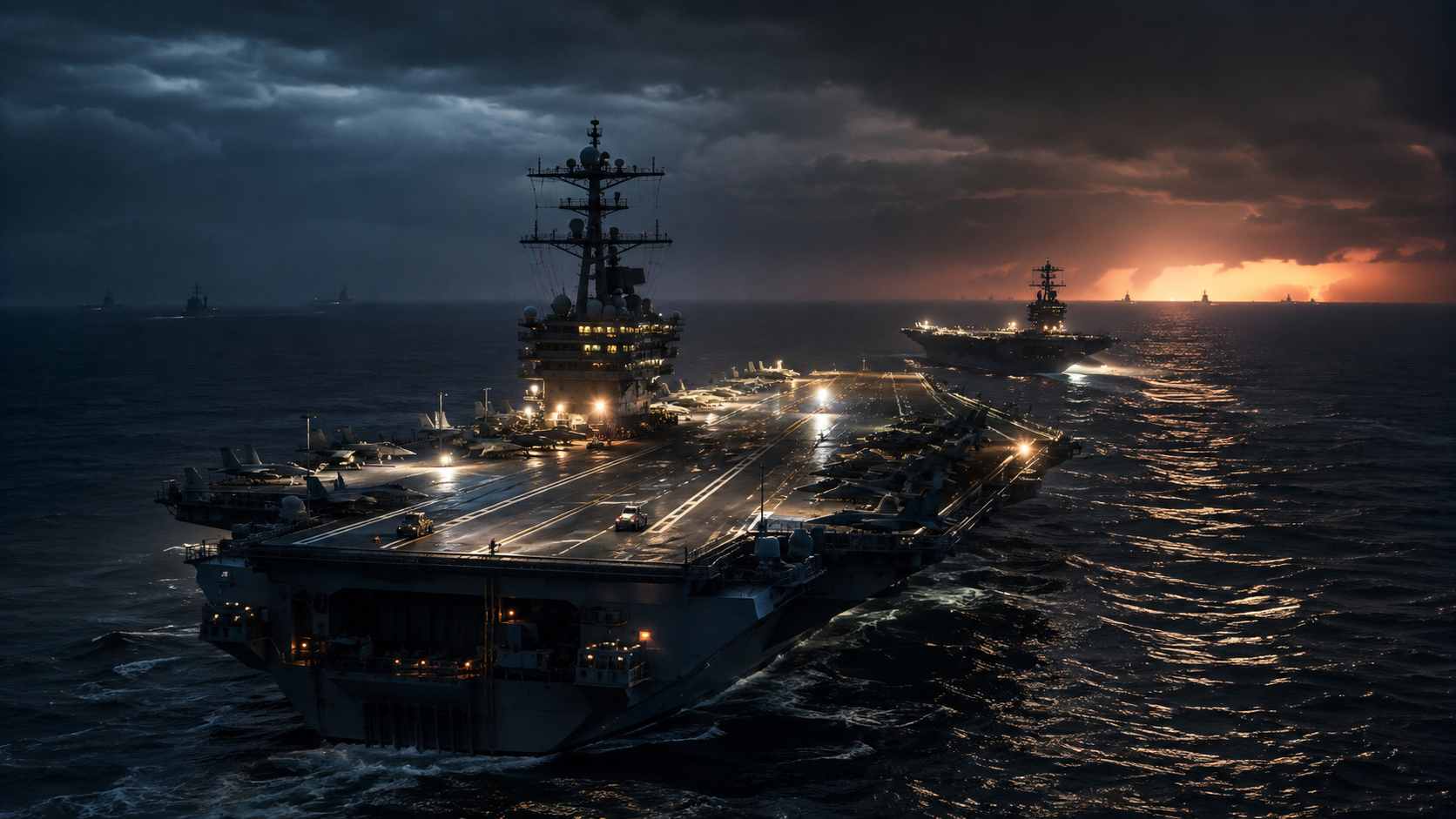
Why has America sent another aircraft carrier to the Middle East?
US Doubles Down In The Middle East With Another Aircraft Carrier As Iran Pressure Builds
The United States has moved another aircraft carrier into the Middle East, giving Washington two carrier strike groups in the region at a moment when its confrontation with Iran remains unresolved and commercial traffic through the Strait of Hormuz is still severely disrupted.
But the arrival of the USS George Washington tells a bigger story than another American warship entering the region. The carrier has been pulled from the Indo-Pacific to relieve the extraordinarily long-deployed USS Abraham Lincoln, while the USS George H.W. Bush remains in the Middle East. Washington is therefore maintaining formidable naval power around Iran — but doing so by accepting a temporary carrier gap in the western Pacific.
That trade-off may prove almost as significant as the deployment itself.
George Washington Has Arrived To Relieve An Exhausted Carrier
The USS George Washington has arrived in the Middle East after travelling west from its normal operating area in the Pacific. Its immediate purpose is not simply to create a permanent three-carrier concentration, but to allow the USS Abraham Lincoln to finally leave after an exceptionally prolonged deployment.
The Lincoln has spent more than 250 days deployed during the conflict with Iran, including an extraordinary stretch without a conventional port call. Concerns about crew conditions, supplies and the strain imposed by the deployment have increasingly followed the ship.
The arrival of the George Washington therefore represents both reinforcement and rotation.
Once the Lincoln leaves, the George Washington is expected to operate alongside the USS George H.W. Bush, which has already been deployed in the US Fifth Fleet area. That leaves America capable of sustaining two carrier strike groups around one of the world's most strategically important maritime regions.
In raw military terms, that is an enormous concentration of mobile air power.
Two Carriers Give Washington Enormous Short-Term Firepower
An American aircraft carrier is far more than a floating runway.
A carrier strike group brings fighter aircraft, airborne surveillance, electronic warfare, helicopters, missile-defence capabilities, destroyers and the logistical infrastructure required to conduct sustained operations hundreds of miles from land.
Two carrier groups dramatically increase the number of missions commanders can generate while also allowing aircraft and escorts to operate across a much wider geographical area.
One carrier can conduct strike missions while another maintains defensive combat air patrols. Aircraft can escort other forces, suppress enemy air defences, monitor maritime movements or respond rapidly to missile and drone attacks.
The accompanying warships also expand America's missile-defence and long-range strike capacity.
For Iran, the calculation is therefore not simply that several dozen more American aircraft have entered the theatre. It is that the United States is maintaining an entire additional network of sensors, missiles, aircraft and command systems close enough to intervene rapidly.
The Deployment Sends Iran A Message Beyond Air Power
The political message is just as important.
Washington could have used the George Washington simply to replace the Lincoln after the older deployment became unsustainable. Instead, America is preserving a two-carrier posture even as attempts to resolve the conflict remain stalled.
That makes it harder for Tehran to assume American pressure is gradually fading.
The United States still has several options short of a major new bombing campaign. Carrier aircraft can enforce airspace, escort shipping, conduct reconnaissance, protect American bases, intercept drones and missiles or support strikes against Iranian military infrastructure if ordered.
The presence of two groups also creates redundancy. An adversary cannot assume that disrupting the operations of one carrier would remove American naval aviation from the battlefield.
But deterrence works only when both sides correctly understand the other's intentions.
Every additional military asset designed to discourage an Iranian escalation simultaneously gives Washington greater ability to escalate itself. Tehran may therefore view precisely the same deployment as preparation for another phase of the war.
That is the uncomfortable paradox of deterrence.
The Strait Of Hormuz Makes Naval Power Economically Critical
The greatest immediate global consequence may not involve a carrier launching a single aircraft.
It may involve ships attempting to move through the Strait of Hormuz.
Commercial shipping remains far below normal levels through the waterway after months of conflict, competing restrictions and attacks. Recent vessel-tracking data has continued to show only a fraction of the traffic normally expected through the strait.
That matters because Hormuz is one of the world's most important energy corridors.
Oil and liquefied natural gas moving from Gulf producers towards Asian and European markets depend heavily on the narrow passage between Iran and Oman. Disruptions therefore move quickly beyond the battlefield and into petrol prices, industrial costs, shipping insurance and inflation.
A powerful American naval presence gives Washington greater capacity to monitor the route and potentially protect or escort commercial shipping.
It does not, however, automatically solve the problem.
Commercial operators will remain reluctant to send valuable ships and crews through the area if they believe missiles, drones, mines or seizures remain realistic possibilities. Military control and commercial confidence are not the same thing.
That means America can possess overwhelming conventional naval superiority while Iran still retains the ability to impose significant economic costs through geography and uncertainty.
Israel And Gulf States Gain Another Layer Of American Protection
The deployment will also be closely watched in Israel.
American carrier aircraft and escort ships add another layer to the wider regional defensive network against Iranian missiles and drones. They also provide Washington with independent offensive capacity should attacks against US forces or allies intensify.
For Gulf states, however, the implications are more complicated.
Countries including Saudi Arabia, Qatar, Bahrain and the United Arab Emirates depend heavily on regional stability and open maritime trade. They benefit from American protection but also have powerful incentives to avoid becoming permanent front-line participants in a US-Iran confrontation.
Iran has repeatedly demonstrated that regional military facilities, energy infrastructure and shipping routes can become instruments of pressure.
The more substantial the American force concentration becomes, the stronger the protection surrounding Washington's partners may appear.
But those partners may also fear being pulled deeper into a confrontation they cannot geographically escape.
America Has Taken This Carrier From The Pacific
The most important geopolitical consequence may be thousands of miles away from Iran.
The USS George Washington is normally America's forward-deployed aircraft carrier in Japan and forms one of the most visible symbols of US naval power in the western Pacific.
Moving it towards the Middle East temporarily leaves that theatre without an American carrier.
That does not mean the United States has abandoned Asia. American submarines, destroyers, aircraft, bases and allied forces remain across the region, while other carrier groups can eventually be moved when operational cycles allow.
But carrier availability is finite.
The US Navy operates eleven aircraft carriers, yet only a portion can be deployed at any moment. Others are undergoing maintenance, training, refuelling, repairs or preparing their crews for future operations.
The Iran conflict has therefore demonstrated something strategically uncomfortable.
American military power is enormous, but it is not unlimited.
A ship cannot simultaneously deter Iran in the Arabian Sea and China in the Philippine Sea.
China Does Not Need A War To Exploit The Gap
Beijing will understand that calculation perfectly.
China does not need to launch an invasion of Taiwan because an American carrier has left Asia to benefit from the situation.
It can instead increase military patrols, conduct exercises, test responses around disputed waters, apply pressure around Taiwan or demonstrate its growing ability to dominate areas closer to the Chinese mainland.
The psychological dimension matters.
Japan, Taiwan and the Philippines all watch American force movements as evidence of Washington's priorities. A temporary absence does not destroy an alliance, but repeated diversions towards crises elsewhere can create doubts about whether sufficient American forces would be available during simultaneous emergencies.
China has spent years building a military designed specifically to complicate American intervention close to its shores.
Its navy now operates on a scale that would have been almost unimaginable several decades ago, supported by large numbers of land-based missiles, aircraft and rapidly expanding maritime capabilities.
The strategic competition is therefore increasingly about presence as much as outright war.
Every American platform committed elsewhere is one less immediately available in the Indo-Pacific.
Russia Also Benefits From America Being Pulled Back Into The Middle East
Russia faces a similar strategic incentive, although in a different theatre.
A prolonged American military commitment around Iran consumes ships, aircraft, precision weapons, maintenance capacity, intelligence resources and political attention that cannot simultaneously be concentrated elsewhere.
That does not mean Moscow controls Tehran or engineered the conflict to distract Washington.
It does mean Russia benefits whenever US strategic attention becomes divided.
The same logic applies to China.
From Washington's perspective, the nightmare scenario is not necessarily losing any single confrontation. It is having several major security crises occur at roughly the same time.
Iran could pressure the Gulf while Russia tests European security and China increases pressure around Taiwan or the South China Sea.
America remains capable of projecting military force across multiple continents, but every additional theatre increases logistical and political strain.
The movement of the George Washington offers a visible example of that problem.
The US Navy Is Showing Both Its Strength And Its Limits
There is another reason the carrier rotation matters.
The USS Abraham Lincoln's extraordinary deployment has demonstrated the human and mechanical cost of maintaining continuous high-intensity naval operations.
Aircraft carriers require thousands of sailors. Their air wings require maintenance, ammunition and spare parts. Escort vessels need servicing. Aircraft accumulate flying hours. Crews need rest.
Wars consume readiness even when ships are not sunk.
The United States has been able to keep enormous naval power around the Middle East precisely because it possesses a fleet capable of rotating forces across oceans.
But prolonged conflicts gradually reduce that flexibility.
Sending the George Washington therefore demonstrates American power and exposes its constraints at exactly the same time.
The United States can move an enormous floating airbase thousands of miles across the world when necessary.
What it cannot do is create another one instantly to replace the strategic presence that has moved.
What Happens Next
The immediate question is how quickly the USS Abraham Lincoln leaves the region.
If the Lincoln departs as expected, the US will effectively have rotated one exhausted carrier out while preserving a two-carrier force through the George Washington and George H.W. Bush.
If circumstances instead force three carriers to remain simultaneously for any meaningful period, that would signal a much more significant military concentration and could indicate preparations for expanded operations.
Iran will meanwhile watch American flight activity, escort formations and supporting deployments far more closely than political statements.
China will be watching another map entirely.
The decisive question is therefore not whether America possesses enough military power to confront Iran. It clearly retains overwhelming conventional capabilities.
The deeper question is how long Washington can keep concentrating that power in one region without creating opportunities somewhere else.
For decades, American strategy rested partly on the assumption that the United States could project decisive power into several regions of the world almost simultaneously.
The USS George Washington's journey from the Pacific towards Iran reveals the pressure now being placed on that assumption.
America has reinforced the Middle East.
But the geopolitical price of doing so may be measured in the waters it has temporarily left behind.
