White House Gunfire Panic Sparks New Security Fears Around Trump As Disturbing Details Emerge About Dead Checkpoint Shooter
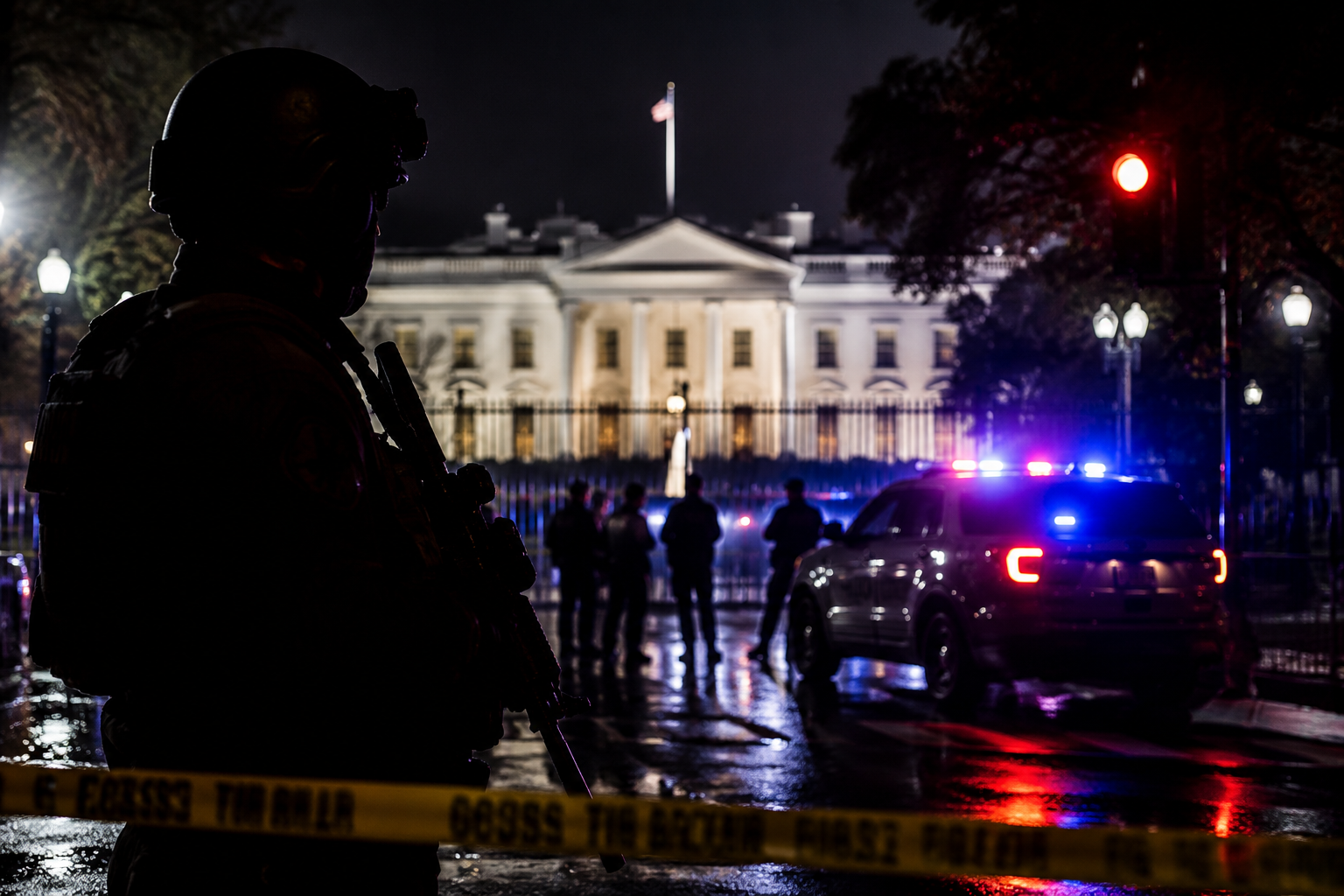
The White House Was Locked Down In Seconds — But The Real Fear Started After The Shooting Stopped
The White House Went Into Lockdown Almost Instantly
The shooting unfolded near a Secret Service checkpoint close to 17th Street and Pennsylvania Avenue NW, just outside the White House complex. According to official statements, a man approached the security area, pulled a firearm from a bag, and opened fire toward officers guarding the checkpoint. Secret Service agents immediately returned fire.
Within moments, the White House entered emergency lockdown procedures. Journalists inside the complex were reportedly ordered to shelter in place as multiple gunshots echoed across the area. President Donald Trump was inside the White House during the incident but was not injured. The speed of the response appears to have prevented the situation from escalating even further.
The suspect was transported to the hospital after being shot by federal agents, where he later died from his injuries. Authorities also confirmed that a bystander was struck during the exchange of fire, although investigators have not publicly established whether the injury was caused by the suspect or by return fire from officers.
The Disturbing Details Emerging About The Suspect
Authorities and law enforcement sources have identified the alleged gunman as 21-year-old Nasire Best from Maryland. The detail now drawing intense attention is tfederal authorities reportedly already knew himties before the shooting took place.
Court and law enforcement records indicate that Best had previous encounters involving the White House security perimeter. During one earlier incident in 2025, he allegedly attempted to enter restricted areas near the White House and reportedly claimed to be Jesus Christ. Officials also reportedly issued a stay-away order connected to prior disturbances.
That detail changes the emotional weight of the story significantly. This was not simply a random armed encounter near a federal building. Investigators are now examining whether the suspect had developed an escalating fixation on the White House itself.
Later, Trump suggested that the suspect might have had a “possible obsession” with the executive mansion. That language matters because federal investigators increasingly monitor fixation-based threats rather than only traditional political assassination plots. Modern presidential security now heavily focuses on lone individuals whose mental instability, paranoia, or ideological obsession slowly intensifies over time.
The Part Of The Story That Should Worry Washington
The most unsettling part of the incident may not be the shooting itself. It is the growing pattern.
This latest confrontation follows several serious security incidents involving areas connected to Trump and the White House in recent weeks. One major armed incident erupted during the 2026 White House Correspondents’ Dinner, while another Secret Service shooting took place earlier in May near the National Mall and Washington Monument area.
Individually, each case can appear isolated. Together, they create a far darker picture. Washington security agencies are increasingly confronting repeated armed encounters involving unstable or radicalized individuals operating alone, often with little warning and no sophisticated network behind them.
That creates a uniquely difficult security environment. Traditional threat detection systems are designed to identify organized plots, communications, financing, or conspiracies. Lone actors behaving erratically are much harder to predict, especially when their motives blur between political anger, mental instability, delusion, personal grievance, and symbolic obsession with power itself.
The White House has always represented political authority. But during periods of extreme polarization, it can also become a psychological magnet for unstable individuals seeking visibility, symbolism, revenge, or personal meaning.
Why The Bystander Injury Changes The Emotional Fallout
One detail continues to dominate discussion around the shooting: the injured bystander.
Officials confirmed that at least one civilian was hit during the exchange of fire, although authorities have not publicly clarified which bullet caused the injury. That uncertainty matters because incidents like this instantly raise difficult questions around urban federal security, return-fire protocols, and how vulnerable surrounding civilians become when violence erupts in dense public areas.
Pennsylvania Avenue around the White House is not an isolated military zone. It is a highly trafficked civilian space filled with tourists, workers, media personnel, and visitors. When gunfire erupts there, the danger spreads far beyond the intended target.
That reality adds another layer to the wider security debate already building around Washington. Federal authorities are trying to preserve public openness around symbolic democratic institutions while simultaneously operating inside an environment where threats now appear more frequent, unpredictable, and emotionally volatile.
The White House was once designed to project accessibility alongside power. Increasingly, it risks resembling a fortified perimeter permanently braced for attack.
The Political Temperature Around Trump Keeps Rising
The broader political atmosphere surrounding Trump is impossible to ignore in this context. The United States is entering another deeply polarized election cycle while tensions across foreign policy, immigration, economics, and cultural identity continue intensifying simultaneously.
That does not mean every unstable suspect is directly motivated by organized politics. But heightened national tension changes the emotional ecosystem in which these incidents occur. Political language becomes sharper. Public trust weakens. Online rhetoric escalates. Conspiracy thinking spreads faster. Institutions become symbols people project anger onto.
The result is a country where the White House increasingly feels less like a distant institution and more like an active frontline symbol in America’s wider emotional conflict.
Federal authorities have not publicly confirmed a political motive in the checkpoint shooting. The investigation remains ongoing. But the psychological atmosphere surrounding the incident is already becoming politically significant because Americans are now seeing repeated armed security scares around the presidency itself.
The Bigger Fear Underneath The Headlines
The deeper fear emerging from this story is not simply that a gunman opened fire near the White House. The growing sense is that Washington security incidents are becoming normalized.
Every new lockdown, evacuation, perimeter breach, or armed confrontation slowly changes public expectations. What once felt extraordinary begins to feel routine. That is psychologically dangerous for any democracy because it creates a permanent atmosphere of tension around national leadership and public institutions.
The White House remains one of the most protected buildings on Earth. Saturday’s response showed the extraordinary speed and aggression of modern Secret Service protection. Officers neutralized the threat within moments, Trump remained unharmed, and the wider complex was secured rapidly.
But the incident still leaves behind a difficult question Washington cannot easily answer: what happens when the threats never really stop coming?
