Why Google’s EU Defeat Could Push Tech Firms Further From Europe
The EU Just Won Against Google, But It May Have Made Europe Look Weaker
The Fine Was About Android, But The Real Fight Is About Power
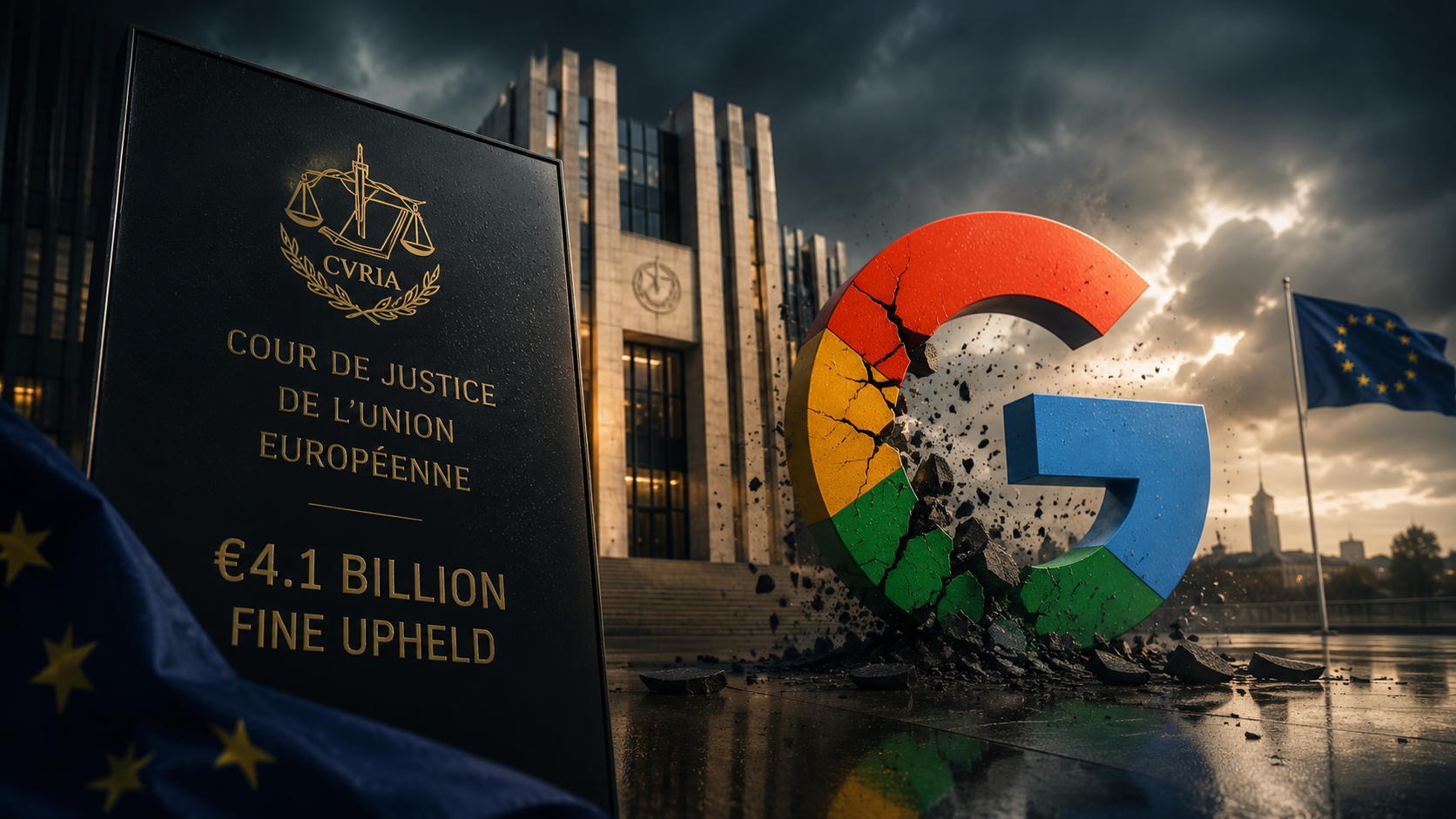
The EU’s top court has upheld a fine of around €4.1 billion against Google, ending a long legal fight over how the company used Android to strengthen its search and browser dominance. The Court of Justice of the European Union dismissed Google and Alphabet’s appeal in Case C-738/22 P, confirming the penalty after years of argument over pre-installation, licensing, and the power of default settings.
That is the confirmed legal story. The wider political story is sharper. Brussels has again shown that it can make American technology companies pay for the way they structure digital markets, even when those products are global, popular, and central to everyday life.
The EU Has Turned Regulation Into A Form Of Power
The Android case began with a simple allegation: Google used its control over the Android ecosystem to protect its search engine and browser from rivals. EU regulators argued that phone manufacturers were pushed into arrangements that made Google services difficult to dislodge, giving consumers the appearance of choice while preserving the power of default placement.
Google’s defence has always been that Android created more choice, not less. The company has argued for years that Android helped build a cheaper, open mobile ecosystem that competes against Apple’s iPhone, rather than a closed monopoly designed to trap users. Google said after the original 2018 decision that the ruling ignored competition from iOS and punished a model that had expanded smartphone access.
That is why the ruling matters beyond the money. The fine is large, but Google can absorb it. The real consequence is that the EU has confirmed its right to judge not just whether a product is useful, but whether the business architecture underneath that product gives one company too much control.
The Backlash Will Be About Europe’s Weakness, Not Google’s Fine
The anti-EU backlash will not be hard to predict. Critics will argue that Brussels has once again chosen litigation over invention, fines over founders, and courtroom power over technological leadership. The harsher version of that argument is that Europe has become world-class at regulating platforms it did not create.
That criticism is not entirely rhetorical. Europe has produced strong industrial companies, luxury brands, defence firms, pharmaceutical leaders, and engineering champions. But in consumer technology, cloud infrastructure, search, mobile operating systems, social media, frontier AI, and global software platforms, the centre of gravity remains overwhelmingly American and increasingly contested by China.
This is where the EU’s victory becomes politically awkward. Brussels can say it defended competition. Silicon Valley can say Europe waited until American companies built the modern digital economy, then arrived with fines, compliance orders, and legal uncertainty. Both claims can be true at the same time.
That same sovereignty tension runs through Taylor Tailored’s wider analysis of US Tensions With Europe And The UK, where regulation becomes one of Europe’s clearest tools for projecting power without owning the underlying technology.
Tech Firms Will Respond By Designing Around Brussels
The next response from major technology firms will not just be legal appeals. It will be product redesign, delayed launches, extra compliance teams, market-specific versions, and more cautious rollouts across Europe. That is already visible in the wider EU technology fight, where Apple has linked delays to new AI and interoperability features to the Digital Markets Act and the legal risk of European rules.
For a company like Google, the lesson is blunt. The EU market is too large to abandon, but too legally exposed to treat like the United States. That creates a predictable pattern: comply where necessary, delay where risk is unclear, lobby where possible, and design future products so that European regulators have fewer obvious handles to grab.
The same logic will apply across AI, app stores, cloud computing, adtech, search, browsers, and operating systems. Companies will increasingly ask a cold question before launching in Europe: will this feature generate enough revenue to justify the regulatory exposure? If the answer is uncertain, European users may wait.
That is the hidden cost of the EU’s approach. Regulation can protect consumers from abuse. It can also make consumers the last to receive new tools, not because companies cannot build them, but because they no longer trust the rulebook that will judge them.
Prominent Tech Figures Have Already Framed Europe As The Warning
The Google ruling lands in a climate where several major technology figures have already attacked Europe’s regulatory model. Mark Zuckerberg and Spotify’s Daniel Ek argued in 2024 that Europe risked falling behind because of complex and incoherent regulation, especially around AI and open-source technology.
Marc Andreessen has gone further. His public argument has been that excessive regulation slows builders, strengthens incumbents, and drains the speed that makes technology sectors dominant. Recent commentary around his position has framed Europe as the model to avoid, not the model to copy.
Elon Musk has made the most aggressive version of the backlash, especially around EU platform rules. After the EU fined X under the Digital Services Act, Musk accused Brussels of deciding on the fine first and inventing reasons afterward, calling it rule by unelected bureaucrats.
These comments are not all about the Android case directly. But they form the atmosphere into which the Google ruling now lands. For many in American tech, this is not an isolated competition judgment. It is another proof point in a larger claim: Europe wants the benefits of technological progress while distrusting the companies that produce it.
The EU Argument Still Has Real Force
The anti-EU case is powerful, but it is not complete. Brussels will argue that technology companies do not become immune from competition law just because their products are useful. A free app, a cheap phone, or a popular service can still be part of a system that blocks rivals from reaching users.
That matters because defaults shape behaviour. Most people do not change every browser, search engine, app store, or operating-system setting. The company that controls the default often controls the market before the user even thinks of making a choice.
The EU’s case is strongest when it focuses on that practical reality. Consumers may technically have options, but technical choice is not always meaningful choice. If the commercial structure of a device quietly pushes billions of people toward the same services, regulators are not irrational to ask whether competition has already been narrowed before the market begins.
That is why this case cannot be dismissed as simple Brussels jealousy. The EU may lack its own Google, but it still has a legitimate interest in whether Europeans are locked into digital pathways designed by one dominant American firm.
The Political Risk Is That Europe Becomes A Compliance Market
The deeper danger for Europe is not that Google has to pay. The danger is that Europe becomes known as the place where technology launches slowly, operates defensively, and grows under permanent legal suspicion. Once that reputation hardens, founders, investors, and product teams adjust their behaviour before regulators even act.
That is already visible in startup concerns about regulatory friction. Recent reporting on European founders found complaints about delayed market entry, paused features, lost deals, and heavy compliance spending. The most serious signal is not anger from Big Tech, but anxiety from smaller companies that cannot afford armies of lawyers.
This is where the EU’s position becomes fragile. Rules aimed at giants can become burdens that giants survive and startups cannot. Google can pay, redesign, and litigate for years. A European challenger cannot always do the same.
The result may be the opposite of what Brussels wants. Regulation designed to weaken dominant platforms can accidentally strengthen them, because only dominant platforms can afford the cost of permanent regulatory conflict.
The Real Question Is Who Sets The Future
The ruling against Google is a victory for the EU’s legal model. It confirms that Brussels can still bend the behaviour of the largest technology companies on Earth. It also sends a message to Apple, Amazon, Meta, Microsoft, TikTok, OpenAI, and every future platform builder: access to Europe comes with political conditions.
But the ruling also sharpens the question Europe cannot fine its way out of. Who is building the next generation of technology? If Europe is mainly setting rules for systems built elsewhere, then each victory carries a quiet humiliation inside it.
The strongest version of the EU case is that markets need boundaries before private power becomes untouchable. The strongest version of the backlash is that Europe has confused rule-setting with leadership. The Google fine proves Brussels still has teeth. It does not prove Europe has solved the harder problem of building the future itself.
