

Why Melania Trump’s Controversial Royal Visit Look Became A Global Talking Point
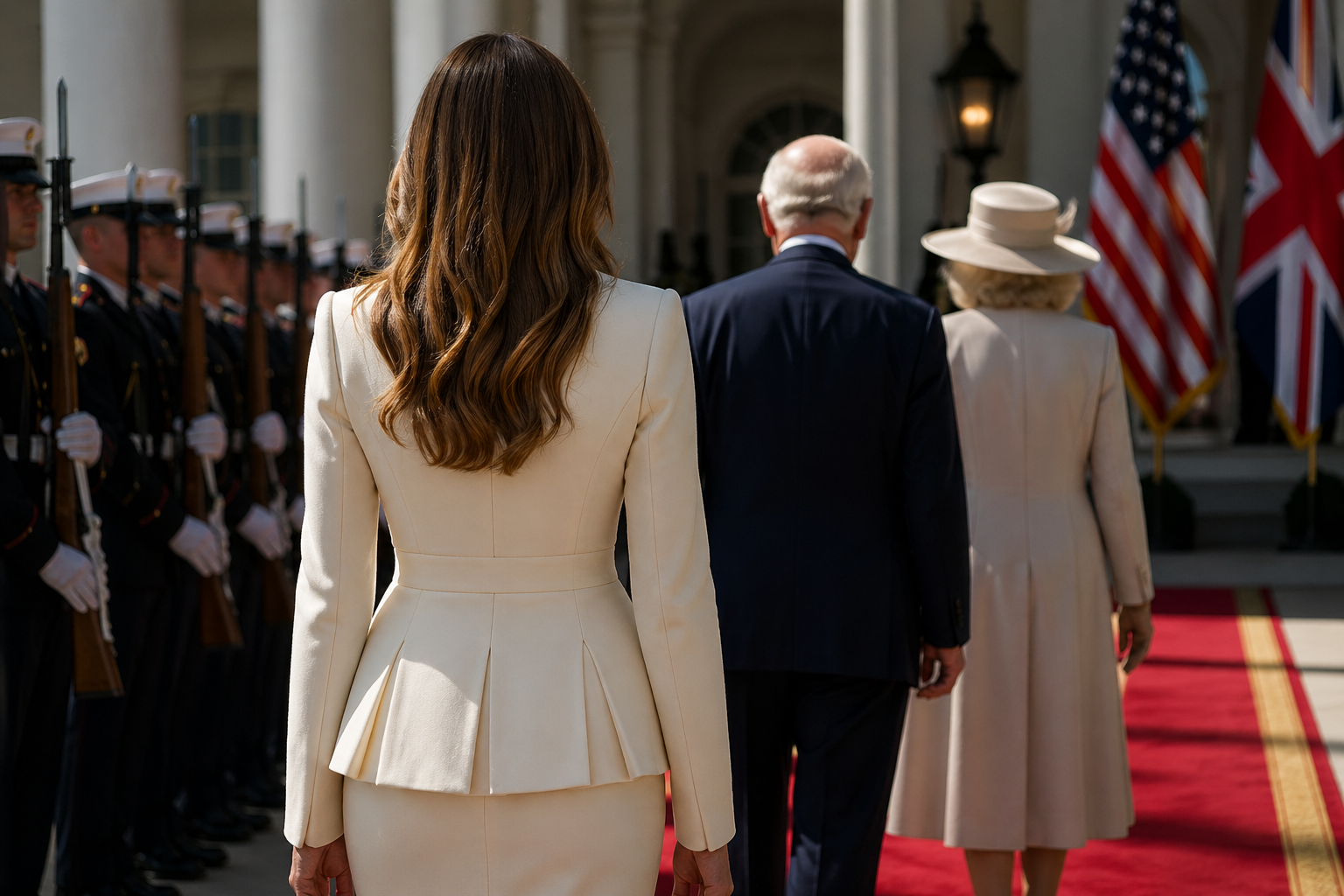
Melania Trump’s Fashion Choice Goes Viral During High-Stakes Royal Meeting
The Outfit That Hijacked A Royal Visit: Melania Trump Under Fire
The optics were supposed to be flawless. A royal visit. A transatlantic reset. Carefully choreographed symbolism between two of the world’s most visible power centers.following elements
Instead, the internet locked onto something else entirely.
Melania Trump’s outfit.
Within minutes of her appearance alongside King Charles III and Queen Camilla, social media reaction surged—not around diplomacy, policy, or geopolitics, but around color, styling, and perceived “appropriateness.” The moment went viral in real time, turning a high-level state visit into a cultural flashpoint.
And that reaction tells you far more than it seems.
What actually happened
During the official welcome event at the White House, Melania Trump stepped out in a striking butter-yellow suit — a sharp departure from her traditionally muted, tailored palette.
The look was deliberate.
Reports indicate the outfit aligned with a broader 2026 fashion trend, with the color appearing prominently across recent runway seasons.
But context matters.
Standing beside King Charles III and Queen Camilla—both dressed in more traditional, understated tones—the contrast was immediate.
That visual difference became the story.
Why the backlash spread so quickly
The reaction wasn’t random. It followed a predictable pattern — one that repeats every time high-profile fashion intersects with power, symbolism, and expectation.
Three forces collided:
1. The “royal etiquette” expectation
Royal events operate under an unwritten code. Subtlety, deference, and visual harmony tend to dominate.
Anything that appears to “stand out” risks being interpreted as breaking that code—even if no formal rule exists.
Online reactions framed the outfit as too bold, too attention-grabbing, or simply “wrong for the moment.”
2. The social media amplification effect
Modern state visits are no longer controlled environments. Every frame is instantly clipped, shared, judged, and reframed.
A single image—color, posture, contrast—becomes a meme before the event has even ended.
What might once have been a quiet fashion critique is now a global reaction cycle measured in minutes.
3. The Melania factor
Melania Trump has long been uniquely scrutinized for her appearance.
Even compared to other First Ladies, her fashion choices receive disproportionate attention—a dynamic tied to her modeling background, wealth, and public persona.
In other words, the reaction wasn’t just about the outfit.
It was about her.
What most people miss
The viral backlash isn’t really about whether the outfit “worked.”
It’s about control.
State visits are meticulously staged displays of power, unity, and symbolism. Every detail — from handshake angles to seating positions — is intentional.
Fashion is part of that system.
So when an outfit becomes the dominant talking point, it disrupts the intended narrative.
Instead of:
Diplomacy
Strategic alignment
Political messaging
The focus shifts to:
Aesthetic judgement
Social media reaction
Cultural interpretation
That shift matters.
Because attention is power.
A distraction — or a signal?
There are two ways to read what happened.
Interpretation 1: A misjudged visual moment
The simplest explanation is that the outfit unintentionally clashed with the tone of the event.
Bright color against muted tradition.
Modern trend against ceremonial expectation.
From this perspective, the backlash is just the internet doing what it always does — reacting fast and often harshly.
Interpretation 2: A deliberate positioning move
The more interesting interpretation is that the contrast was intentional.
A visual signal:
Confidence
Independence
Refusal to blend into royal hierarchy
Seen this way, the outfit becomes less of a mistake—and more of a statement.
Not against the royals, but alongside them.
Why this matters now
This moment didn’t happen in isolation.
The visit itself was already politically sensitive—framed as an effort to stabilize strained UK-US relations.
That makes the optics even more important.
When symbolism is fragile, small details become amplified.
An outfit becomes:
A headline
A talking point
A proxy for deeper tensions
Even if unintentionally.
The pattern is bigger than this one moment
This isn’t new.
Melania Trump’s public image has repeatedly been shaped—and reshaped—through fashion moments:
Outfits interpreted as political signals
Styling choices dissected for meaning
Visual presentation overshadowing messaging
In some cases, criticism has been harsh or disproportionate.
In others, the ambiguity of her style has invited interpretation.
Either way, the result is consistent:
The image becomes the story.
The cultural layer underneath
There’s a deeper reason this kind of moment explodes online.
Fashion sits at the intersection of the following:
Identity
Power
Gender expectations
Public perception
For high-profile women in political spaces, that intersection becomes even sharper.
What might be considered a bold or modern choice in one context becomes “inappropriate” in another—depending on expectations that are often unspoken and unevenly applied.
That tension fuels the reaction.
What this reveals about modern political theatre
The real story isn’t the outfit.
It’s how quickly the narrative shifted.
A diplomatic event designed to project unity was instantly reframed into a cultural debate about style, symbolism, and perception.
That’s the reality of modern political theater:
Image travels faster than message
Reaction outpaces intent
Interpretation overrides control
And once that shift happens, it’s almost impossible to reverse.
The bottom line
Melania Trump’s outfit didn’t just attract attention.
It redirected it.
In a moment designed for diplomacy, the conversation moved elsewhere—into aesthetics, reaction, and cultural judgment.
That’s not a small detail.
That’s the story.
