AI Can Move Your Money. Who Takes Responsibility When It Fails?
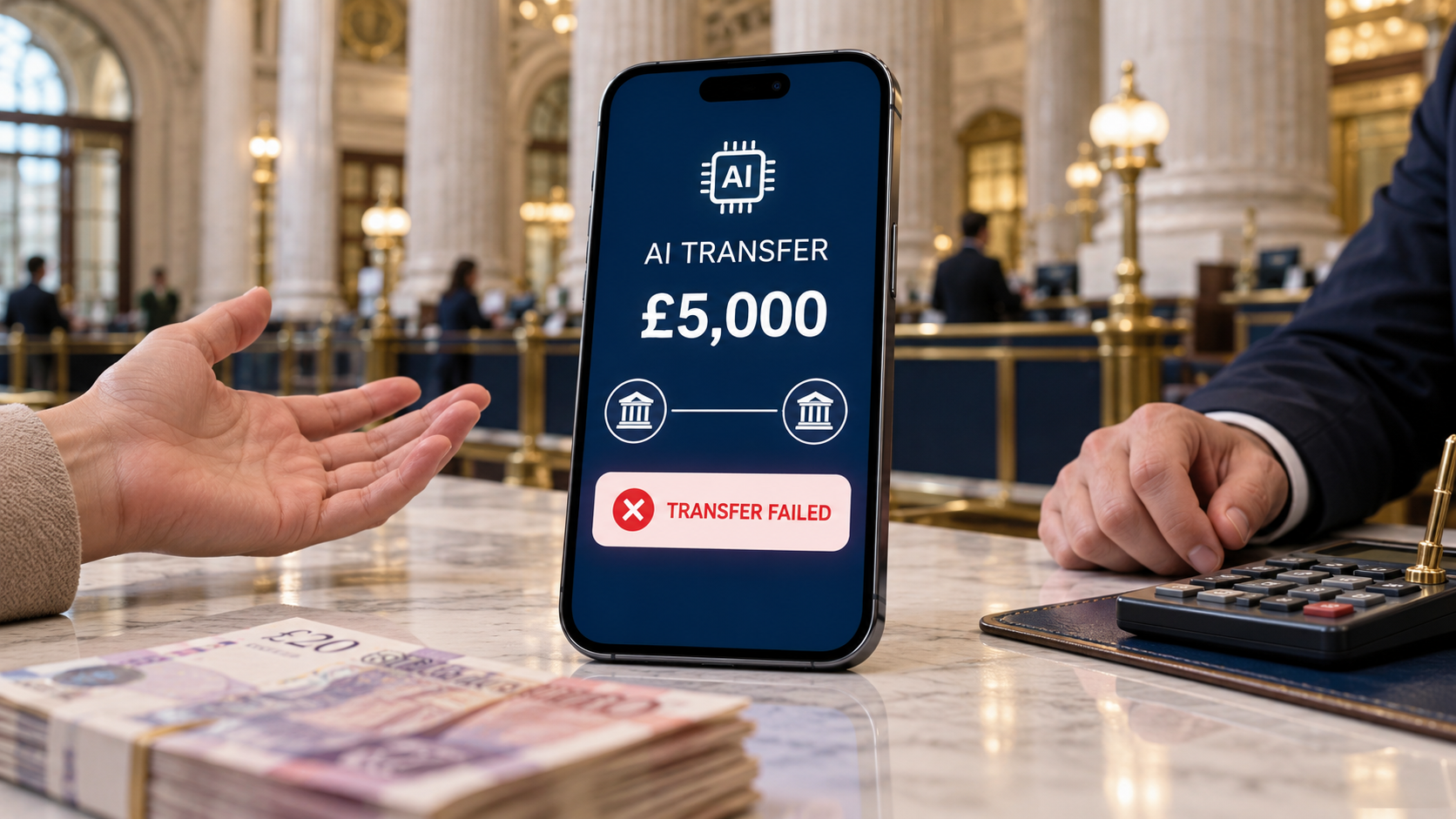
Who Pays When AI Gets It Wrong? Bailey Raises Financial Liability Concerns
When AI Holds the Purse Strings
AI agents can act on instructions, but financial safeguards must also establish their limits, preserve evidence and give customers a route to challenge mistakes.
Andrew Bailey has warned that people could misunderstand who carries legal responsibility when they authorise artificial intelligence agents to make payments or other financial transactions. Speaking at a Group of Thirty event in Bangkok on 17 October 2026, the Bank of England governor said policymakers “have got to address” the concern.
The practical question is who bears a loss when software acts on someone’s behalf. Calling a product an agent does not, by itself, establish what it was allowed to do or who must answer for its mistakes.
What Changes When AI Can Spend Money
An assistant that recommends a purchase leaves a decision for its user. An agent connected to payment tools may be able to complete it. That changes the importance of a misunderstood instruction: an imperfect answer can become an executed transaction.
The distinction rests on permissions as much as intelligence. Two applications using the same underlying model could have very different consequences if one can only read an account and the other can move funds. Understanding how artificial intelligence works therefore means examining the tools and access around the model, as well as its output.
Consider a hypothetical instruction to buy supplies within a fixed budget. A system might choose the wrong item, misread the price or repeat an order. Those failures raise different questions from a purchase made after an attacker changes the payment details. An investigation would need to establish what happened before deciding which party should bear the cost.
Bailey Has Been Asking About Authority for Months
The governor raised the underlying issue in parliamentary evidence on 14 July. He discussed the difficulty of applying familiar ideas about a principal and an agent when the supposed agent is software rather than a person or company.
Bailey explicitly acknowledged the limits of his legal knowledge. His remarks should be understood as a warning about governance, rather than a definitive ruling on who would win a claim.
In his Mansion House speech that day, he also asked whether agentic AI should be treated as a tool of the person or organisation directing it, and what that would mean when it spends real money. These were questions about the allocation of responsibility, not an announcement of a new compensation scheme.
For a bank, that uncertainty creates a deployment decision. Before allowing a system to act, it needs to understand the consequences of the authority it is granting. A broad objective such as improving returns does not explain which transactions the system should be permitted to execute.
Existing Consumer Duties Still Apply
It would be misleading to describe AI as operating in a legal vacuum.
Guidance published by the Competition and Markets Authority on 9 March 2026 says businesses remain responsible for how AI agents deal with their customers, including when another company supplies the technology. Consumer protection obligations do not disappear because a business automates an interaction.
The authority calls for appropriate training, testing, monitoring and prompt correction of problems. Its examples include agents handling refunds and answering questions about customers’ rights.
That guidance establishes an important boundary to the debate. A business cannot simply assume that buying an AI service transfers its consumer law responsibilities to the supplier. However, guidance on those responsibilities does not decide every dispute involving a payment, an investment loss or competing claims between businesses.
There is also a difference between something going wrong and someone breaking the law. Establishing liability requires attention to the relevant duty, the facts and the loss. Bailey’s warning does not establish that every unsuccessful AI-assisted financial decision creates a right to compensation.
Testing Must Examine the Power to Act
In a September essay on frontier AI governance, Bailey argued that the starting point should be the specific problem society wants to solve. He placed meaningful oversight and the ability to intervene at the centre of that discussion.
Applied to payments, that suggests a more demanding assessment than checking whether a model understands ordinary requests. A useful test would examine whether the complete application respects spending limits, recognises when further approval is needed and stops when permission is withdrawn. These are proposed safeguards, not a claim that one universal test already governs every service.
The same principle underpins meaningful AI safety rules: findings need consequences. Discovering a weakness achieves little if the system retains the same access while the problem remains unresolved.
Records matter too. If a customer challenges a transaction, an explanation generated afterwards is less useful than reliable evidence of the original instruction, the permissions in force and the action taken. Keeping that evidence creates its own privacy and security responsibilities; collecting everything indefinitely is not a substitute for a considered design.
The unresolved question is how a service turns those records into a remedy. When a payment crosses an agreed boundary, the affected customer needs a clear route to dispute it, and the organisations involved need an established process for deciding who answers the claim.
Sources
Financial Times — BoE’s Bailey Tells G30 They ‘Have Got to Address’ AI Agent Concerns — 17 October 2026; the Bangkok remarks and warning about users misunderstanding liability.
UK Parliament — Oral Evidence, 14 July 2026 — Bailey’s discussion of agentic AI, legal personality and responsibility, particularly questions 237 to 240.
Competition and Markets Authority — Complying With Consumer Law When Using AI Agents — 9 March 2026; business accountability, testing, monitoring and correcting problems.
Next Reads
What AI Safety Rules Could Actually Look Like — How testing, permissions and enforceable restrictions could work together.
What Is Artificial Intelligence? A Clear, Modern Definition — The foundations needed to understand AI systems and their operational limits.
Sam Altman Says We Are Right To Fear AI Power — What Would Make The Industry Trustworthy? — An examination of accountability and the move from AI answers to actions.
