AI Is About to Transform Shopping Forever — Soon Your Agent Could Buy Things Before You Even Look
The Death of Online Shopping? AI Agents Are About to Change How We Buy Everything
When Machines Start Buying for Us
For almost three decades, online shopping has followed roughly the same ritual. Search for something, open several websites, compare prices, read reviews, choose a seller, enter payment details and wait for a parcel.
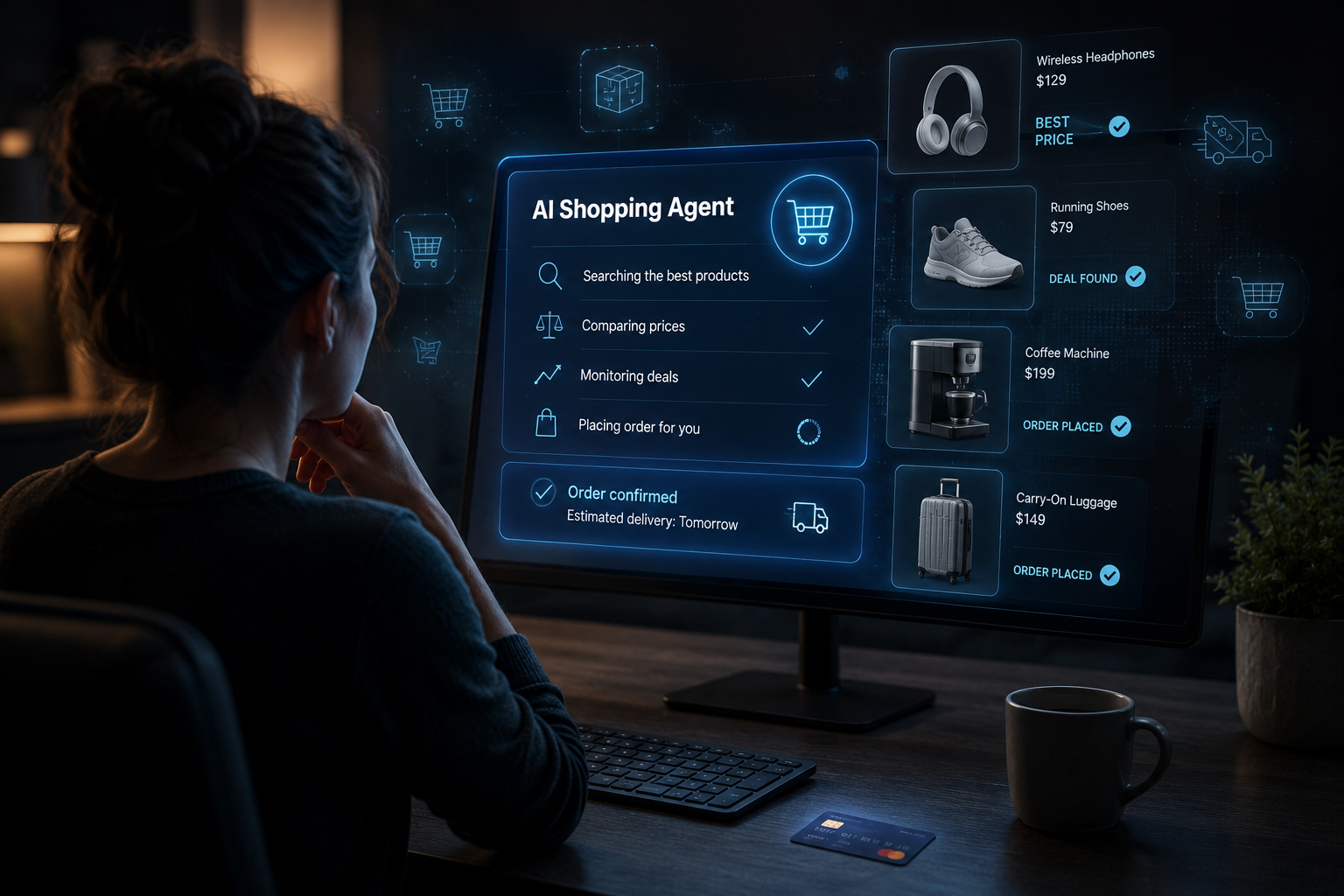
Artificial intelligence is beginning to dismantle that entire process. The emerging model is not simply AI helping people shop. It is AI increasingly being trusted to search, compare, monitor and eventually buy on their behalf — turning the traditional online store from somewhere consumers visit into infrastructure their software talks to instead.
Shopping Is Moving From Search to Conversation
The first transformation is already obvious. Instead of trying to construct the perfect Google search or navigating dozens of filters, shoppers can describe what they actually want.
A customer can ask for a lightweight laptop suitable for travelling, powerful enough for video editing, with strong battery life and costing less than £1,000. An AI system can interpret those competing requirements, research products, compare specifications and explain the trade-offs in ordinary language.
ChatGPT already presents product recommendations using information including price, availability and product characteristics, while its shopping research system can conduct multi-step product discovery and produce personalised comparisons. Google has similarly integrated conversational shopping into its AI experiences, supported by a Shopping Graph containing more than 60 billion product listings.
This matters because searching and shopping are different problems. Traditional search engines are excellent when somebody knows exactly what they want. AI becomes more powerful when the customer only knows the problem they need solved.
The Numbers Suggest Consumers Are Already Changing
This is no longer merely a prediction about some distant AI economy.
Shopify said AI-driven traffic to stores on its platform increased eightfold year-on-year during the first quarter of 2026. Orders originating from AI-powered searches increased nearly 13 times over the same period.
John Lewis offered another striking indication in September. The British retailer said AI-agent shopping accounted for around 2.5% of product searches, compared with just 0.3% a year earlier, and said the trend was appearing across age groups rather than being confined to younger consumers.
That is still a small proportion of total shopping. The rate of growth, however, explains why retailers and technology companies are moving so quickly.
AI Is Starting to Act Instead of Simply Recommend
The crucial next step is the transition from generative AI to agentic AI.
A conventional chatbot might tell you which television offers the best value. An AI agent can potentially find it, monitor its price, check whether delivery is available, select an authorised payment method and complete the transaction.
OpenAI introduced Instant Checkout in ChatGPT in 2025 as an early move towards this model, allowing eligible transactions to be completed from within the conversation instead of requiring the customer to begin the shopping process again on another website. Its Agentic Commerce Protocol was designed to allow agents, shoppers and merchants to communicate through a common commerce framework.
Visa and OpenAI expanded that direction in June 2026 by announcing a collaboration intended to provide Visa payment infrastructure for agentic commerce experiences. The significance is greater than another payment option: the infrastructure required for AI software to become an authorised economic actor is being constructed.
The Shopping Cart Is Becoming Intelligent
Google is pushing the concept further with its Universal Cart.
Rather than belonging to one retailer, Google describes a cart capable of working across merchants and across services including Search, Gemini, YouTube and Gmail. Once something enters the cart, AI can watch for price reductions, monitor stock and provide pricing information.
The interesting part is what happens when reasoning enters the cart.
Google gives the example of somebody assembling a custom computer. Instead of allowing the customer to unknowingly buy incompatible components, the AI could recognise the conflict and propose replacements before the purchase happens.
That changes the shopping cart from a passive list into something closer to an adviser.
The same concept could eventually work across thousands of purchasing decisions. An AI planning a holiday could simultaneously weigh flights, baggage policies, hotels, transfers and travel insurance. One organising a wedding could compare hundreds of suppliers against a single budget. One furnishing a home could ensure that everything physically fits before anything is ordered.
Your AI Could Know What You Want Before You Search
Personalisation could make this much more powerful.
Today's recommendation engines largely learn from behaviour inside individual platforms. Amazon knows what you bought on Amazon. Netflix understands what you watch on Netflix. A sufficiently capable personal AI assistant could potentially understand preferences across much more of somebody's life — provided the user chooses to give it that access.
ChatGPT's shopping research can already use remembered preferences where memory is enabled. Amazon's shopping assistant also uses individual shopping activity to personalise recommendations and conversational answers.
The logical destination is a digital buyer with a surprisingly detailed model of its owner.
Tell it once that you are 6ft 4in, dislike slim-fitting shirts, normally spend less than £70 on them and prefer breathable materials, and those constraints could potentially become persistent shopping preferences rather than information you repeatedly enter into websites.
The experience becomes less like searching a catalogue and more like telling somebody who knows you: “I need something to wear to a wedding.”
AI Could Buy Without Asking Every Time
The more radical version appears when consumers give agents limited authority over money.
Instead of approving every transaction, somebody could establish rules.
An agent might be authorised to reorder household essentials whenever supplies are running low. It could buy a train ticket below a specified price, renew frequently purchased items, replace a broken consumable or automatically purchase something from a watchlist when its price falls below a threshold.
Visa has outlined precisely this type of future: consumers could authorise an AI while limiting what categories it can purchase and how much it is allowed to spend. Visa's developing infrastructure includes ways for merchants to establish that an agent is legitimate and has permission to act for a particular customer.
Mastercard is developing similar agentic-payment infrastructure. In Europe, it says controlled scenarios are already being tested in which consumers authorise an AI agent to complete purchases using existing payment credentials.
India may offer an especially important glimpse of what comes next. Work is under way on infrastructure that could allow AI agents to conduct some smaller UPI payments without requiring individual approval for every transaction, while incorporating mechanisms such as spending limits and identity controls.
Retailers Now Have to Impress the Machine
For businesses, the upheaval could be enormous.
For years the objective of ecommerce was getting somebody onto a website. Companies fought for Google rankings, bought advertisements, perfected landing pages and spent fortunes improving conversion rates.
But what happens when the customer never visits?
An AI agent could examine hundreds of sellers and return three options. If the customer trusts it enough, the traditional store homepage, banner advertisements and elaborate navigation system become significantly less important.
Product data becomes critical instead.
Is the price clear? Is the product in stock? What are its measurements? Does it fit the buyer's requirements? Can the merchant deliver tomorrow? Is there reliable information explaining precisely what distinguishes it from competing products?
Shopify is already building infrastructure designed to expose merchant products to AI shopping environments. Its Universal Commerce Protocol work with Google and Catalog API are intended to allow agents to discover products and conduct transactions across merchants.
Retail optimisation could therefore increasingly mean optimisation for machines as well as humans.
An Entire New Battle for Retail Power Is Beginning
There is a massive commercial question buried inside all this: who controls the customer?
Retailers traditionally want shoppers inside their own ecosystems because the relationship is valuable. They can collect behavioural data, promote loyalty schemes, recommend additional products and encourage repeat purchases.
AI platforms threaten to place another gatekeeper between the customer and retailer.
That tension is already visible. Retailers are trying to benefit from customers arriving through AI platforms while protecting the direct relationships and first-party customer information that underpin much of modern ecommerce.
If shopping agents become dominant, the most valuable position in ecommerce might no longer belong to the shop with the best website.
It could belong to whoever controls the agent making the recommendation.
Advertising Could Be Completely Rewritten
Advertising will not disappear. It may become more sophisticated.
Traditional internet advertising tries to influence people. Agentic advertising may increasingly have to influence a system acting for those people.
That creates strange new questions.
If your agent knows you need a dishwasher, should manufacturers be allowed to pay to make their models more visible? Should an AI disclose that a particular recommendation is sponsored? Should the system always select what it calculates is objectively best, or should a shopper be able to prioritise certain retailers, brands or ethical considerations?
Google has already introduced commercial concepts designed around AI-era shopping, including Direct Offers that allow businesses to present specific offers when a shopper appears ready to purchase.
The familiar fight for the top of the search results could gradually become a fight for inclusion in the AI's shortlist.
Prices Could Become More Personal Too
There is also a darker possibility.
An AI with extensive knowledge of a consumer could negotiate better prices for them. But sophisticated retailers could use AI and customer data in the opposite direction — working out precisely how much an individual is willing to pay.
That concern has become serious enough to attract regulatory attention.
The US Federal Trade Commission is currently consulting on an enforcement policy regarding personalised pricing, where personal information may be used to estimate what an individual consumer will pay. The regulator has warned that undisclosed or deceptive uses of such systems may fall foul of existing consumer-protection law.
This could create one of the strangest battles of the AI economy: the shopper's algorithm attempting to minimise a price while the seller's algorithm attempts to maximise it.
Shopping becomes a negotiation between machines.
Trust Could Decide Whether Agentic Shopping Succeeds
Handing software access to money introduces obvious dangers.
An AI misunderstanding a recommendation is irritating. An AI misunderstanding an instruction and spending £2,000 is different.
Systems therefore need to establish who authorised the purchase, what the agent was permitted to do and whether a transaction genuinely reflects the user's instructions.
Payments companies are already designing infrastructure around that problem.
Visa's Trusted Agent Protocol is intended to let merchants distinguish recognised commerce agents from malicious bots using cryptographic verification. Its proposed systems can carry information about agent intent, consumer identity and authorised payment credentials.
Limits could become as important as intelligence: maximum transaction values, approved retailers, prohibited categories, geographical restrictions and purchases requiring additional confirmation.
The best shopping AI may therefore not be the agent capable of spending the most autonomously. It may be the one users trust enough to give carefully controlled autonomy.
Shopping Agents Could Eventually Negotiate With Each Other
The longer-term implications become stranger still.
Today's ecommerce is designed principally for humans using websites and apps. Tomorrow's commerce may include machines selling services directly to other machines.
Mastercard has already launched infrastructure designed partly around extremely fast machine-to-machine transactions and microtransactions. Its vision includes AI services purchasing other digital services programmatically, potentially for tiny amounts of money.
The consumer version could eventually involve competing agents.
Your personal agent could ask several retailer agents for their best price. One might offer free delivery. Another could offer a discount because you are a returning customer. Another could bundle accessories.
The negotiation could happen in seconds, invisible to the person making the purchase.
What Shopping Could Look Like by the End of the Decade
Imagine needing a new television.
Today you might search Google, watch reviews, compare Amazon listings, visit retailer websites, read specifications and wait for a sale.
The emerging model compresses that process into a conversation: “Find me the best 65-inch television for my room. Maximum £1,200. I mostly watch films. I don't care about gaming. Don't buy it until it falls below £1,000.”
The agent researches the market. It remembers the room. It rejects irrelevant specifications. It monitors prices. It verifies availability. A week later a qualifying offer appears and, depending on the permissions you have granted, either asks for approval or completes the transaction.
That is not one hypothetical technology requiring a distant breakthrough. Different pieces of that workflow already exist across OpenAI, Google, Amazon, Shopify and major payment networks. What remains uncertain is how quickly they become interoperable, trusted and widely used.
The Biggest Change May Be That We Stop Shopping
Every previous technological shift has reduced friction. Supermarkets eliminated repeated trips to specialist shops. Ecommerce eliminated the journey to the supermarket. Smartphones put those stores in everybody's pocket.
Agentic AI could eliminate much of the active shopping itself.
Consumers will still care about beautiful products, fashion, luxury, discovery and the pleasure of browsing. AI is unlikely to eradicate shopping as entertainment.
But enormous amounts of purchasing are not entertainment. Buying printer ink, replacement razor blades, detergent, insurance, cables, office supplies, groceries or the cheapest suitable train ticket is work disguised as shopping.
Those transactions are prime territory for machines.
That is why the real AI shopping revolution is bigger than better recommendations. We are moving towards a world in which people increasingly specify an outcome — the budget, preferences and rules — and software handles everything between wanting something and owning it.
The defining ecommerce question of the next decade may therefore cease to be “Where should I shop?”
It could become “How much authority should I give my AI to shop for me?”
