

AI Just Found Hidden Laws Inside Plasma—And It Could Change How Science Discovers The Universe
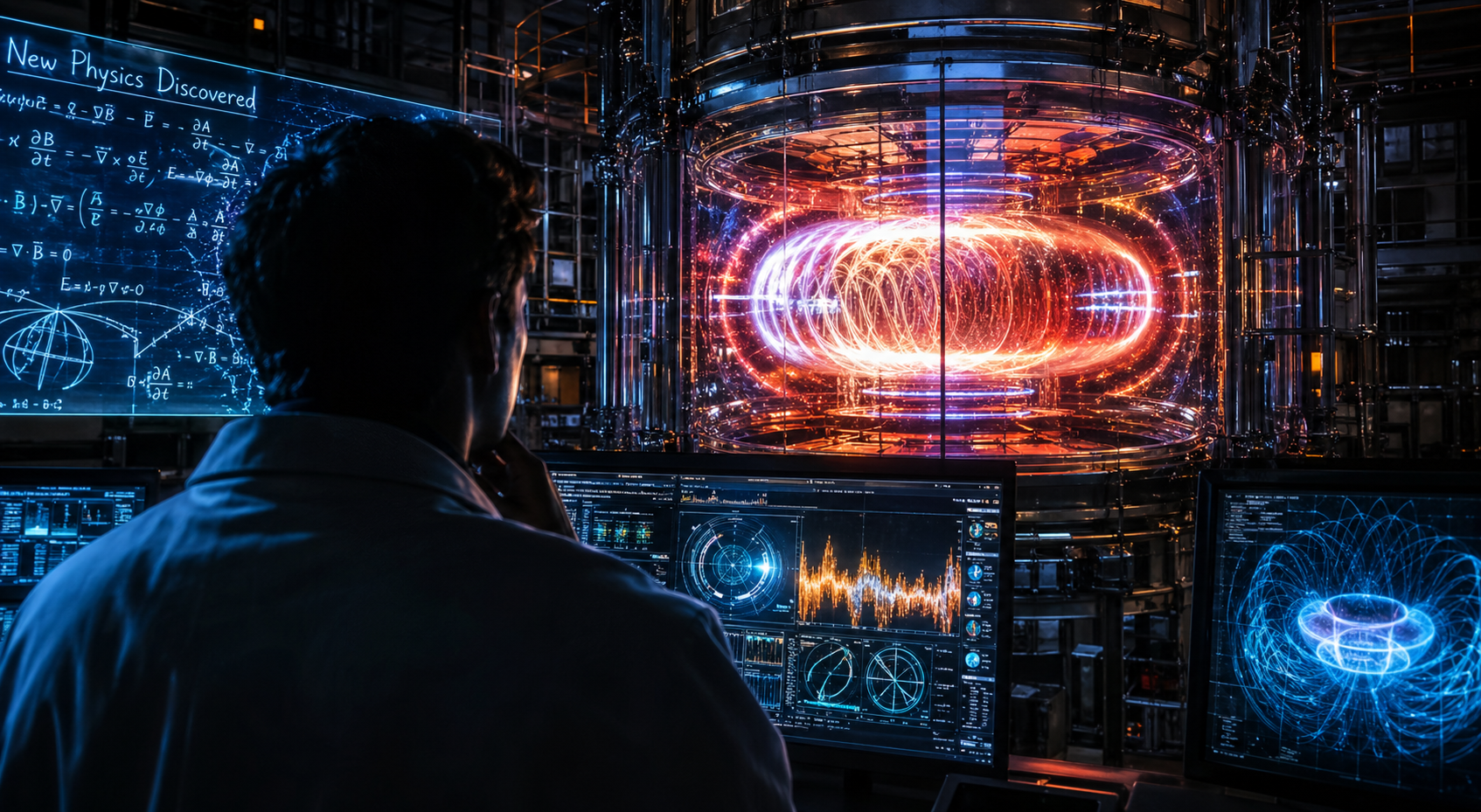
Scientists Used AI to Find New Physics Hiding in Plasma
AI Has Uncovered Hidden Rules Inside the Fourth State of Matter
The machine did not just analyze the chaos—it found the rules beneath it.
The most important part of this breakthrough is not that artificial intelligence looked at plasma.
It is that artificial intelligence helped expose rules inside plasma that human-built models had not fully captured.
That distinction matters. A calculator givprovides answer. A simulation tests a theory. A search engine retrieves information. But this work points toward something more powerful and more unsettling: AI as a discovery system—not merely processing science, but helping reveal parts of nature that were hiding in the noise.
The case comes from dusty plasma, a strange version of the fourth state of matter. Plasma is ionized gas: matter so energized that electrons and ions move freely, giving it unusual electrical behavior. Dusty plasma adds charged particles of dust to that environment, creating a messy, collective system where tiny particles influence one another in ways that are difficult to track by eye, by intuition, or by older mathematical assumptions. Plasma is not rare in the wider universe; it dominates visible cosmic matter and appears in environments from solar wind to lightning, while dusty plasma appears in places such as planetary rings, the ionosphere, lunar dust, and even wildfire smoke.
That is why this is bigger than one laboratory result.
If AI can help identify hidden laws in a chaotic many-particle system, the implications stretch far beyond one type of plasma. They reach into fusion energy, space physics, materials science, biology, and any field where complex systems are too tangled for traditional modeling alone.
What Was Actually Discovered
The researchers used a specially structured machine-learning model alongside high-resolution laboratory data from dusty plasma experiments. The goal was not simply to predict what particles would do next. The goal was to infer the forces governing their motion.
That is the crucial leap.
The system was trained on three-dimensional particle trajectories. It was designed with physics built into its structure, so it was not an unrestricted black box guessing patterns blindly. It had constraints. It had rules. But within those rules, it could search for unknown relationships in the data.
What emerged was a clearer description of non-reciprocal forces — interactions where one particle affects another differently than it is affected in return. In ordinary intuition, force often feels symmetrical: if one object pulls or pushes another, the relationship seems mutual. In dusty plasma, the story is stranger.
One particle can behave like the leader. Another trails behind it. The leading particle can attract the trailing particle, while the trailing particle repels the leader. The interaction is not a simple two-way mirror. It is directional. It is asymmetric. It is closer to a hidden traffic system inside matter than a neat textbook push-and-pull.
The AI-assisted model described these forces with more than 99% accuracy and helped correct earlier assumptions about how particle charge and force decay behave inside dusty plasma. One previous assumption held that particle charge scaled in direct proportion to particle size. The new work showed the relationship depends on other plasma conditions, including density and temperature. Another assumption suggested the force between particles weakened with distance in a way independent of particle size. The model indicated particle size does affect how that force drops away.
That is not just a better measurement.
It is a better map.
Why Plasma Is The Perfect Test Case
Plasma is one of the universe’s great troublemakers.
It appears simple from a distance: glowing gas, charged particles, motion. But inside it, countless interactions stack on top of one another. Particles move, repel, attract, screen, drift, and respond to fields. Add dust, and the system becomes even richer. Each particle is no longer just a passive speck. It becomes part of a collective dance.
That is why dusty plasma is so useful. It is complex enough to contain hidden behavior but controlled enough to study in a lab. Researchers can suspend tiny particles in a plasma-filled chamber, record their motion, and then reconstruct their positions over time. In this case, the team used a tomographic imaging method involving laser light and high-speed cameras to track the three-dimensional movement of particles over centimeter-scale distances for several minutes.
That kind of data is gold for AI.
Not because AI magically “understands” plasma in the human sense. It does not. But it can detect mathematical relationships inside dense motion data that would be brutally difficult to extract by hand.
The deeper point is this: nature often hides its rules inside movement.
If you can track the movement precisely enough, and if your model is disciplined enough, the rules begin to show themselves.
What Media Misses
The tempting headline is that AI discovered “new laws of physics.”
The sharper version is this: AI helped scientists discover effective laws inside a complex system where older assumptions were too blunt.
That difference matters.
This does not mean a machine woke up, replaced physicists, and rewrote the foundations of the universe. It means physicists built a carefully constrained AI system, fed it unusually detailed experimental data, and used it to infer force laws that could be tested, interpreted, and validated.
The breakthrough is not AI acting alone.
The breakthrough is AI becoming a new kind of scientific instrument.
A telescope extends sight. A microscope extends sight inward. A particle accelerator extends experimental reach. A physics-aware AI model may extend pattern discovery — especially in systems where there are too many moving parts for human intuition to dominate.
That is the real line being crossed.
AI is moving from answer machine to hypothesis machine. From data processor to law finder. From an assistant at the edge of science to a possible engine inside science itself.
Why This Could Matter For Fusion Energy
Fusion is one of the obvious places people will look when they hear “plasma.”
That makes sense. Fusion reactors depend on controlling plasma under extreme conditions. The dream is simple to say and brutally hard to engineer: hold superheated plasma long enough, stably enough, and efficiently enough to extract useful energy.
A dusty plasma experiment is not the same thing as a fusion reactor. This study does not suddenly solve fusion. It does not hand the world a working clean-energy machine.
But the relevance is still real.
Fusion is, at heart, a plasma control problem. The better scientists become at modeling complex plasma behavior, the better they can understand instabilities, interactions, and collective motion. AI systems that can infer hidden force laws from data may eventually support better models of plasma dynamics, better diagnostics, and better control strategies.
The near-term value is not “AI discovered fusion.”
The near-term value is subtler and more important: AI may help reveal the rules inside plasma systems that are too complicated for older models to capture cleanly.
In fusion, small modeling improvements can matter because plasma is unforgiving. It does not care about human optimism. It escapes, twists, cools, disrupts, and misbehaves. Any tool that helps scientists see its hidden structure has potential.
Why This Could Matter For Space
Space is full of plasma.
Solar wind is plasma. Lightning involves plasma. Planetary environments can contain dusty plasma. The rings of Saturn, the ionosphere, and charged lunar dust all connect to this wider family of phenomena.
That means the breakthrough is not locked inside a chamber.
If researchers can use AI to infer force laws in laboratory plasma, the same broad method could help scientists interpret complex natural systems elsewhere. Space environments are often difficult to sample directly. They are noisy, dynamic, and full of interacting forces.
A better AI-assisted framework could help researchers ask sharper questions:
What invisible interactions are shaping charged dust around planetary bodies?
How do collective particle behaviors influence space weather?
Where are older assumptions smoothing over important details?
The power is not just prediction. It is an explanation.
Prediction tells you what may happen next. Explanation tells you why the system behaves that way at all.
Science needs both.
Why This Could Matter For Materials And Biology
The researchers also point toward many-body systems beyond plasma: industrial materials, colloids, living cells, and collective biological motion. That is where the story becomes even more interesting.
A many-body system is any system where the whole cannot be understood by looking at one component in isolation. Paint, ink, dust clouds, cell clusters, crowds, flocks, and tissues all depend on interaction. The mystery is not merely what each part is. The mystery is how the parts generate behavior together.
That is exactly where human intuition often struggles.
We are good at simple cause and effect. One object hits another. One switch turns on a light. One decision creates one outcome.
Complex systems are different. They are webs of feedback. Tiny interactions accumulate. Local movements create global patterns. The group develops behavior that no single component contains on its own.
That is why this AI method could become valuable outside plasma physics. A system that can infer interaction rules from motion data could help scientists study how particles cluster, how materials flow, how cells migrate, or how biological groups organize themselves.
The plasma result becomes a proof of principle.
If the machine can find hidden order there, it may find hidden order elsewhere.
The Human Role Still Matters
This is not a story about scientists becoming irrelevant.
It is almost the opposite.
The AI worked because the scientists designed it carefully. They did not simply throw data into a generic model and accept whatever came out. They built a network shaped by physical constraints. They separated different contributions to particle motion, including drag, environmental forces, and particle-to-particle forces. They validated the inferences against experiments.
That is the key to trustworthy AI science.
The danger of AI is not that it sees patterns. It is that it can see false patterns beautifully. A model can be confident and wrong. It can fit noise. It can produce outputs that look impressive but collapse under testing.
The strength of this work is that it was not just pattern recognition. It was structured, constrained, and experimentally checked.
That is the future worth paying attention to: not AI replacing the scientific method, but AI becoming embedded inside it.
Human scientists ask the right questions, design the right experiments, impose the right constraints, and test the outputs. AI searches the pattern space at a speed and scale humans cannot match.
The winner is not machine over human.
The winner is machine-shaped science guided by human judgement.
What Changes Now
The immediate change is conceptual.
AI is no longer credible only as a tool for sorting data, speeding up calculations, or predicting known outcomes. It is becoming credible as a partner in discovering unknown relationships, especially where the system is complex, dynamic, and difficult to reduce.
That is a major shift.
For decades, much of physics has relied on a powerful loop: observe, theorize, test, refine. AI adds another layer to that loop. It can infer candidate laws from data and hand scientists new structures to examine.
That does not make the process easier in every way. It may make science more demanding. Researchers will need to know when to trust the machine, when to challenge it, when to simplify it, and when to reject its patterns as artifacts.
But the direction is clear.
The next frontier of AI in science will not be chatbots giving textbook answers. It will be specialized systems trained to uncover hidden structure in the real world.
What Happens Next
The most likely next phase is expansion.
Researchers will try similar approaches in other complex systems: different plasma environments, soft materials, biological motion, fluid systems, and perhaps eventually more difficult fusion-relevant dynamics. Some attempts will fail. Some will produce useful approximations rather than dramatic discoveries. A few may expose rules that were previously invisible.
The most dangerous next phase is overstatement.
If every AI-assisted pattern is branded a “new law of nature,” public trust will erode fast. Science needs excitement, but it also needs precision. A newly inferred effective law inside a specific system is not the same thing as a universal law of physics. The language matters because the credibility matters.
The most underestimated next phase is methodological.
The biggest breakthrough may not be this one dusty plasma result. It may be the framework: physics-aware AI trained on rich experimental data, used to infer interpretable laws, then checked against reality.
That pipeline could become one of the defining scientific tools of the next decade.
The Bigger Meaning
The oldest dream of science is that the universe is intelligible.
Not simple. Not gentle. Not arranged for human convenience. But intelligible—if we build the right tools, ask the right questions, and refuse to stop at surface chaos.
AI is now becoming one of those tools.
This plasma breakthrough matters because it hints at a future where machines do not merely accelerate research already imagined by humans. They may help reveal patterns humans did not know to look for.
That is thrilling. It is also humbling.
The universe has not run out of hidden rules. Human beings have simply reached the edge of what unaided intuition can easily see.
Now the machines are staring into the chaos with us.
And for the first time, they may be helping the chaos answer back.
