

AI Memory: Why Machines Forget, Why Brains Don’t, and What Reliable AI Memory Will Require
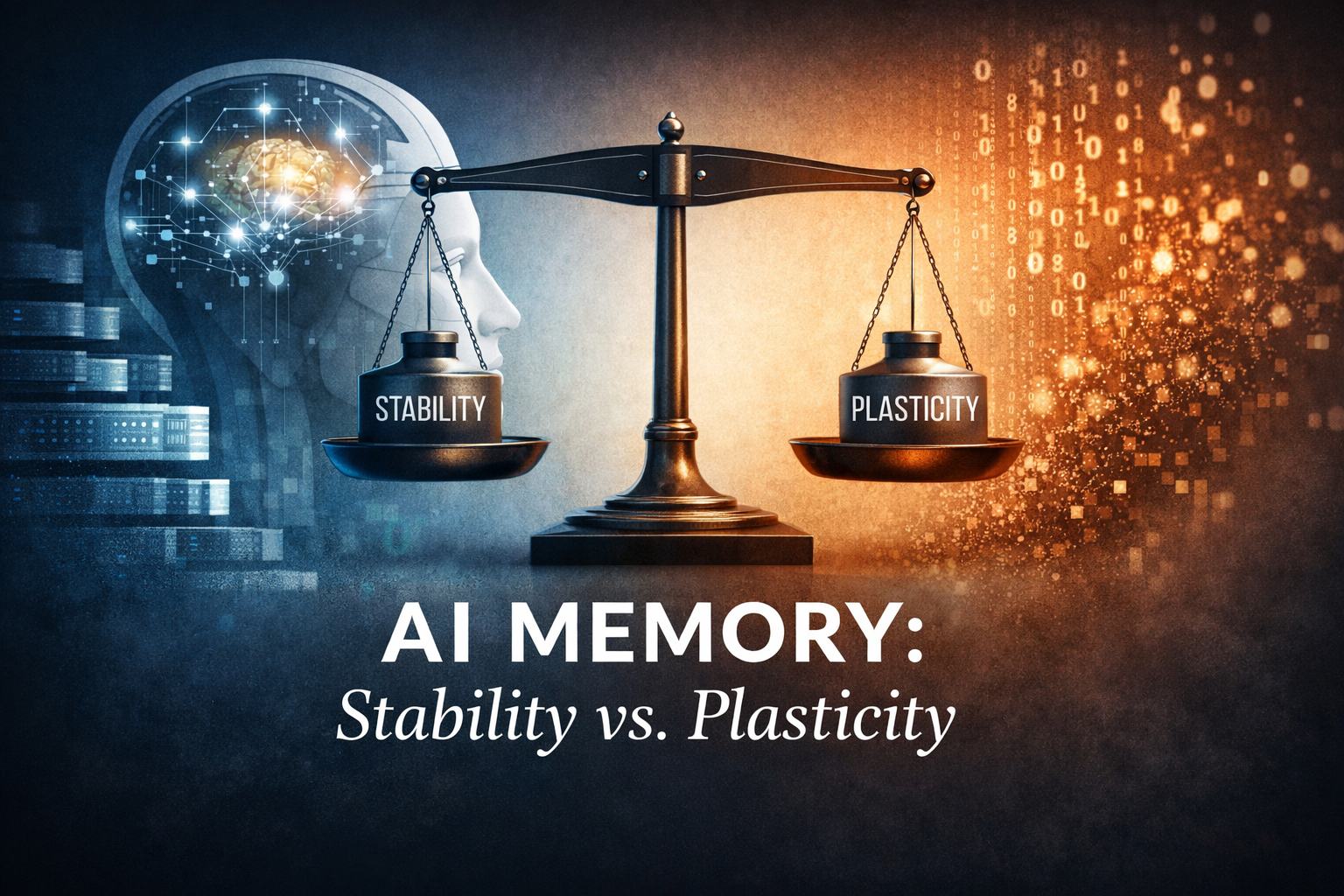
AI memory is becoming infrastructure. Learn why machines forget, why context isn’t memory, and the strategies needed for reliable AI memory.
AI memory is becoming a practical feature, not a philosophical one. It shows up when a system “remembers” your preferences, tracks a long project, or pulls the right document at the right moment. And it fails in ways that feel less like a bug and more like a breach of trust.
The tension is simple to state and difficult to solve: learning new information should not erase what came before, but freezing the system to preserve the past makes it brittle in the present. In engineering terms, this is the stability–plasticity problem. In real life, it is the difference between an assistant you can rely on and one you have to babysit.
Brains are not perfect recorders, but they are built to learn continuously without collapsing into total amnesia. Machines, by contrast, can be brilliant at a single training snapshot and fragile the moment the world shifts. That gap matters because we are starting to treat memory as infrastructure: a layer that other products, workflows, and decisions will stand on.
By the end of this piece, you will understand why “more context” is not the same as memory, why forgetting happens, what a reliable memory stack needs, and what realistic milestones look like.
The story turns on whether AI memory becomes reliable infrastructure or an ungoverned liability.
Key Points
AI memory is not mainly about storage; it is about retrieval, reliability, and control.
Catastrophic forgetting is what happens when learning new tasks overwrites older knowledge instead of layering on top of it.
The stability–plasticity trade-off is the central constraint: systems must adapt without dissolving.
A longer context window helps reasoning in the moment, but it is still not durable memory.
Four practical strategies dominate: retrieval, replay, gating, and modular memory.
“Memory failure modes” are predictable: drift, contamination, and injection are the big three to design around.
Reliable memory requires evaluation that tests recall, grounding, and security—not just fluency.
The near-term path is not human-like memory; it is auditable, scoped, and attack-resistant memory.
Names and Terms
AI memory — Any mechanism that lets a system use information from the past in the present.
Stability–plasticity — The trade-off between retaining old knowledge and learning new knowledge.
Catastrophic forgetting — Sudden loss of older capabilities when training on new tasks.
Context window — The temporary text the model can “see” right now; not durable storage.
Retrieval — Pulling relevant facts from an external store at the moment of use.
Replay — Reusing past data during learning to prevent overwriting.
Gating — Controlling which parts of a system update, and when.
Modular memory — Separating capabilities into components to reduce interference.
Model drift — Performance decay as the real world changes around a deployed model.
Contamination — Bad or irrelevant information entering the memory store.
Prompt injection — Malicious instructions hidden in inputs that hijack behavior.
Data leakage — Sensitive information escaping through outputs, logs, or retrieval pathways.
What It Is
AI memory is the engineered ability for a system to carry useful information forward through time and apply it when it matters. That information can be personal preferences, organizational context, facts from documents, lessons from past interactions, or patterns learned from ongoing data.
The confusion starts because the word “memory” covers two very different things. One is what the system learned during training: patterns baked into model parameters. The other is what the system can access at run time: notes, documents, and records it can retrieve and use now.
When people say “just provide it more context,” they are usually asking for the second kind. They want a bigger scratchpad. That helps, but it does not solve the deeper problem: keeping knowledge stable while the system keeps learning, and keeping the memory layer safe while attackers try to corrupt it.
What it is not: a human-like inner life, a guarantee of truth, or a single feature you can toggle on. Memory is a stack, and it breaks at the seams between its layers.
How It Works
Start with the simplest picture: a model is trained on a large snapshot of data, then deployed. If you never update it, it can appear stable. But it also becomes stale, because the world changes. If you do update it, you risk breaking what it previously did well.
This is the stability–plasticity dilemma in practical form. A fully plastic system absorbs new patterns quickly but can overwrite older ones. A fully stable system preserves older behavior but resists learning and adaptation. Brains manage this by distributing memory across different mechanisms and timescales, rather than forcing one circuit to do everything.
In modern AI systems, the most reliable approach is to separate “general skill” from “current knowledge.” General skill lives in model weights. Current knowledge lives outside the model, in a store that can be updated, audited, and scoped.
That separation is where retrieval comes in. Instead of forcing the model to memorize every update inside its weights, the system retrieves relevant information at the moment it needs it. This can reduce hallucinations, keep knowledge fresh, and make updates easier, but it also creates a new attack surface: the system is now only as trustworthy as what it retrieves.
Replay addresses a different weakness: learning itself. If you train on a sequence of tasks or domains, the model can forget earlier ones because new gradient updates interfere with older representations. Replay reduces this by mixing in older examples or summaries during learning, forcing the model to keep older skills alive while it learns new ones.
Gating is a control strategy. Instead of letting every part of the system update for every new signal, gating restricts plasticity. It can freeze sensitive parts, route different tasks through different pathways, or apply updates only when confidence is high. The point is not to stop learning; it is to stop accidental overwriting.
Modular memory pushes the same idea further. If tasks compete inside one monolithic network, interference is almost guaranteed. Modular approaches isolate capabilities into components so that adding a new skill does not rewrite the entire system. This can look like separate modules per domain, expandable architectures, or routing layers that keep knowledge partitioned.
Now return to the phrase “more context.” A longer context window increases how much text the system can consider right now. That can improve coherence and reduce the need to retrieve. But it is still transient. It disappears when the conversation ends, and it remains expensive and brittle when it grows large. Context is closer to working memory than long-term memory: powerful for the moment, unreliable as a foundation.
Reliable AI memory emerges when these pieces become an integrated system: retrieval for up-to-date facts, replay for retention during learning, gating for controlled updates, and modularity for reduced interference.
Numbers That Matter
Three to five meaningful items is a widely cited rough limit for human working memory under many conditions. It is not a hard ceiling, but it is a useful reminder: even biological systems treat “what is in mind right now” as scarce. This is why brains lean so hard on cues and retrieval rather than brute-force holding. The analogy matters because a context window is closer to working memory than to durable memory.
O(n²) is the core scaling problem of standard self-attention with sequence length. Double the sequence, and you do far more than double the work. This is one reason “just increase context” runs into cost, latency, and energy constraints. Even when engineering tricks reduce the pain, longer context still competes with throughput, price, and responsiveness.
Two distinct update pathways exist in most practical memory stacks: updating model weights versus updating external memory stores. Weight updates are slow, expensive, and risky because they can shift behavior globally. Memory-store updates are faster and more reversible, but they demand tight controls because they can be poisoned, manipulated, or leaked.
Two competing metrics sit at the heart of retrieval: recall and precision. Retrieve too little and you miss the needed fact. Retrieve too much and you flood the model with noise, making it easier to latch onto the wrong detail or the wrong instruction. Reliable memory is often a story of disciplined narrowing, not maximal retrieval.
Minutes to hours is a useful way to think about “update windows” in operational systems, even if the exact cadence varies. The key idea is that memory layers update more frequently than model weights, so mistakes in memory can propagate faster than you can retrain your way out of them. That is why logging, rollbacks, and quarantine mechanisms matter.
Four engineering strategies dominate because each solves a different failure mode. Retrieval fights staleness. Replay fights are overwriting. Gating fights uncontrolled updates. Modular memory fights interference. If one is missing, the system leans too hard on the others and becomes fragile.
Where It Works (and Where It Breaks)
AI memory works best when the goal is grounded assistance: summarizing internal material, drafting with consistent preferences, answering questions against a defined corpus, or maintaining continuity across long projects. In these cases, external memory is a strength because it can be curated, updated, and audited.
It breaks when memory becomes an unbounded junk drawer. If the system stores everything, it retrieves irrelevant clutter. If it stores the wrong things, it repeats errors with confidence. If it stores sensitive material carelessly, it leaks. And if it accepts untrusted content into memory, it can be steered by whoever controls that content.
Trade-offs show up everywhere. More retrieval can improve factuality but can also increase latency and expose more data. More frequent updates can improve freshness but can accelerate drift. More modularity can reduce interference but can increase complexity and integration risk.
Memory failure modes deserve their own spotlight because they are not edge cases; they are the normal ways memory goes wrong.
Drift is the slow erosion of performance as data, users, and environments change. Even if the model weights remain fixed, the meaning of inputs can shift, the distribution of tasks can change, and the retrieved corpus can evolve. Drift is not a moral failure. It is physics: systems degrade when the world moves.
Contamination is what happens when low-quality, outdated, or malicious content enters the memory store. In retrieval-based systems, contamination does not need to be dominant to be dangerous. It only needs to be retrieved at the wrong moment.
Injection is the sharpest failure mode. If an attacker can hide instructions inside content the system retrieves, the system can be tricked into prioritizing the attacker’s goals over the user’s. Unlike classic software, language models do not naturally separate “instructions” from “data.” They are trained to treat text as text, which makes memory layers a tempting target.
The deeper point is that memory is not neutral. It changes incentives. Once memory exists, people will try to exploit it.
Analysis
Scientific and Engineering Reality
Under the hood, “AI memory” is usually not a single mechanism. It is a choreography between a generative model, a retrieval process, a memory store, and an evaluation loop that decides what to save, what to ignore, and what to surface.
For the system to be reliable, three things must be true. First, retrieval must be relevant: it must bring back the right material more often than it brings back noise. Second, the model must use retrieved material in a constrained way: grounding should reduce confabulation, not provide new material for it. Third, memory updates must be controlled: the system must not write permanent notes based on transient mistakes.
What would falsify the reliability story is straightforward. If the system performs well in demos but degrades under real-world distribution shift, it is not reliable memory; it is a fragile pipeline. If it cannot resist adversarial content in retrieval, it is not infrastructure; it is an exposed surface. If it cannot explain what it used and why, it cannot be audited, and it will not be trusted where stakes are high.
Economic and Market Impact
If reliable AI memory works, it changes the cost curve of knowledge work. Not because it replaces experts, but because it reduces repeated retrieval by humans: fewer hours spent searching, re-reading, and reconstructing context.
The winners are organizations with large internal corpora and high coordination costs: policy-heavy teams, regulated industries, complex operations, and any place where institutional knowledge lives in scattered tools. Memory systems can turn that sprawl into a usable map.
But adoption will not be driven by capability alone. It will be driven by liability. The practical bottleneck is not “can it remember,” but “can we prove what it remembered, where it came from, and whether it was allowed to use it?” That means spending on governance, evaluation, access control, and incident response, not just model performance.
Near-term pathways will emphasize scoped memory: specific projects, specific datasets, strict permissions, and clear retention rules. Long-term pathways depend on standardization: shared evaluation methods, shared security assumptions, and shared patterns for audits and rollbacks.
Security, Privacy, and Misuse Risks
Memory expands the attack surface because it creates a persistent state. Attackers love persistent state. It gives them a place to plant influence and wait.
Prompt injection is the most direct risk. If the system treats untrusted text as instruction, an attacker can steer outputs, extract sensitive information, or disable safeguards. Indirect injection is worse because it can hide in the data the system retrieves: documents, emails, tickets, or web content that appears legitimate.
Data leakage is the sibling risk. Retrieval can pull sensitive content into the model’s working context. Once there, it can be echoed in outputs, logged in traces, or exposed through clever questioning. Even without malice, leakage can happen through over-broad retrieval or weak access boundaries.
Memory manipulation is the quieter threat. If a system writes to memory based on user input, a bad actor can poison future behavior. The system may “learn” false preferences, store misleading facts, or internalize adversarial phrasing that later influences decisions.
Guardrails matter most at the interfaces: what enters memory, what gets retrieved, what is allowed to be used, and what gets written back. In classic software terms, memory is an input-validation problem, an access-control problem, and an observability problem all at once.
Social and Cultural Impact
Reliable AI memory changes what people expect from tools. We stop treating them as calculators and start treating them as colleagues. That shift is subtle, and it can create over-trust.
In education and research, memory can compress onboarding: the system can carry a project’s backstory, definitions, and constraints. But it can also fossilize mistakes. If early notes are wrong, memory can turn a temporary misunderstanding into a persistent misconception.
In workplaces, memory can reduce friction by preserving decisions and context. It can also increase surveillance anxiety if people do not know what is stored, how long it is stored, or who can access it. Trust will depend on clear boundaries: explicit retention, explicit access, explicit purpose.
Culturally, we may see a split between “stateless assistants” that feel disposable and “stateful systems” that feel like they know you. The second category will be more useful and more dangerous, because it invites attachment, authority, and dependence.
What Most Coverage Misses
Most coverage treats memory as a capability upgrade, like adding RAM to a laptop. The real story is that memory is a governance upgrade. It forces you to decide what the system is allowed to know, what it is allowed to keep, and how it should behave when knowledge conflicts.
The overlooked detail is that retrieval makes memory legible. If knowledge stays inside model weights, you cannot easily inspect it, update it surgically, or prove provenance. External memory can be logged, versioned, rolled back, and permissioned. That is not just an engineering convenience. It is the difference between “we hope it works” and “we can show why it worked.”
The second blind spot is that safety is not only about model outputs. It is about the whole memory loop: ingestion, indexing, retrieval, and write-back. A system can be “safe” in a static test and unsafe in production because the memory layer changes faster than the model.
Why This Matters
The people most affected in the short term are those who live inside complex information environments: analysts, operators, compliance teams, researchers, and managers who coordinate across many tools. Reliable memory can reduce repeated work and improve continuity. Unreliable memory can create silent errors that spread.
In the long term, reliable memory changes what we automate. Stateless systems can draft and summarize. Stateful systems can manage ongoing processes, learn preferences, and carry institutional context forward. That is where the productivity upside lives, and it is also where the risk concentrates.
Milestones to watch are not only bigger models. They are reliability triggers.
Memory evaluation benchmarks that test retrieval accuracy, grounding, and resistance to injection, not just answer quality.
Auditable memory logs that show what was retrieved, what was used, and what was written back.
Permissioned retrieval that enforces “need to know” boundaries across documents and teams.
Rollback and quarantine mechanisms for memory stores, so contamination does not become permanent.
Clear retention standards that define what is stored, for how long, and why, with defaults that minimize harm.
Each milestone is a signal that AI memory is becoming infrastructure: tested, constrained, and governable.
Real-World Impact
A policy team uses a memory-enabled assistant to track changes across drafts, highlight what shifted, and surface the reasoning behind decisions. It saves time, but only if the system can cite what it used internally and avoid pulling restricted material across boundaries.
A customer support operation uses retrieval to answer questions from a changing knowledge base. It works when retrieval is tight and permissions are strict. It fails when old articles are not retired, when duplicates proliferate, and when malicious content slips into the corpus.
A research group runs weekly literature digests through a memory layer. The benefit is continuity: the system remembers what was already tested and what failed. The risk is contamination: a single mistaken summary can become the seed for repeated misunderstanding.
A personal workflow tool remembers preferences and recurring tasks. The value is low friction. The danger is quiet manipulation: if memory can be edited indirectly, your tool can be nudged into becoming someone else’s megaphone.
The Road Ahead
The next phase of AI memory will not be defined by a single breakthrough. It will be defined by whether we can make memory boring: predictable, testable, permissioned, and resilient under attack.
One scenario is “reliable retrieval-first memory.” In this world, most durable knowledge stays outside the model, and systems become better at finding, scoping, and grounding. If we see strong standards for logging and evaluation, it could lead to widespread adoption in high-stakes workflows.
A second scenario is “feature-first memory sprawl.” In this world, products ship memory quickly, store too much, and rely on hope rather than controls. If we see repeated incidents of injection and leakage tied to memory layers, it could lead to a backlash and tighter regulation.
A third scenario is “hybrid memory stacks.” Here, systems use retrieval for facts, limited write-back for stable preferences, replay for learning, and modularity for containment. If we see tools that can roll back memory safely and prove provenance routinely, it could lead to stateful systems that people trust.
A fourth scenario is “stateless by design.” Some domains may decide memory is not worth the risk. If we see strict compliance regimes treat persistent AI memory as a liability by default, it could lead to a market split: powerful stateful systems inside controlled environments, and stateless tools everywhere else.
What to watch next is not whether systems can remember more. It is whether they can remember on purpose: with boundaries, with receipts, and with defenses that assume the memory layer will be attacked.
