

Anthropic Quietly Built A Physical Biology Lab As Its AI Drug Push Accelerates
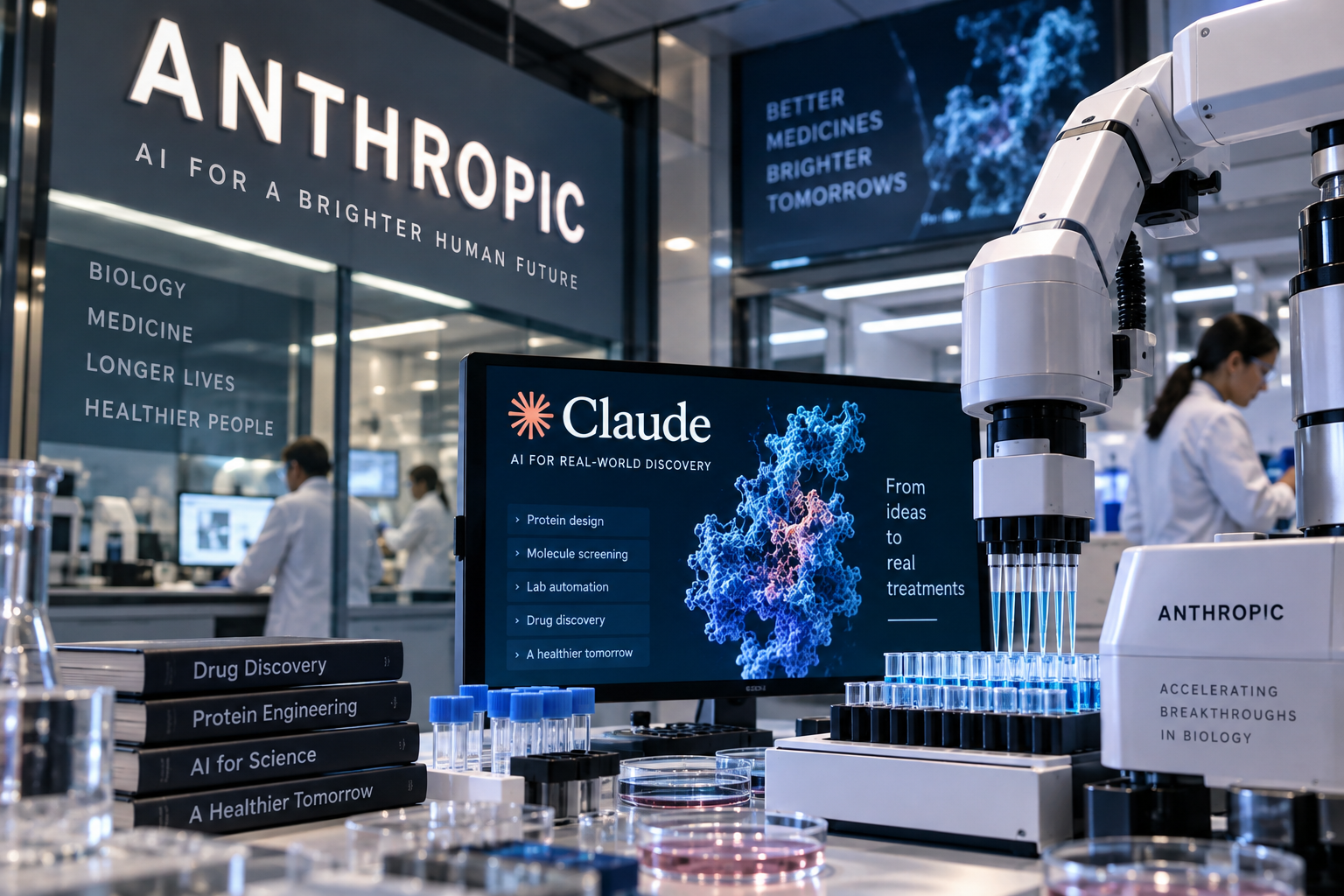
Anthropic’s Next AI Frontier Could Be The Laboratory
Inside Anthropic’s Secretive Push To Bring Claude Into The Biology Lab
Anthropic has quietly established a physical biology laboratory in the San Francisco Bay Area, taking the company behind Claude considerably deeper into experimental science.
The facility is a “wet lab” — a laboratory where researchers conduct physical experiments rather than relying entirely on computer simulations. Anthropic’s head of life sciences, Eric Kauderer-Abrams, confirmed its existence to Reuters, saying that real laboratory work remains the ultimate test of biological ideas. The company later stressed that the facility itself is not specifically a drug-discovery laboratory.
Claude Is Moving Beyond The Computer
The distinction matters, but so does the direction of travel.
Anthropic has been expanding aggressively into life sciences, exploring how advanced AI models could help researchers design proteins, analyse scientific data and eventually coordinate increasingly automated laboratory workflows.
Its ambition is not simply to make Claude better at answering biology questions. The larger goal is to connect AI reasoning with the physical process of science.
Anthropic recently introduced its Model Hardware Standard, designed to allow AI agents to communicate with laboratory and manufacturing equipment including microscopes, robotic arms and liquid-handling systems. In a proof-of-concept experiment, Claude coordinated several pieces of laboratory equipment while performing a protein assay and even recovered autonomously from some hardware errors.
That creates the possibility of laboratories where scientists define an objective while AI systems help coordinate experiments, analyse results and adjust subsequent steps.
Human involvement, Anthropic insists, remains essential.
Why Anthropic Is Betting On Biology
The company sees life sciences as one of the areas where increasingly capable AI could produce enormous real-world benefits.
Kauderer-Abrams told Reuters that life sciences is already among Anthropic’s biggest investment areas when measured by resources and headcount. The company is particularly interested in diseases and biological targets that have historically been considered difficult or commercially unattractive to pursue.
Its research is already producing intriguing results.
In August, Anthropic reported experiments in which Claude designed protein binders against 15 targets. External laboratory testing found successful binders against 14, with individual design hit rates between roughly 22 and 35 per cent depending on the experimental setup. Anthropic cautioned that protein binding represents only an early part of the much longer drug-development process.
The company has also been developing tools intended to connect AI with the wider scientific ecosystem.
On September 17, Anthropic announced its Life Sciences Verification Program, giving approved scientific organisations access to models with safeguards specifically adapted for legitimate biological research, including drug discovery, research biology, clinical development and manufacturing.
The Bigger Race For AI-Driven Science
Anthropic is far from alone in believing AI could transform drug development.
The pharmaceutical industry already uses machine learning extensively, while specialist AI companies are attempting to shorten a process that can traditionally take many years and billions of dollars.
Anthropic’s approach, however, increasingly combines general-purpose AI reasoning with specialist scientific software, laboratory hardware and physical experimentation.
That could become important because biology cannot ultimately be solved on a screen.
A model may predict that a molecule should work. A computer simulation may suggest that a protein will bind successfully. But those predictions eventually have to confront physical biology — followed, for potential medicines, by extensive safety testing, clinical trials and regulatory scrutiny.
Anthropic is not currently running clinical trials and says it does not intend to compete directly with pharmaceutical and biotechnology companies bringing medicines to market.
The Opportunity Comes With A Serious Risk
There is another reason Anthropic’s move into physical biology deserves attention.
Advanced biological AI is inherently dual-use.
Systems capable of helping legitimate scientists design proteins and automate experiments could potentially lower barriers to dangerous biological research as well. Anthropic itself has acknowledged this problem, warning that increasingly autonomous biological research capabilities could be misused without appropriate safeguards.
That tension is likely to become increasingly important as AI moves from generating information to controlling physical equipment.
For now, Anthropic’s wet lab appears to be an early step rather than the birth of an autonomous AI pharmaceutical company.
But it reveals something significant about where the industry may be heading.
The next frontier for artificial intelligence may not simply involve better chatbots, coding agents or digital assistants.
It could involve AI systems designing experiments, operating laboratory machinery and helping scientists test ideas directly against the messy reality of biology.
And Anthropic has now started building the physical infrastructure to find out how far that can go.
