

China’s Massive AI Mobilization Is Redrawing the Global Tech Map
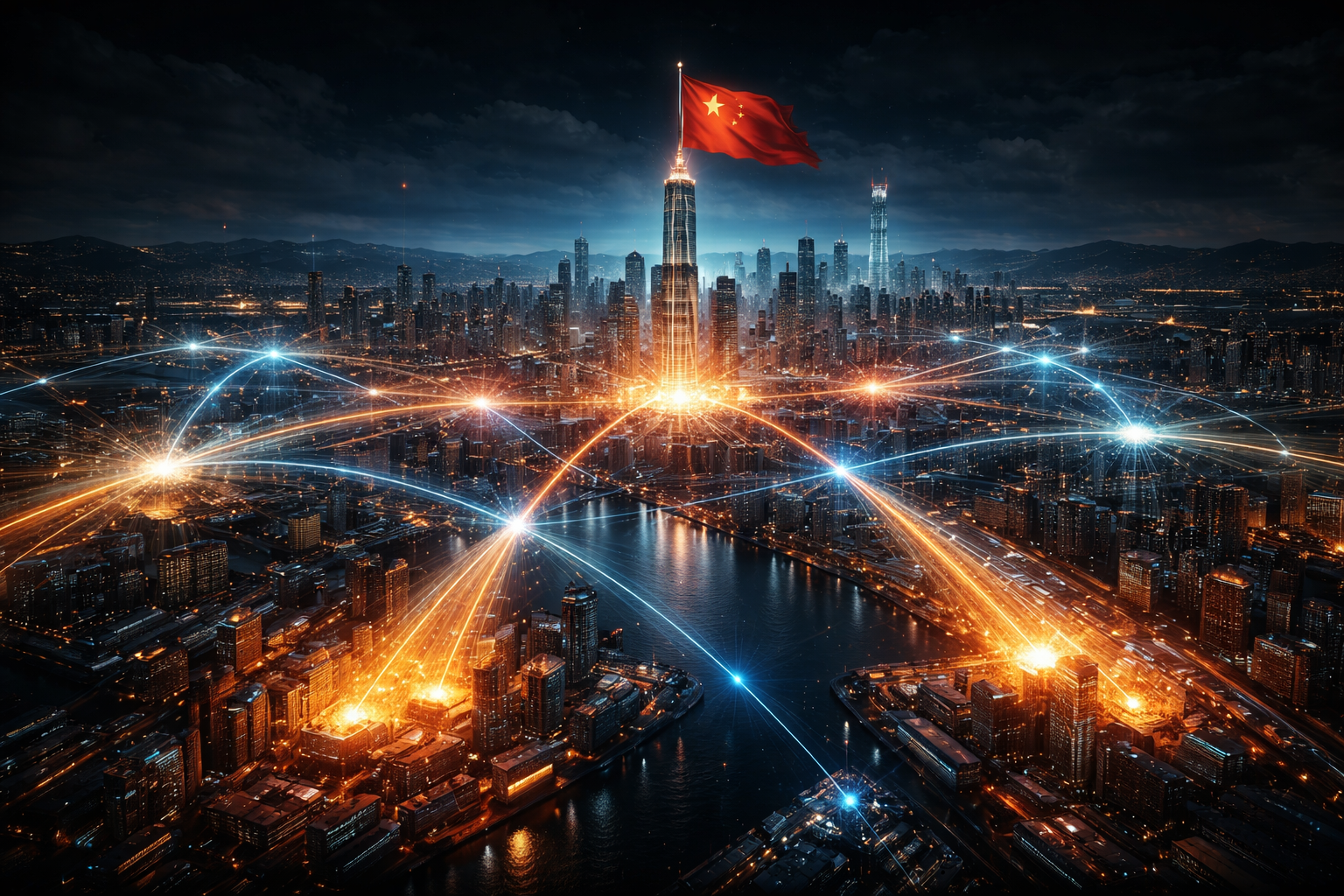
The AI Race Just Entered a New Phase—and China Is All In
China’s Nationwide AI Push Could Reshape the Global Tech Race
China is attempting something no country has tried before in artificial intelligence: turning AI from a technology sector into a nationwide economic infrastructure.
Beijing has embedded AI at the center of its new five-year economic strategy, with policies aimed at deploying AI across manufacturing, services, education, and government systems. The goal is not simply to build better algorithms. It is to rebuild the country’s entire economic model around machine intelligence.
The shift comes at a delicate moment. China faces slowing economic growth, a rapidly aging population, and intensifying technological rivalry with the United States. Policymakers increasingly see AI as the tool that could solve all three.
But the strategy also represents a deeper gamble: that mass adoption of AI across an entire society can generate economic dominance—even if the country does not lead at the technological frontier.
The story turns on whether China can scale AI faster than the rest of the world can innovate it.
Key Points
China’s latest five-year plan places artificial intelligence at the center of economic policy and references AI dozens of times.
The strategy emphasizes nationwide deployment of AI across industries, not just developing advanced models.
Cities are offering major subsidies, housing, and office space to attract AI startups and developers.
Beijing hopes AI will offset labor shortages caused by demographic decline and boost productivity.
The strategy is unfolding amid intensifying technological competition between China and the United States.
Even if China trails the U.S. in frontier models, rapid deployment across the real economy could reshape global competitiveness by enhancing efficiency in various sectors such as manufacturing, healthcare, and transportation.
The Strategic Shift: AI as National Infrastructure
China’s AI ambitions date back years, but the current phase represents a structural change.
Earlier initiatives focused on building research labs, training engineers, and launching tech companies. The new strategy focuses on diffusion—embedding AI into every sector of the economy.
Government policy documents refer to an “AI+” approach. The idea is simple but sweeping: combine artificial intelligence with traditional industries to upgrade productivity and competitiveness.
Manufacturing lines now integrate machine-learning systems that optimize supply chains. Hospitals deploy AI diagnostic tools. Logistics networks rely on predictive algorithms to route goods and manage warehouses.
China’s vision is an economy where AI becomes an invisible operating layer beneath everyday activity.
The Economic Pressures Driving the Strategy
Three forces are pushing Beijing toward an aggressive AI strategy.
First is economic slowdown. China’s growth rate has cooled compared with previous decades, prompting leaders to search for new productivity engines.
Second is demographics. China’s population is aging rapidly, meaning fewer workers will be available to sustain growth in the coming decades. AI and robotics could help replace labor shortages in factories and services.
Third is geopolitics. Export restrictions from the United States on advanced chips and semiconductor equipment have forced China to accelerate domestic technological development.
In response, policymakers have framed AI and other advanced technologies as “new quality productive forces”—industries expected to power the next phase of economic growth.
Local Governments Join the AI Gold Rush
A massive push at the local level reinforces China's national strategy.
Cities across the country are competing to become AI hubs by offering subsidies, housing support, and free office space for startups building AI products.
In some cases, incentives for developers reach millions of yuan, with entire districts built around AI research and entrepreneurship.
This decentralized competition creates a powerful dynamic. Each region attempts to build its own ecosystem of AI companies, computing infrastructure, and talent pipelines.
The result is a nationwide effort that resembles an industrial mobilization rather than a conventional tech boom, as regions compete to attract investment and foster innovation in AI technologies.
The U.S.–China AI Rivalry Intensifies
China’s strategy unfolds within a broader global contest over artificial intelligence.
The United States still leads in several critical areas, including advanced semiconductor design, cutting-edge models, and venture capital networks.
Recent analyses suggest U.S. institutions produce more frontier AI models, which are the most advanced and innovative artificial intelligence systems, although Chinese models have rapidly closed the performance gap in recent years.
Washington also benefits from alliances with technology partners across Europe and Asia.
China, on the other hand, has its own set of benefits. It has a massive domestic market, strong manufacturing supply chains, and the ability to coordinate industrial policy across government and industry.
The result is a race defined by two different models: innovation leadership versus deployment scale.
What Most Coverage Misses
Much of the global discussion about the AI race focuses on who builds the most powerful models.
China’s strategy suggests that may be the wrong metric.
Beijing believes that the extent of AI usage, rather than the sophistication of the models, determines economic power.
In this view, the decisive factor is not which country invents the best algorithm but which country integrates AI fastest into factories, hospitals, logistics networks, and public services.
If millions of businesses adopt AI tools across supply chains and production systems, the cumulative productivity gains could be enormous—even if the underlying models are slightly less advanced.
That means the real competition may be less about the frontier of AI research and more about industrial scale and adoption speed.
The Risks Behind the Ambition
The strategy carries significant risks.
Automation could eliminate jobs faster than new AI industries create them, particularly in manufacturing and administrative work. Some analysts warn that the employment shock could be severe before new roles emerge.
Security and privacy concerns also loom. Large-scale AI deployment increases exposure to cyber vulnerabilities and data misuse, which could lead to significant risks for businesses and individuals if not properly managed.
And China still faces major bottlenecks in semiconductor production, especially advanced chips needed for training cutting-edge models.
These constraints could slow the country’s progress if geopolitical tensions escalate.
The Global Stakes of China’s AI Strategy
China’s nationwide AI push is not just an economic policy. It is a strategic experiment in how a technological revolution unfolds.
If Beijing succeeds, it could demonstrate that the most important advantage in AI is not invention but system-level integration across an entire economy.
If it fails, the experiment will reinforce the view that leadership in fundamental technology remains the decisive factor.
Watch for three signals in the coming years:
whether Chinese industries adopt AI at large scale
whether domestic semiconductor production improves
whether productivity gains appear in economic growth data
Those indicators will reveal whether China’s strategy is transforming its economy—or simply chasing a technological mirage.
The global tech race may ultimately hinge on a simple question: who deploys intelligence faster than the world can adapt to it?
