

Claude Opus 5.5 Launches As Anthropic Escalates The AI Coding War
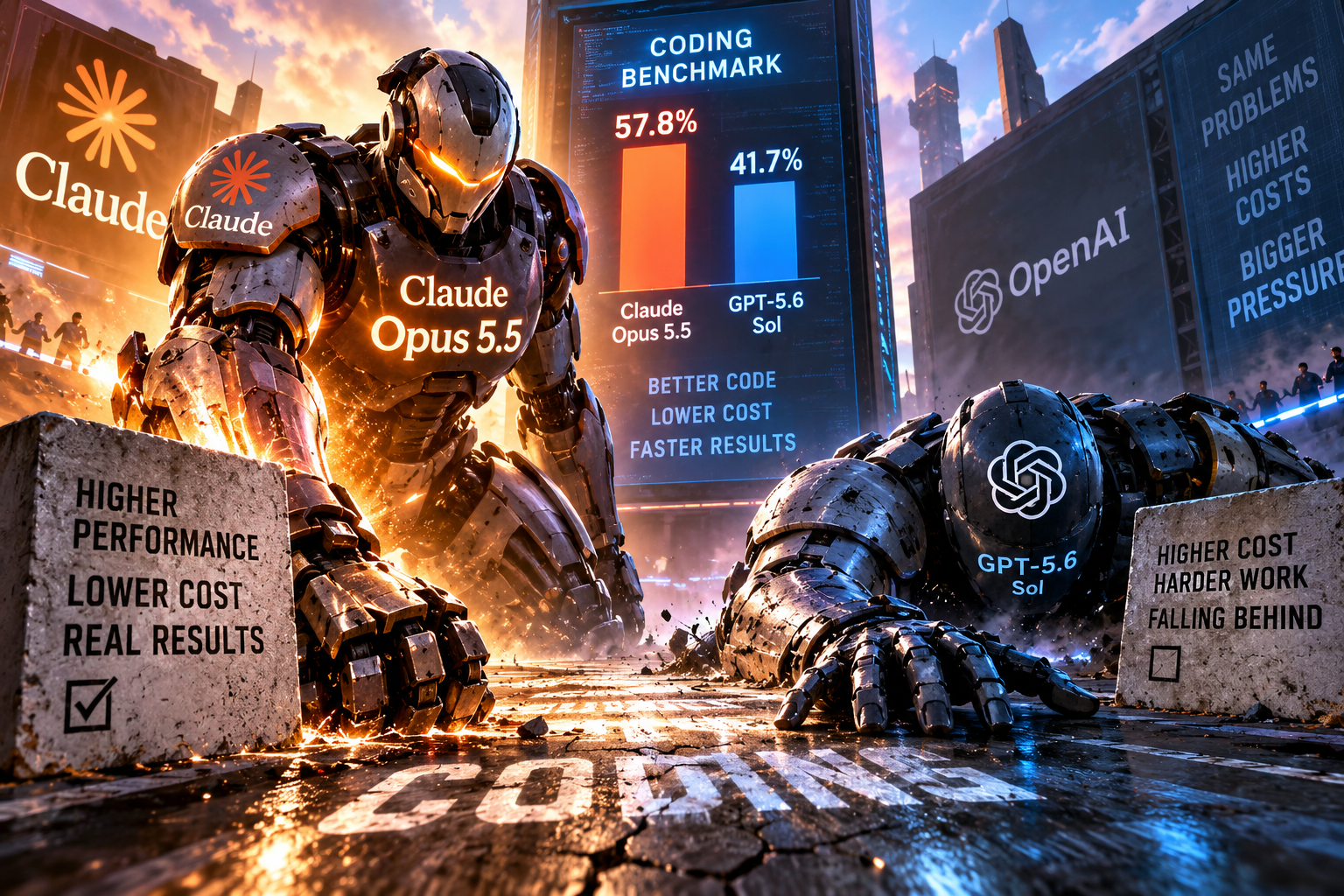
Claude Opus 5.5 Promises Cheaper Frontier AI Coding
Anthropic Challenges OpenAI With Claude Opus 5.5
Anthropic’s newest frontier model does not simply promise better code — its most provocative claim is that developers may now be able to buy significantly more intelligence for every dollar they spend.
The artificial intelligence race has entered a brutal new phase. Anthropic launched Claude Opus 5.5 on September 22, presenting a model that it says leads its benchmark suite across agentic coding, computer use and professional knowledge work while substantially reducing the cost of running its previous flagship. On one coding benchmark built from ambiguous real-world development tasks, Anthropic says Opus 5.5 beats OpenAI’s GPT-5.6 Sol by around 11 percentage points while costing roughly one-third as much per task.
That does not establish Claude as universally superior to every OpenAI model. Benchmark results depend on the task, harness, reasoning setting and methodology, and OpenAI has continued releasing newer systems beyond GPT-5.6. But the numbers reveal something potentially more disruptive than another model taking first place on another leaderboard: the economics of frontier AI are collapsing almost as quickly as capability is increasing.
Claude Opus 5.5 Has Arrived With An Aggressive Claim
Anthropic describes Opus 5.5 as the first model in its new Claude 5.5 family. The company says it performs around the level of its more powerful Claude Fable 5.1 system on most work while costing 40% less to run than the previous Claude Opus 5 under typical workloads.
The headline API prices are $4 per million input tokens and $20 per million output tokens, compared with $5 and $25 respectively for Opus 5. More strikingly for developers building persistent AI agents, cache reads have fallen from $0.50 to $0.20 per million tokens. Anthropic says Opus 5.5 also generates output more than 30% faster than Opus 5.
Those reductions matter because the real cost of an AI coding agent is not simply its published token price. An agent may inspect files, call tools, retry failed approaches, edit code, run tests and continue operating for hours. A model that reaches the correct solution with fewer steps can therefore become dramatically cheaper even if its headline API price moves only modestly.
That is the pressure point behind this launch.
The GPT-5.6 Sol Comparison Is Hard To Ignore
Anthropic’s most eye-catching OpenAI comparison comes from CursorBench 4.0, an evaluation designed around ambiguous, multi-file coding tasks taken from real development sessions.
Anthropic reports a 57.8% score for Opus 5.5 at its highest tested setting, compared with 41.7% for GPT-5.6 Sol. At Opus 5.5’s default medium effort, Anthropic says it scores 52.5% and still beats GPT-5.6 Sol’s reported top score while completing the work for roughly one-third of the cost per task.
That is a significant gap, but it needs the right context. It is one benchmark rather than a universal declaration that Claude is better at every kind of programming. OpenAI’s own GPT-5.6 material previously showed Sol performing extremely strongly across coding evaluations, including its then-leading result on the Artificial Analysis Coding Agent Index and strong results on Terminal-Bench and DeepSWE.
The important development is therefore not that one benchmark has produced a winner.
It is that frontier-level software engineering performance is becoming substantially cheaper.
That follows a trend already visible when GPT-5.6 Sol pushed frontier AI deeper into coding, cybersecurity and long-running agentic work. The competition is moving beyond who can generate the most impressive answer and towards who can complete an entire useful workflow with the least time, supervision and money.
Anthropic Is Already Fighting A Newer OpenAI Model
There is another reason not to treat GPT-5.6 Sol as the entire story.
Anthropic’s own launch data also compares Opus 5.5 with GPT-6 Astra, a newer and more capable OpenAI system. On FrontierCode v1.1, Anthropic reports Opus 5.5 at 54.4% against GPT-6 Astra at 53.3%. On Terminal-Bench 4.0, Opus 5.5 reaches 66.4% compared with 57.9% for Astra in the published comparison, although benchmark settings and statistical uncertainty matter when reading these figures.
At Opus 5.5’s default effort setting, Anthropic makes an even more provocative efficiency claim: it says the model beats Astra on FrontierCode for roughly one-fifth of the cost per task, while on Terminal-Bench it can roughly match Astra for around 40% of the cost.
That changes the significance of the launch.
Anthropic is not merely claiming victory over a previous-generation OpenAI model. It is attempting to demonstrate that the highest tier of AI capability no longer automatically requires the highest tier of spending.
For businesses deploying thousands or millions of model calls, that distinction can be worth far more than a few percentage points on a leaderboard.
The Bigger Battle Is Cost Per Successful Task
The AI industry spent years teaching users to compare token prices.
That may increasingly be the wrong metric.
Imagine Model A costs half as much per token as Model B but requires twice as many attempts, longer outputs and more tool calls to solve the same software problem. Model A may look cheaper on a pricing page while costing more once deployed.
Agentic AI makes that problem even larger. The more autonomy a model receives, the more its planning efficiency matters. A coding agent that can remain focused for hours, recognise a failed strategy and correct itself without repeated human prompting could potentially replace dozens of shorter interactions.
Anthropic says one early Opus 5.5 test involved auditing and fixing a codebase containing roughly 200,000 lines. The company says the job took under three hours with Opus 5.5, compared with more than 20 hours using Opus 5, while consuming substantially fewer tokens. Another internal test translating HAProxy from C to Rust saw Opus 5.5 finish faster than Fable 5.1 while costing 51% less.
Those are company-provided examples rather than independent guarantees of what every developer will experience. But they demonstrate where the competition is heading.
The prize is not cheapest intelligence.
It is cheapest completed work.
AI Coding Is Rapidly Becoming An Autonomous Labor Market
The consequences stretch beyond programmers deciding which chatbot produces cleaner Python.
Frontier models increasingly operate as agents: reading entire repositories, executing commands, testing their own code and continuing across long sequences of actions. That shift from answering questions to performing work is central to why increasingly autonomous AI agents create both extraordinary commercial opportunities and new categories of risk.
A sufficiently reliable coding agent can change how software itself is produced.
Small companies could maintain larger codebases with smaller engineering teams. Experienced developers could delegate migrations, testing, documentation and repetitive implementation work. Startups could build prototypes that previously required significantly more capital. Large companies could run thousands of automated engineering tasks simultaneously.
None of that means software engineers disappear. Complex architecture, product judgment, security, accountability and understanding what should be built remain difficult problems.
But the amount of code a single person can supervise may rise dramatically.
That is why a 50% reduction in the cost of completing an AI engineering task could matter far more economically than a 50% reduction in the price of an ordinary software subscription.
The Price War Could Become More Important Than The Intelligence Race
Frontier AI has historically been defined by scarcity.
Training required enormous computing clusters. Running the strongest models was expensive. Premium intelligence sat behind premium prices.
That structure is beginning to weaken.
Anthropic says Opus 5.5 requires less compute to serve, uses fewer tokens for many tasks and is cheaper at both the input and output level than Opus 5. Companies are simultaneously learning how to use caching, routing and different reasoning settings to avoid spending maximum compute on every request.
The result could be a market where yesterday’s extraordinary AI capability rapidly becomes tomorrow’s commodity infrastructure.
That would intensify the wider technology competition already reshaping the industry. China has been narrowing parts of the capability gap with leading American AI laboratories, while US companies are fighting one another over performance, speed, developer adoption and cost.
Every major efficiency improvement therefore creates two races simultaneously.
One is technological.
The other is economic.
Benchmarks Still Cannot Tell You Which AI Is “Best”
There is a temptation whenever a new model launches to create a single league table.
Claude wins.
OpenAI loses.
Then another benchmark appears and the order changes.
That interpretation is becoming increasingly unreliable.
Anthropic itself acknowledges that small benchmark differences between frontier models may exaggerate the practical distinction users experience. Different models can dominate different tasks, and results vary according to reasoning effort, tools, agent harnesses, safety systems and the exact type of software problem being attempted.
OpenAI’s previous GPT-5.6 results illustrate the same problem. Sol performed extremely strongly on several coding benchmarks and was designed around efficient long-running agent work, yet Anthropic can now point to other evaluations where Opus 5.5 establishes a substantial lead.
For developers, the rational question increasingly becomes narrower: which model performs best on my workload, at my required reliability, for the lowest total cost?
That answer may be different for coding, research, cybersecurity, data analysis and everyday office automation.
The Most Important Number May Be The One On The Invoice
Claude Opus 5.5 therefore matters for a reason that reaches beyond Anthropic.
The AI industry has become accustomed to enormous leaps in intelligence. What may now prove equally disruptive is the speed at which that intelligence is becoming cheaper to operate.
Anthropic’s headline coding comparison is striking: on CursorBench, Opus 5.5 can outperform GPT-5.6 Sol while costing roughly one-third as much per task under the company’s comparison. Its results against the newer GPT-6 Astra suggest the efficiency battle has already moved on again.
For consumers, these improvements may eventually mean stronger AI assistants for the same subscription price.
For developers, they could mean running vastly more autonomous work within the same budget.
For businesses, they could change the calculation behind whether an AI agent is an interesting experiment or an economically viable worker.
And for Anthropic, OpenAI and every company trying to compete at the frontier, the question is becoming brutally simple.
Building the smartest model may no longer be enough.
The winner in the commercial AI race may be whoever can make extraordinary intelligence feel ordinary on the bill.
