Europe’s Big Tech Crackdown Is Rewriting Apple, Meta, and Google in Real Time
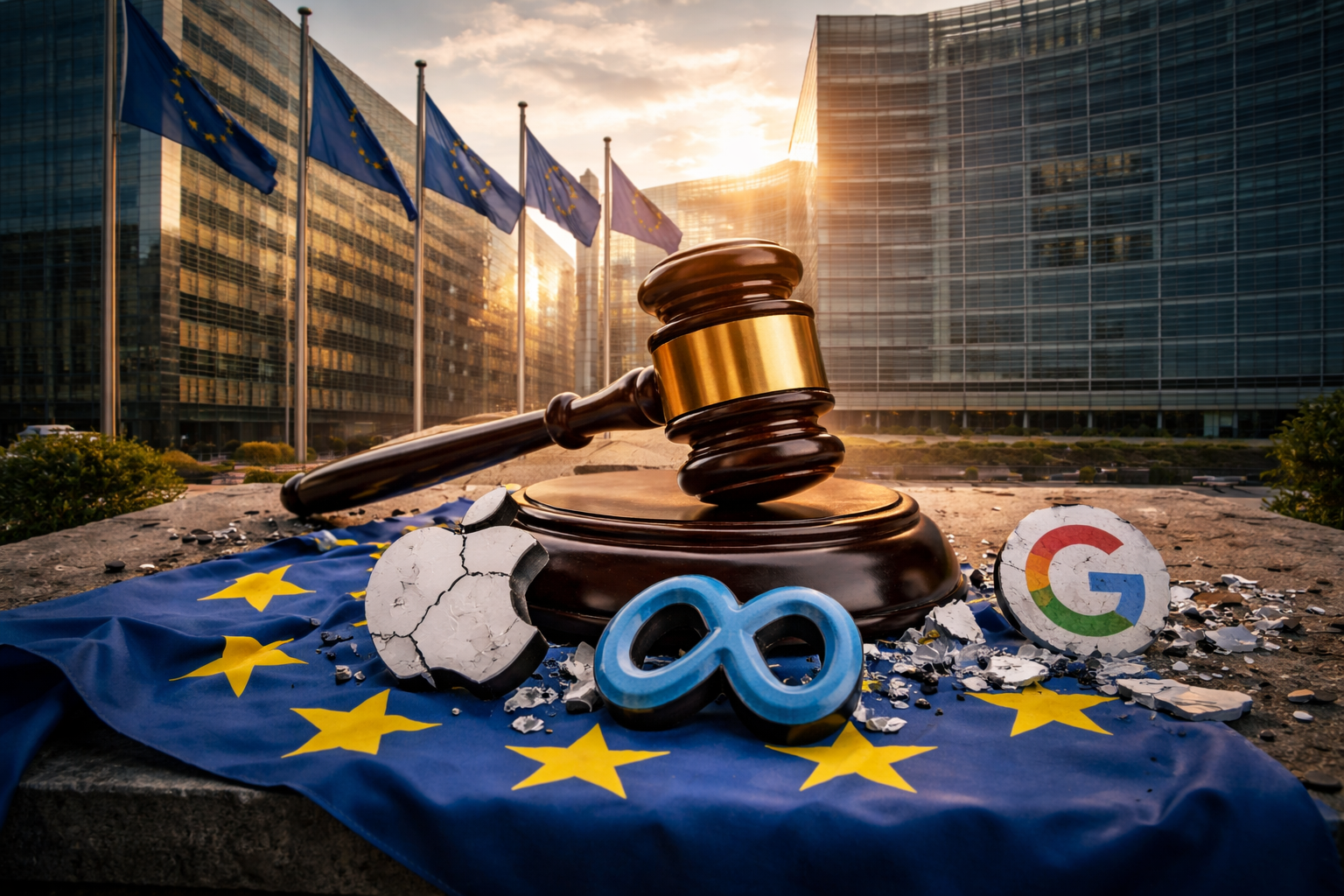
Europe just flipped the switch on Big Tech.
Europe's campaign against Big Tech is no longer just a regulatory warning. It is an operating reality.
Apple has already been fined under the Digital Markets Act, Meta has already been fined and pushed to change its ad model, and Google is under fresh pressure to rework core parts of Search as Brussels tests how far it can force platform change, not just punish past behavior.
What makes this moment bigger than another Brussels-versus-Silicon-Valley clash is that Europe is now shifting from rule-writing to rule-enforcement across two fronts at once: competition under the DMA and platform safety, transparency, and consumer protection under the Digital Services Act. That means the same companies are being squeezed not only over market power but also over how their products shape what people see, download, buy, and trust online.
The deeper issue is not simply whether Europe can fine US tech giants. It is whether regulators can force changes to default design choices that helped make those giants so dominant in the first place.
The story turns on whether Europe can turn legal victories into durable product changes.
Key Points
Europe’s Big Tech crackdown has moved beyond theory. Apple and Meta were fined €500 million and €200 million in April 2025 under the DMA (Digital Markets Act), while Google remains under active DMA pressure over Search and interoperability, which refers to the ability of different systems to work together seamlessly.
Apple’s pressure is now split. One area of competition is app distribution and anti-steering rules. The other is platform safety under the DSA, where the App Store has faced information requests over scams, age ratings, and harmful apps.
Meta has already paid a DMA fine over its consent-or-pay approach and later committed to offering EU users a less personalized ads option. It is also under DSA scrutiny tied to transparency and researcher access.
Google faces pressure on two fronts as well: Google is under pressure to comply with DMA obligations regarding search ranking and data access, as well as DSA oversight impacting Google Search and Google Play. Reuters reported that Google is preparing tests in Europe that would give rival services more prominence in search results.
For users, the likely result is more choice, more friction, and less uniformity. Some changes could enhance competition and privacy, while others might complicate products, slow them down, or make them less seamless than the integrated experiences users are accustomed to.
The next phase is crucial because Europe now has to prove it can enforce product redesign at scale without producing confusing workarounds or politically costly standoffs with Washington.
The Digital Markets Act is Europe’s competition rulebook for the biggest digital “gatekeepers,” meaning companies that control critical platforms businesses and consumers rely on. The point is to stop self-preferencing, lock-in, and restrictive defaults before those behaviors harden into permanent market power. The Digital Services Act is different. It focuses on platform governance: illegal content, systemic risks, transparency, researcher access, scams, child safety, and user protections.
Apple, Meta, and Google sit near the center of both frameworks.
Apple’s App Store is a designated massive online platform under the DSA, and Apple has already been penalized under the DMA over anti-steering rules. Meta’s Facebook and Instagram are designated under the DSA, and Meta was fined under the DMA over the choice it gave users on personalized advertising. Google Search is a very large online search engine under the DSA, while Google Play is a very large online platform. Google remains under DMA pressure regarding how Search treats rival services and data-sharing obligations.
This scrutiny scrutiny has intensified over the past year. In April 2025, the Commission fined Apple and Meta under the DMA. In December 2025, it acknowledged Meta’s undertaking to offer EU users an alternative with less personalized ads. It began legal action in January 2026 to assist Google in meeting its obligations regarding online search data sharing and interoperability. And in February 2026, it decided that Apple Ads and Apple Maps should not be designated as gatekeepers, showing that Brussels is not automatically expanding every case everywhere.
Political and Geopolitical Dimensions
Europe is making a sovereignty argument as much as a legal one. The message is that if global tech companies shape European commerce, speech, app distribution, and access to information, then European law should shape those companies in return. That logic is now colliding more openly with Washington, where the Trump administration has pushed back against parts of Europe’s digital agenda and instructed diplomats to fight what it sees as burdensome data sovereignty rules.
That matters because enforcement is no longer a quiet legal process. It has become a trade and diplomacy issue. One plausible scenario is steady EU enforcement with limited retaliation, where fines and product changes continue but both sides avoid a full economic clash. Another is escalation, where each new case becomes evidence in a broader US-EU dispute over censorship, industrial policy, and foreign targeting of American firms. Signposts include tougher public statements from Washington, new tariff threats, or attempts to frame EU enforcement as discrimination rather than neutral rule application.
Economic and Market Impact
For Apple, Meta, and Google, the direct fines matter less than the forced redesign of revenue machinery. Apple’s App Store economics depend on how tightly it can control payments, discovery, and distribution. Meta’s ad machine depends on how much data it can combine and how hard it is for users to opt out. Google’s search business depends on ranking, defaults, and the visibility of its own vertical services. Europe is targeting those levers, not just writing checks.
A first scenario is partial compliance that preserves most of the old business model through more complex interfaces. A second is deeper structural change, where rivals gain meaningful distribution and the incumbents lose some control over discovery and monetization. The signposts are practical, not rhetorical: whether alternative app stores keep gaining traction on iPhones in the EU, whether Meta’s less-personalized option materially shifts ad performance, and whether Google’s new search layouts actually send traffic to rival comparison and vertical search services.
Technological and Security Implications
Europe’s crackdown is also about product safety and platform architecture. Under the DSA, Apple and Google have faced questions over illegal or harmful apps, scams, and age-rating systems. That pushes app stores closer to the status of regulated infrastructure, not just private marketplaces. It also creates tension: Europe wants more openness and competition under the DMA while still demanding strong safety controls under the DSA.
For users, that tension could produce mixed outcomes. More app distribution channels and more interoperable services can reduce lock-in. But they can also create more decision points, more warnings, more consent screens, and more room for lower-quality or deceptive services to compete for attention. A likely scenario is a messier but more contestable digital market. A more optimistic one is that Europe slowly forces the big platforms to build products that are both more open and more accountable. Signs to watch include whether scam complaints fall, whether app review standards tighten, and whether new user-choice screens remain understandable instead of becoming dark-pattern theater.
What Most Coverage Misses
Most coverage treats Europe’s Big Tech crackdown as a battle over fines. The real hinge is product governance. Brussels is trying to regulate how default settings, ranking systems, app store rules, and consent flows are built, because that is where platform power actually lives.
That changes the stakes. A fine can be absorbed. A product redesign can ripple through growth, conversion, trust, fraud exposure, developer economics, and user behavior for years. Google changing how Search presents hotel, flight, and restaurant results is not a cosmetic tweak if it shifts traffic patterns. Apple opening room for alternative app distribution is not symbolic if it changes where users discover software. Meta offering less-personalized options is not merely a legal patch if it changes the price and precision of ads in Europe.
The other underplayed point is that Europe is testing whether two ambitions can coexist: more competition and more safety. Open the ecosystem too little, and incumbents stay dominant. Open it too much, and scams, harmful apps, and compliance complexity can rise. That is why the crackdown matters far beyond antitrust. It is an attempt to redesign the digital market without breaking user trust.
Why This Matters
In the short term, the biggest effects fall on developers, advertisers, publishers, comparison sites, app marketplaces, and users in the EU, who will see more choice architecture inserted into products they use every day. Over the next days and weeks, attention will focus on whether Google’s search-result tests expand, how Meta’s ad-choice changes perform, and whether Apple faces further pressure over how open the iPhone ecosystem really is in practice.
Over the longer term, the outcome could shape the global rules of the internet. If Europe proves it can force lasting product changes, other jurisdictions may borrow the model. If enforcement produces cluttered interfaces, weak consumer gains, or open trade conflict, critics will argue that Brussels has created a slower, more fragmented digital economy without truly denting platform power. Key dates will revolve around future Commission decisions, company compliance updates, and any new formal findings under the DMA or DSA.
Real-World Impact
A small travel-comparison business in Europe could benefit if Google Search gives rival vertical services more visible placement. Increased exposure could lead to higher traffic without incurring significant costs for visibility.
An iPhone user in the EU may get more ways to install apps or pay outside Apple’s preferred system, but that freedom may come with more warnings, more choices, and more need to judge trust for themselves.
A parent downloading apps for a teenager could see tighter age-rating scrutiny in app stores, especially as Brussels pushes Apple and Google on harmful or illegal apps and minors’ access safeguards.
A retailer or app maker that depends on Meta ads may find Europe becoming a slightly less precise targeting market if more users choose less personalized ad experiences.
The Next Test for Europe’s Digital Power
Europe has progressed beyond the initial phase of regulating Big Tech. The next test is whether it can make Apple, Meta, and Google operate differently in ways users can actually feel, rivals can actually use, and courts can actually sustain.
This is the pivotal moment. One path leads to a more open, more contestable digital economy with better user protections. The other leads to endless procedural combat, defensive redesigns, and a growing transatlantic fight over who gets to govern the infrastructure of digital life. Watch the signposts that matter: product changes in search and app stores, the shape of Meta’s EU ad choices, and whether Brussels keeps converting legal authority into working reality. If it does, this will be remembered as the period when Europe stopped merely complaining about platform power and started rewriting it
