How Close Are We to Mind Reading? A Reality Check on Brain Implants
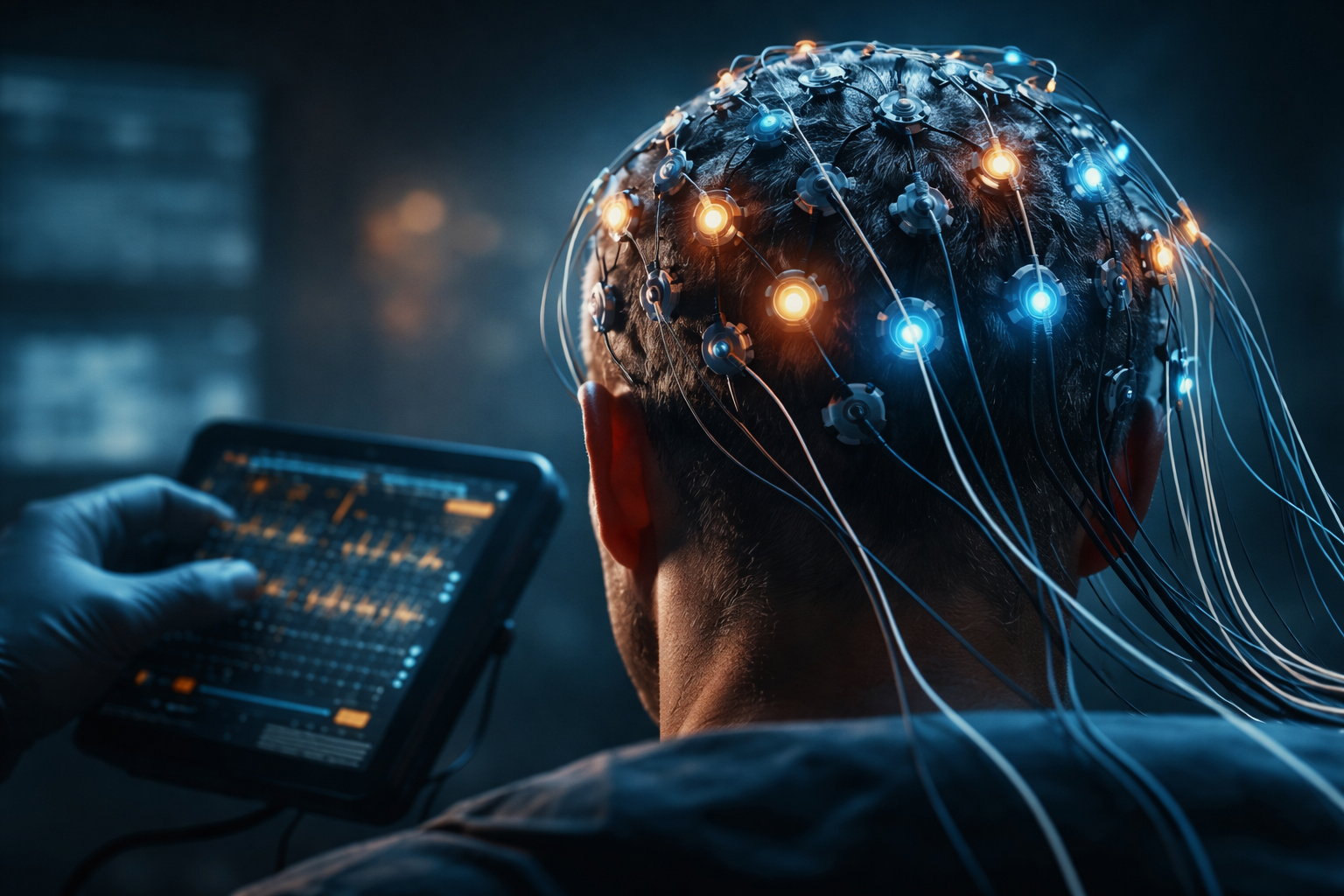
Can brain implants read minds evidence? A reality check
“Mind Reading” Tech: The Simple Physics Test Most Headlines Fail
“Mind reading” has become a headline shortcut for a wide range of brain-tech demos—some impressive, many overstated, and almost all simple to misinterpret. The problem is not that neuroscience is fake. The system's actual function is usually different from what people believe it to be ("They can read my thoughts").
Here’s the quick way to judge any brain-tech “mind reading” claim: ask what signal was measured, how much information it can physically carry, and how much the model had to assume to fill in the rest. That single test separates decoding from guesswork.
The story turns on whether the device is extracting high-bandwidth information from the brain—or mainly reconstructing what it already expects to see.
Key Points
“Mind reading” can mean anything from detecting attention and fatigue to reconstructing words or images in constrained lab settings. Those are not the same claim.
The measured signals differ wildly in fidelity: some are coarse, surface-level proxies; others capture much richer activity but require surgery and controlled conditions.
Most demos are classification or prediction (choosing among options), not true open-ended decoding (producing arbitrary, never-seen content).
If a model utilizes robust priors such as context, prompts, training data, and language models, it can appear to "read thoughts."
The proof standard is simple: show performance that survives new people, new contexts, and strong anti-cheating controls—without hidden constraints.
Even limited capability raises real ethics issues: consent, security, coercion risk, data ownership, and secondary use.
Regulation is likely to split: medical implants under device rules and consumer neurotech under privacy, advertising, and product safety enforcement.
Background
A “mind reading” system always has three parts: a sensor, a decoder, and a target.
The sensor measures a physical signal correlated with neural activity: electrical potentials, magnetic fields, blood-flow changes, or implanted recordings. The decoder is the statistical model that maps those measurements to outputs. The target is what the system claims to infer: a word, an image, an intention, an emotion, or a clinical state.
The public confusion comes from collapsing all targets into one: “thoughts.” But thoughts are not a single thing. Some are language-like, some are visual, some are motor intentions, some are emotional states, and most are messy mixtures. That matters, because different signals can only access some of those layers—often indirectly.
Analysis
What the claim actually implies
A strong “mind reading” claim implies all of the following, whether stated or not:
It works on new people without hours of personal training; it works in ordinary settings (movement, noise, stress); it produces open-ended content, not just picking from a menu; it does so reliably, not in cherry-picked moments; and it doesn’t rely on cooperation (the person isn’t deliberately imagining the exact thing the decoder was trained on).
If any of those are missing, it may still be valuable technology—just not the headline claim.
What signals are measurable today
Today’s measurable signals sit on a spectrum:
Some capture coarse summaries of brain state (like arousal, attention, sleep stage, and seizure risk) reasonably well, because those states have broad, global signatures.
Some can capture structured intent under constraints (like “move left vs. right” or “yes vs. no”) because the task is simple and repeated.
Some can support richer outputs like text or speech, but typically only when the signal is high fidelity and the environment is controlled—and even then, the system often learns your neural patterns, not “the human mind.”
The key reader move: never judge the decoder without first judging the sensor. The sensor sets the ceiling.
Resolution constraints in plain English
This is the physics trap that most headlines miss:
A brain signal is like a crowded stadium chant. If your microphone is outside the stadium, behind walls, and you sample only a few points, you’ll mostly hear a muffled roar. You might detect “they’re cheering” and sometimes “that sounded like a chant,” but you won’t reliably extract every word from every person.
Noninvasive signals tend to be blurred mixtures of many sources. You get a useful summary, but not fine detail. Movement, muscle activity, eye blinks, and environmental noise further contaminate the measurement. That doesn’t make the tech worthless—it defines what it can honestly claim.
Higher-resolution signals generally require getting closer to the source, which brings trade-offs: surgical risk, stability challenges, calibration burden, and narrower deployment.
Decoding vs prediction vs classification
Most “mind reading” demos fall into three buckets:
Classification: The system chooses among a small set of labels. Example: Which of 10 images you’re looking at; which of 5 words you’re imagining. This exercise can look magical because accuracy can be high, but it’s fundamentally a multiple-choice test.
Prediction: The system forecasts a likely next state based on patterns and context. Example: predicting intended movement trajectory or whether you’re about to speak. Strong priors can make the process look like mind reading when it’s often “smart guessing.”
Decoding: The system produces a representation of the underlying content—ideally open-ended. True decoding is harder because it can’t hide behind a small option set.
A practical rule: if the output space is small, the claim is weaker. A system that picks “happy vs sad” is not reading a diary.
What would count as proof
If you want one gold-standard framing, it’s this: show that the information came from the brain signal, not from the experimental setup.
What strong proof tends to include:
Pre-registered evaluation: metrics and test conditions set before results are known.
Out-of-sample tests: new sessions, new prompts, new stimuli, and ideally new people.
Ablations and controls: show performance collapses when brain signal is removed or scrambled and doesn’t persist via leakage (timing cues, audio artifacts, prompt structure, operator bias).
Open-ended benchmarks: not just choosing among fixed options; demonstrate generalization to novel content.
Real-world robustness: motion, fatigue, time gaps, and different environments.
Independent replication: separate lab, separate team, same result.
If a headline doesn’t mention at least two of those, treat it as a demo—not a capability.
What Most Coverage Misses
The hinge is the information bottleneck: how many independent bits of brain information the sensor can capture per second.
The process is straightforward: if the signal being measured is unclear or complicated, the decoder has to rely on previous knowledge—like language patterns, usual scene layouts, task rules, and the setup of the experiment. That can create outputs that feel specific and personal, even when the measured brain data only supports a broad outline.
The signposts to watch are concrete: claims that (1) work on new people with minimal training, (2) remain accurate in uncontrolled settings, and (3) succeed at open-ended outputs without narrow prompts. If those three show up together—and then replicate—you’re looking at a genuine step change.
Why This Matters
The immediate stakes are not sci-fi telepathy. They’re mundane and high-impact: medical communication, disability access, consumer surveillance, and legal ambiguity.
In the short term (weeks to a year), the most affected groups are people who could benefit from assistive communication and consumers using attention, sleep, or “focus” neuro-wearables. The risk is over-claiming—because marketing pressure rewards boldness more than accuracy.
In the long term (years), neural data could become a premium behavioral signal. That matters because neural data is not just “health data.” It can become identity and intent data, which changes how consent, employment screening, insurance, targeted ads, and even criminal investigations could evolve.
The main consequence follows a “because” line: because brain signals are probabilistic and context-sensitive, systems will be vulnerable to misuse, overreach, and false confidence unless standards force clear capability boundaries.
Real-World Impact
A disability services team considers a new communication device. The vendor demo looks miraculous, but the fine print shows it only works after long personal calibration and under narrow task conditions.
A consumer buys a “focus headset” for productivity. The app infers attention and mood, then shares derived profiles with third parties under vague consent language.
A workplace trial of fatigue monitoring for safety. Managers treat the score as objective truth, even though the model was trained on a different population and confounds stress with “low engagement.”
A court hears a claim that neural data indicates intent. The jury hears “brain-based evidence” and assumes certainty, even if the decoding is just statistical classification.
What We Can Prove, What We Can’t, and What Happens Next
What we know: serious scrutiny increasingly emphasizes early-stage limits, calibration burden, and the gap between lab demos and real-world deployment.
What we don’t know is whether any “strong” demonstration exists that meets the public’s implied bar—open-ended, cross-person, low-cooperation decoding in everyday settings—rather than constrained reconstructions.
What happens next: watch for peer-reviewed demonstrations with harsh controls, independent replication, and standard benchmarks. In parallel, expect more regulatory attention focused on neural data privacy, marketing claims, and safety/security requirements—especially as consumer neurotech expands beyond clinical contexts.
The historical significance of this moment is that “mind reading” is becoming a product category—so the burden shifts from wonder to proof.
