

How To Verify A Deepfake: A Checklist That Goes Beyond Spotting Glitches
Real Footage, False Caption: The Verification Problem
Why A Deepfake Detector Cannot Settle Every Video
The strongest checks investigate where a recording came from and what independently supports its claim.
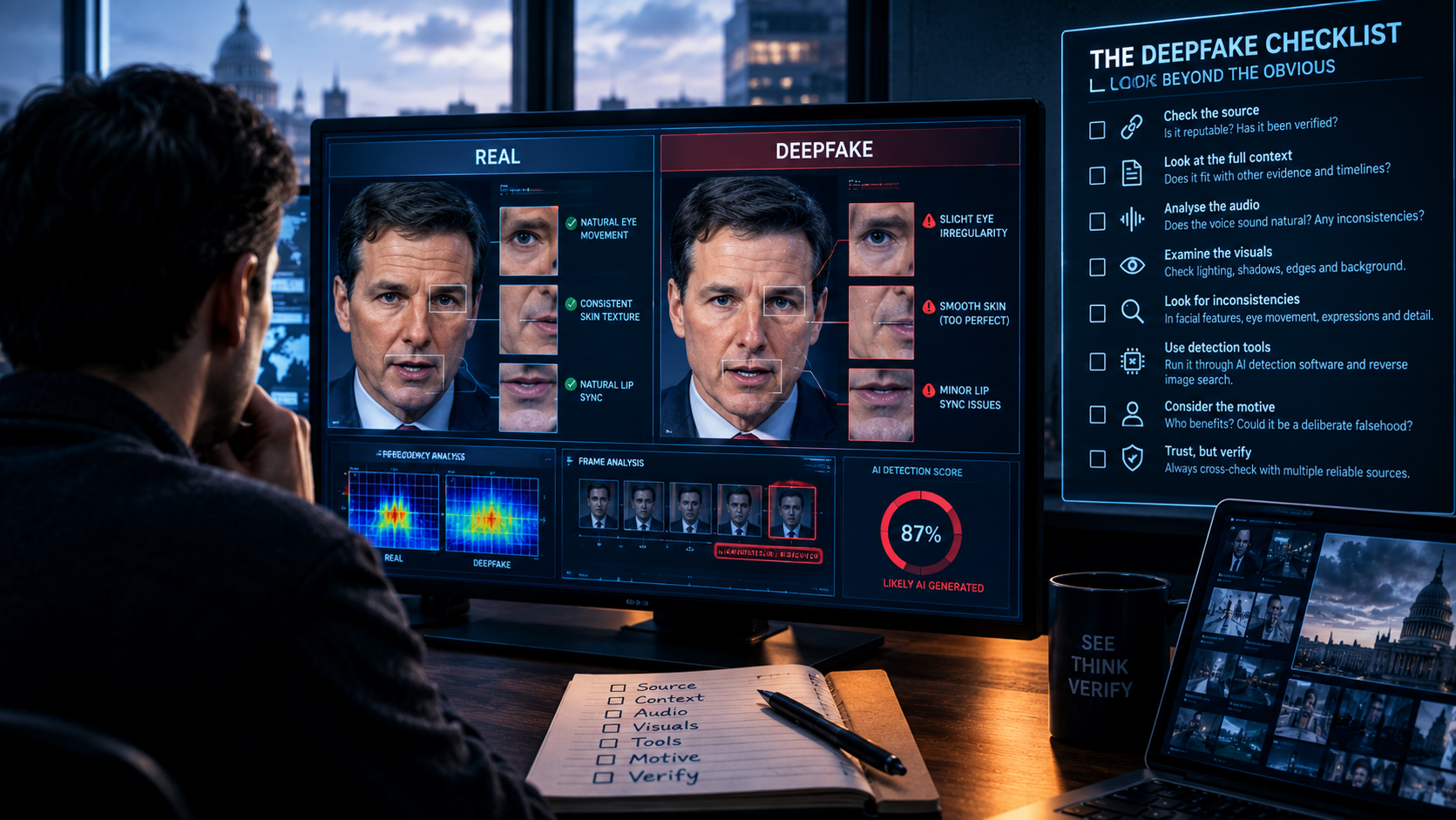
A convincing video is not necessarily authentic. An awkward-looking video is not necessarily fake. To assess suspected deepfakes, begin with the recording’s source and context rather than treating unusual fingers, blinking or lighting as a verdict.
The practical aim is usually narrower than proving every pixel genuine: establish whether the specific claim being made is supported. Did this person say these words? Was the recording made at this event? Is an old scene being presented as something that happened today?
Those questions remain useful even when the manipulation involves no AI at all.
Start By Writing Down The Claim
Separate the media from its caption. A genuine recording of a politician can carry a false translation. Authentic footage of an explosion can be mislabelled with a different country. A real interview can be cut immediately before the qualification that changes its meaning.
Write a single sentence describing what you are being asked to believe. Include the person, action, place and date only where they are actually alleged. This prevents a moving target in which evidence for one detail is used to imply proof of everything else.
For example, confirming that a building exists does not establish when a video was recorded outside it. Confirming that a speech occurred does not authenticate a particular audio clip. Each part of the claim needs an appropriate check.
Taylor Tailored’s broader guide to deepfakes explains the technology. Verification begins by refusing to confuse appearance with evidence.
Find The Earliest Accessible Source
Follow the chain backwards. Who uploaded the version you saw? Did they create it, receive it or copy it from another account? Is there a longer version? Can you locate the original broadcaster, organiser or participant?
The earliest version you find is not automatically the original. Describe it accurately as the earliest accessible upload unless you can establish more. A screenshot of a deleted post is also a separate artefact that may need verification.
Check the account through an independent route. A familiar display name or logo can be copied. Navigate from an organisation’s established website to its linked social profile where possible, rather than trusting a link supplied by the suspicious post.
If the source cannot be found, that is a limitation. It does not establish fabrication, but it weakens the case for treating the material as confirmed.
Look For Independent Corroboration
Ten accounts sharing one clip are one evidence chain, not ten witnesses. Seek another camera angle, a full event recording, an official transcript or reporting that explains how the material was authenticated.
Independence is especially important when an alleged statement would have major consequences. Ask whether the second source investigated the claim or simply embedded the same post.
A denial is relevant but not automatically decisive. So is an official confirmation. The strength of either depends on what it addresses and what evidence accompanies it. A person might deny the caption while accepting that the underlying recording is genuine.
Keep those distinctions visible. “The office disputes the translation” is more precise than “the video has been debunked” if the disagreement concerns only the translated words.
Check Date, Place And Continuity
Search distinctive phrases from the alleged speech. For images, reverse-image searching can help locate earlier uses. For video, clear frames may expose an older source or a different context.
Look for details that can be checked independently: venue layouts, signs, the sequence of an event and the presence of other participants. Treat small visual similarities cautiously. Many streets and conference rooms look alike.
Do not overstate metadata. File creation dates may reflect copying or export, and metadata can be absent or altered. Platform upload time establishes when a platform received a version, not necessarily when the underlying scene occurred.
Continuity can be more informative than a striking frame. Does the full recording include the lead-in and response? Are there abrupt changes in sound or perspective? These are reasons to investigate, not standalone proof of deception.
What Content Credentials Can Establish
The Coalition for Content Provenance and Authenticity describes Content Credentials as a way to attach tamper-evident information about a digital asset’s history. A credential may record creation or editing assertions and identify the signing system.
That is useful provenance information. It is not a universal truth certificate. C2PA explicitly distinguishes checking a credential’s integrity and association with an asset from deciding whether the scene or underlying assertions are true.
A genuine camera can photograph a staged event. Equally, the absence of credentials does not establish that a recording is artificial. Many legitimate files were created without them or have passed through processes that do not preserve them.
Use a credential to answer the question it actually addresses. Do not promote a technical integrity result into a conclusion about every claim attached to the image.
Why A Detector Score Is Not A Verdict
NIST’s review of synthetic-content transparency covers detection, provenance and watermarking as complementary approaches with limitations. A detector’s usefulness depends on what it was tested against and how well that resembles the material being examined.
A number on a website is not automatically the probability that a particular video is fake. It may be an internal score, a classification confidence or something else entirely. Without an explanation of calibration, it is unsafe to interpret the number as certainty.
Compression, cropping, editing and unfamiliar generation methods can complicate assessment. Different detectors may disagree. That disagreement is a reason to inspect their assumptions, not to average the numbers and call the result scientific.
Before uploading material, consider whether it contains private information or sensitive evidence. A public verification problem does not justify distributing an intimate recording to multiple unknown services.
A Worked Verification Example
Imagine a clip claiming that a company’s chief executive has announced an immediate closure. The lips look slightly out of sync, and the caption urges employees to share it.
First, identify the exact announcement being alleged. Next, check the company’s established channels and find the full event. Search for the quoted wording and look for independent reporting. If a longer recording shows the speaker discussing a hypothetical scenario, the key problem is misleading editing, regardless of whether AI was involved.
If no original appears, the appropriate conclusion is narrower: the announcement has not been verified. A detector’s negative result would not fill the evidential gap.
This example is hypothetical. Its purpose is to demonstrate a sequence of checks, not report a real company incident.
Use Conclusions That Match The Evidence
Earlier upload establishes a different event
Appropriate Description: Misleading date or context
Original recording contradicts the clip
Appropriate Description: Altered or selectively edited, as evidenced
Credible provenance but no event corroboration
Appropriate Description: Origin partly established; claim unresolved
Detector alone raises concerns
Appropriate Description: Suspected manipulation, not confirmed
No reliable source found
Appropriate Description: Unverified
The last category is an essential part of verification. You do not have to choose between “definitely real” and “definitely AI” when the evidence supports neither.
Audio Requires The Same Source Discipline
A cloned voice can make a familiar speaker seem to say unfamiliar words. But a genuine voice recording can also be misleadingly edited, mistranscribed or presented without its original question.
Start by locating the full recording and checking the surrounding exchange. If the audio concerns a public event, compare it with an independently obtained version. If it is a private instruction to move money or disclose information, verify the request through a separately established channel rather than using the contact details supplied with it.
Do not assume that recognising a voice authenticates the instruction. The action being requested should pass its own checks. This principle remains useful whether the deception uses AI, impersonation or a copied message.
Keep A Short Verification Record
Write down the original claim, the versions examined and the evidence supporting the conclusion. Record a source’s actual wording where precision matters, while keeping quotations proportionate.
A useful record might say that an earlier upload establishes the footage predates the alleged event. It should not say that the event itself never happened unless the evidence establishes that separate conclusion.
This becomes particularly valuable when a post changes. A caption may be edited, a clip replaced or a denial clarified. Your conclusion should correspond to the version you checked.
What If The Checks Disagree?
A credible source, an ambiguous detector and missing context do not have to produce a binary answer. Describe the strongest established fact and the unresolved part.
For example, the origin of a file might be verified while a claim about its location remains unsupported. That is a more useful finding than an overall authenticity score whose meaning is unclear.
Good verification ends with an appropriately bounded conclusion. Sometimes the most important result is identifying exactly which question the available evidence cannot yet answer.
Before You Share
Ask whether your caption accurately reflects what has been established. If you cannot authenticate a damaging allegation, sharing it with a question mark can still spread the allegation.
Save the source link and the context needed to explain your conclusion. If better evidence emerges, correct the original claim where practical rather than adding an obscure reply elsewhere.
The most durable defence against deepfakes is a habit of tracing claims to evidence. Visual inspection can contribute, but source, context and independent corroboration are what turn suspicion into a defensible judgement.
