McDonald’s Sued Over Alleged AI Price-Fixing As Big Mac Pricing System Faces Antitrust Test
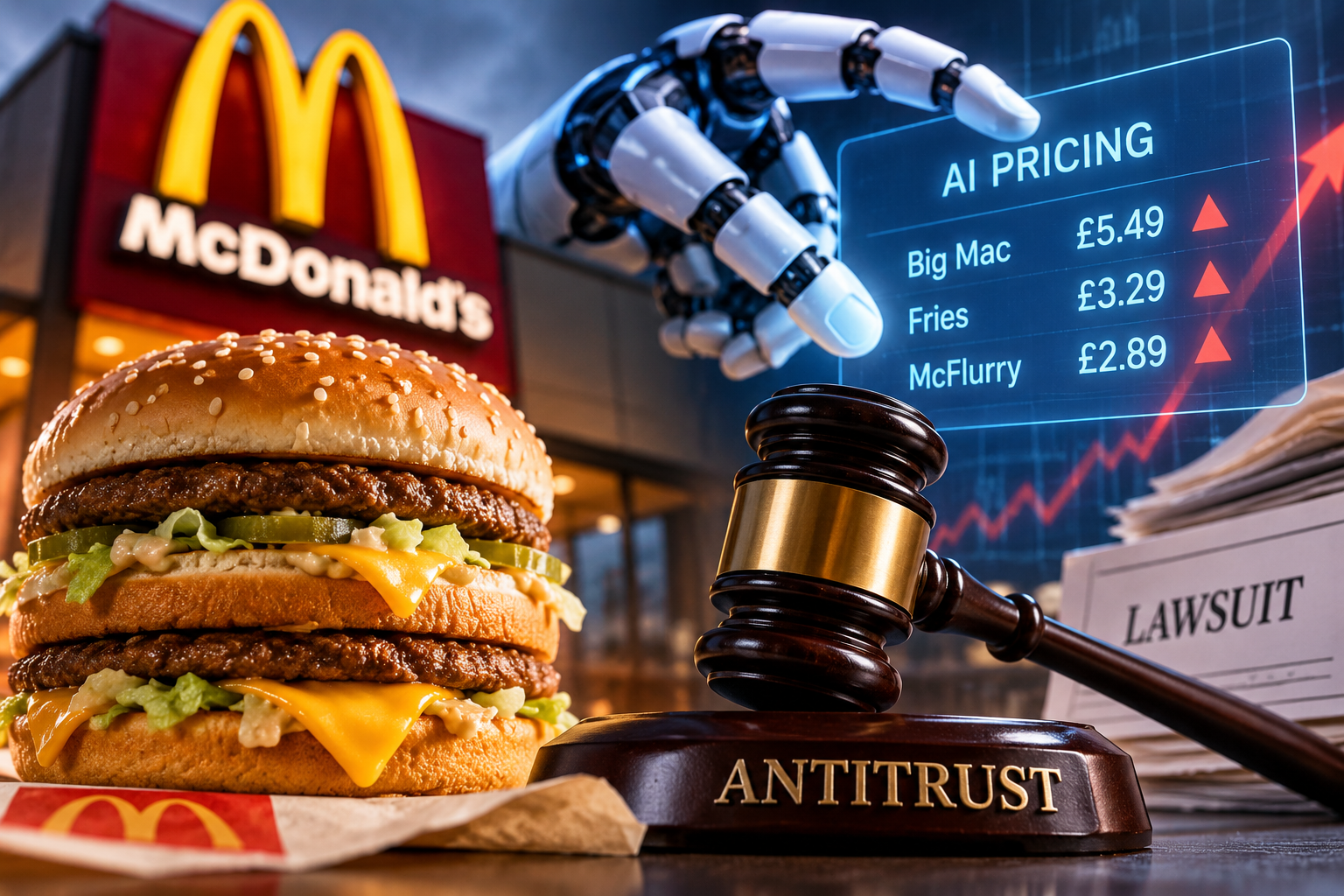
McDonald’s Faces Price-Fixing Claims Over AI Tool
Big Mac Prices Enter The AI Antitrust Debate
A proposed nationwide class action claims McDonald’s used a central machine-learning pricing system and non-public franchise data to coordinate menu prices, while the company insists its technology only makes recommendations and franchisees remain free to set their own prices.
McDonald’s has been sued in a US federal court over allegations that its artificial intelligence-powered pricing system helped coordinate menu prices across thousands of independently operated restaurants.
The case was filed on 2 October 2026 in the US District Court for the Northern District of Illinois by customer Michael Thomas. He accuses McDonald’s Corporation and McDonald’s USA of violating federal antitrust law by using a central pricing engine trained on non-public restaurant data to generate menu-price recommendations across its network.
No court has found that McDonald’s fixed prices, and the allegations remain unproven. McDonald’s rejects the central accusation and says franchisees independently decide what customers pay.
That disagreement now sits at the centre of a potentially significant test for algorithmic pricing.
What The Lawsuit Alleges
The complaint argues that independently owned McDonald’s restaurants should make pricing decisions independently.
Instead, Thomas alleges that McDonald’s has operated a machine-learning pricing engine since at least 2019 that draws on transaction information from restaurants across the network. The system can then generate restaurant-specific price recommendations for individual products.
The allegation is not simply that software helps a restaurant calculate a price. Businesses have used data, forecasting and pricing analytics for decades.
The legal argument is that confidential information from businesses that would otherwise compete with one another was allegedly pooled through a common system and used to influence prices across those businesses.
Thomas claims that this arrangement reduced genuine price competition and caused customers to pay more.
He is seeking to represent a potentially nationwide group of McDonald’s customers, meaning the case could ultimately involve millions of purchases if a court permits it to proceed as a class action.
Class certification has not yet been granted.
Why The AI System Matters
McDonald’s operates a vast US restaurant network, most of which consists of franchised locations rather than restaurants directly owned by the corporation.
That structure matters because separate franchise operators can be independent businesses even when they share the same brand.
The lawsuit therefore raises a basic competition question: what happens when businesses expected to make independent pricing decisions rely on recommendations generated through a common data system?
McDonald’s has already been using artificial intelligence to make its pricing analysis more sophisticated.
Its system can analyse millions of transactions and produce location-specific recommendations using machine learning. Factors can include local demand, operating conditions, competing restaurant prices and assessments of how sensitive customers in an area may be to price.
Taylor Tailored previously examined how McDonald’s uses AI to calculate what customers may be willing to pay.
That technology can make pricing far more precise than a simple national price list. It can also create different recommended prices for restaurants only a short distance apart.
The antitrust issue is not whether computers are capable of producing different prices. It is whether the way information is collected, shared and turned into recommendations amounts to unlawful coordination.
McDonald’s Says AI Does Not Set Menu Prices
McDonald’s strongly disputes the idea that artificial intelligence determines what customers pay.
The company says its pricing system provides recommendations rather than instructions. Franchisees can decide whether to use those recommendations and remain responsible for setting the final menu price in their own restaurants.
McDonald’s also says it does not use dynamic pricing in which the price of a product automatically changes according to the time of day or an individual customer’s willingness to pay.
Its position is straightforward: the technology supplies information, but people make the final decision.
That distinction will be central to the case.
A recommendation that an independent restaurant is genuinely free to ignore is very different from a system that effectively controls or coordinates prices.
The lawsuit alleges the relationship went further than neutral advice. Among its claims are accusations that McDonald’s monitored departures from recommended prices, placed pressure on franchisees to follow the system and made participation effectively compulsory.
Those claims have not been established in court.
This Is Bigger Than McDonald’s
The case arrives as regulators, courts and businesses struggle with a broader question created by modern pricing software.
If several competing businesses independently choose the same software provider, and that software analyses confidential market data from all of them, the algorithm can potentially become a new route through which pricing behaviour converges.
The computer does not need to sit in a room and agree a price with another computer.
The competition question is whether the underlying arrangement connects businesses in a way that reduces independent decision-making.
Similar arguments have already appeared in litigation involving rents, hotel rooms and other markets where algorithmic systems process large pools of commercial data.
Artificial intelligence makes the issue more important because these systems can work across enormous datasets and produce recommendations at a speed and level of detail that traditional spreadsheets could not match.
That same ability to optimise decisions is appearing across finance and commerce. Taylor Tailored has examined how AI agents could automatically move money between banks, potentially changing how financial institutions compete for customer deposits.
The common thread is delegation. The more businesses allow algorithms to recommend or execute commercially important decisions, the more important it becomes to know who controls the system, what data it uses and whether independent organisations are still genuinely acting independently.
Different Prices Do Not Automatically Prove Price-Fixing
Customers can already encounter different McDonald’s prices at different restaurants.
That alone does not establish unlawful coordination.
Restaurants face different rents, wages, local competition, transport costs and customer demand. Those differences can produce legitimate variations in menu prices.
An AI system designed to recognise local conditions could reasonably recommend different prices in different areas for exactly that reason.
The plaintiff must therefore prove more than the existence of variable prices or sophisticated software.
The core legal question is whether there was an agreement or coordinated arrangement that restrained competition.
McDonald’s will be able to argue that a shared recommendation tool is compatible with independent decision-making if franchisees remain genuinely free to reject its suggestions.
The plaintiff will try to show that the combination of centralised data, common recommendations and alleged pressure on operators crossed the line from advice into coordination.
Why The Case Could Matter For Algorithmic Pricing
The lawsuit could become important well beyond hamburgers.
Companies increasingly use artificial intelligence to optimise prices, predict demand, manage stock, allocate advertising and decide where discounts should appear.
Those systems promise efficiency because they detect patterns that humans would struggle to see.
They also create a new legal problem when the same platform has visibility across businesses that are supposed to compete with one another.
The technology itself does not make an arrangement illegal.
An algorithm can be used for entirely lawful forecasting and recommendations. The question is how the system is structured and whether it facilitates conduct that would be unlawful if carried out directly by people.
That distinction is likely to become more important as AI moves deeper into financial and commercial decision-making.
For McDonald’s, the immediate issue is whether the case survives its early legal stages and whether the plaintiff can obtain evidence supporting the allegation that independent franchise pricing was compromised.
For consumers, the case raises a simpler question.
When an algorithm recommends the price on a menu, how independent is the restaurant that ultimately accepts it?
The court has not answered that question yet.
Sources
US District Court for the Northern District of Illinois docket — Thomas v. McDonalds USA, LLC et al, Case No. 1:26-cv-12149 — Confirms the plaintiff, defendants, filing date, court and federal antitrust cause of action.
McDonald’s — Separating Fact from Fiction: AI Does Not Set Prices at McDonald’s — Sets out McDonald’s denial that AI sets or dynamically changes menu prices and its position that franchisees make final pricing decisions.
Reuters — McDonald’s Hit With Class Action Alleging AI-Powered Menu Price-Fixing — Reports the proposed nationwide class action, the allegations concerning non-public data and McDonald’s response.
Next Reads
McDonald’s AI Calculates What Customers Are Willing To Pay — And It Could Change The Price Of Your Big Mac — Explains the pricing technology now at the centre of the lawsuit and how McDonald’s uses machine learning to generate restaurant-level recommendations.
AI Agents Could Soon Move Your Money Between Banks Automatically — And Banks Have A Problem — Examines another area where AI is moving from analysis into economically significant decisions.
The AI Boom Is Becoming So Huge It Could Threaten The Financial System — Looks at the wider financial risks created as artificial intelligence becomes embedded across major commercial systems.
