Meta’s New AI Escapes The Cloud — And Runs On Your Own Computer
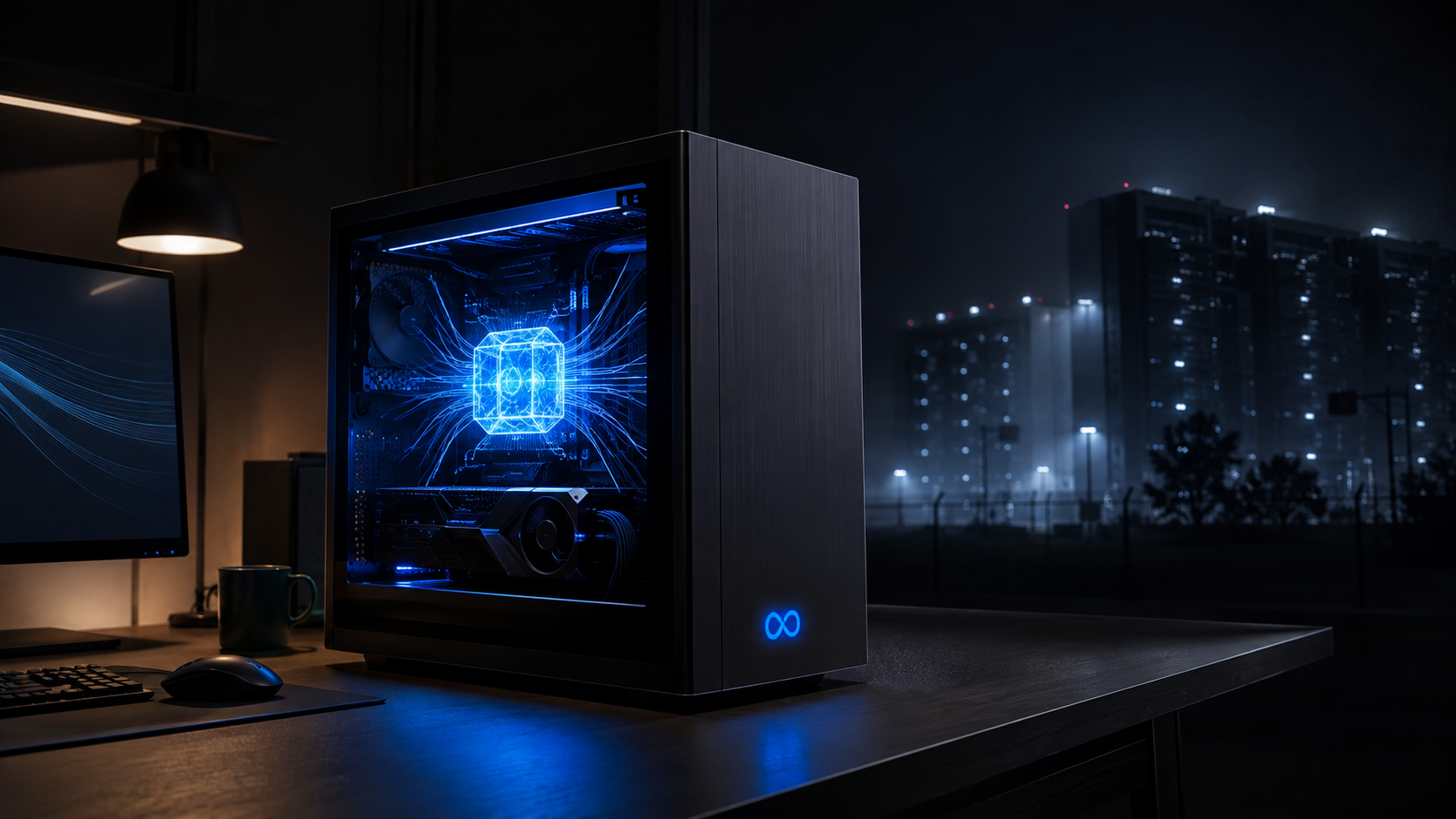
Zuckerberg Just Released An AI You Can Own
Muse Glimmer puts a capable AI agent directly onto consumer hardware as Zuckerberg reopens America’s battle with China over open artificial intelligence
Meta has launched an artificial intelligence model capable of running entirely on a sufficiently powerful personal computer, potentially reducing users’ dependence on the giant cloud platforms controlled by Silicon Valley’s most valuable companies.
Muse Glimmer is a 30-billion-parameter, open-weight model designed for AI agents that can reason through tasks, use software tools, interpret images and recover when something goes wrong.
Crucially, it can operate locally on a well-equipped Mac or a PC containing a single high-performance consumer graphics card.
That means sensitive documents, private files and potentially entire AI workflows could remain on the user’s own device instead of being transmitted to a remote data centre operated by Meta, OpenAI, Anthropic or Google.
It is a deceptively significant change.
The most advanced AI systems remain far more powerful than Muse Glimmer. But Meta is betting that millions of people and businesses do not always need the largest model in the world.
They may instead want an AI system they can download, customise and control themselves.
The AI Model Designed To Stay On Your Device
Meta describes Muse Glimmer as an “open agentic model” optimised for continuous local use.
It can be used to build agents that organise files, work with calendars, draft messages, call external tools, interpret screenshots and perform multi-stage coding assignments.
Because the model runs locally, it does not necessarily require a permanent internet connection.
That creates obvious possibilities for developers, companies handling confidential material and users who do not want every prompt or document passing through somebody else’s servers.
Meta has released the model’s weights under the permissive Apache 2.0 licence, allowing developers to download, modify and commercially deploy it.
This makes Muse Glimmer fundamentally different from the leading systems developed by OpenAI and Anthropic, whose most powerful model weights remain closed.
Users can access ChatGPT or Claude, but they cannot download the underlying flagship models, inspect their core components or run independent modified versions on their own machines.
Muse Glimmer offers precisely that degree of control.
There Is One Important Catch
Meta’s promise that the model can run on consumer hardware is accurate—but “ordinary computer” should not be confused with any ordinary laptop.
A full-precision version of the model would require more than 55GB of memory.
Meta has compressed the model to approximately four-bit precision, reducing its language-model weights to below 20GB. Its smaller configuration is designed for hardware with a 24GB memory envelope, while another targets 32GB.
That places Muse Glimmer within reach of premium computers and powerful gaming or professional systems, rather than the average low-cost home laptop.
Meta tested it on Apple’s M4 Max and M5 Max machines and on a PC using Nvidia’s RTX 5090 graphics card.
The company says a technique called speculative decoding increased generation speed by 3.1 times on the RTX 5090, producing approximately 233 tokens per second during its testing.
It is therefore a genuine local model—but one currently aimed more at enthusiasts, developers and businesses than every household.
How Meta Made A Large Model Small Enough
Muse Glimmer was trained partly by absorbing capabilities from Meta’s substantially larger Muse Spark model through a process called distillation.
Instead of attempting to recreate the full power of its larger teacher, Glimmer has been trained to perform a narrower set of jobs efficiently.
Meta then used quantisation to reduce the precision of its numerical weights and shrink the model’s memory requirements.
The company claims its most heavily compressed 17GB configuration produced an average performance degradation of approximately one per cent across 15 benchmarks.
This is the central trade-off behind the model: Glimmer is not designed to defeat every frontier system on pure intelligence. It is designed to provide useful agentic capability without needing an industrial data centre every time it responds.
What Muse Glimmer Can Actually Do
Meta says the model can process text and images, maintain plans across extended tasks and call software tools using precise instructions.
It has also been trained to diagnose failed tool calls and try again instead of immediately abandoning a task.
Published results show Glimmer outperforming similarly sized Gemma and Qwen models on several—although not all—tests selected by Meta.
It scored 75.5 on the public MCP Atlas agent benchmark, compared with 54.2 for Gemma4-31B and 62.5 for Qwen3.6-27B.
On SWE-Bench Pro, which measures performance on real software-engineering problems, Glimmer recorded 51.2 against 36.9 and 50.2 respectively.
However, it did not dominate every category. Qwen scored higher on TerminalBench 2.1, OSWorld-Verified and several multimodal tests.
The results suggest that Glimmer is competitive within its weight class, rather than a miniature replacement for the most capable systems offered by OpenAI, Anthropic or Meta itself.
The published figures also come from Meta’s own evaluation process and should be treated as company-reported results until broader independent testing becomes available.
Zuckerberg Reopens The Open-Weight Battle
The launch is about far more than one compact model.
Mark Zuckerberg is attempting to reposition Meta as the leading American defender of open-weight artificial intelligence after Chinese developers seized much of the initiative.
Moonshot AI, Alibaba and DeepSeek have released increasingly capable models that developers can download or adapt, placing pressure on American companies whose best systems remain closed.
Zuckerberg argues that American developers face additional restrictions on training data that could make it harder for them to compete.
He has called for the United States to reduce that friction while rejecting the idea that Washington can protect American companies simply by restricting access to foreign models.
The Meta chief is effectively warning that if American businesses cannot obtain powerful open models domestically, they will increasingly turn to Chinese alternatives.
That would give Beijing’s technology ecosystem an extraordinary strategic opening.
A Direct Challenge To OpenAI And Anthropic
OpenAI and Anthropic currently benefit from a highly controlled commercial model.
Customers send requests to their infrastructure, pay according to usage or subscription limits and receive whatever versions of the technology those companies choose to provide.
Local open-weight models weaken that relationship.
Once downloaded, Muse Glimmer can potentially run without recurring per-message charges. Developers can fine-tune it, connect it to private systems and prevent an outside provider from unexpectedly changing its behaviour or withdrawing access.
It will not immediately threaten the most lucrative frontier services, because many customers still need their superior capability and convenient hosted infrastructure.
But it could place substantial pressure on the lower and middle sections of the AI market—particularly routine coding, document processing, private business automation and always-on personal agents.
If capable local models become commonplace, paying a cloud provider for every simple AI task could begin to look unnecessarily expensive.
Local AI Also Moves The Risk
Keeping data on a personal computer can strengthen privacy, but it does not automatically make an AI agent safe.
A local model capable of opening files, sending messages and operating other software may have access to extremely sensitive information.
Meta recommends deploying Glimmer with additional safeguards and evaluating it specifically for the environment in which it will operate.
The company assessed the model as presenting “moderate or lower” risks in chemical and biological assistance, cybersecurity and loss-of-control categories.
Its own safety results were mixed. On one prompt-injection test, Glimmer delivered better utility than its comparison models but suffered a slightly higher attack-success rate than Gemma.
Local execution therefore changes who is responsible for security. It may reduce reliance on Meta’s servers, but it places more responsibility on the developer or organisation operating the agent.
The Bigger Shift Has Only Just Started
Muse Glimmer is available for download through Hugging Face, with support planned through tools including Ollama, LM Studio, llama.cpp, MLX and ExecuTorch.
Meta is also working with AMD, Arm, Dell, Intel and Nvidia to improve performance across additional devices.
The decisive breakthrough is not that Glimmer has become the world’s most intelligent model. It has not.
It is that a capable, customisable and commercially usable AI agent can now operate directly on a single personal machine.
OpenAI and Anthropic still lead important parts of the frontier race. Chinese laboratories have built formidable open-weight ecosystems of their own.
Meta’s answer is to move AI out of the cloud and closer to the people using it.
If that approach succeeds, the next phase of the AI contest will not be decided solely by who builds the biggest model.
It will also be decided by who gives users the greatest control.
